

118 The Bricard linkages
Since we have a six- link, single- loop linkage (n = 6), the closure condition
(2.17) takes the form
,
(6.3)
or
.
(6.4)
Considering Eqs (6.1) and (6.2), the closure equation of the threefoldsymmetric linkage can be extrapolated from Eq. (6.4), which is
(6.5)
Eqs (6.2) and (6.5) form a set of independent closure equations for this 6R
linkage. For any given α (0 ≤ α ≤ π), Eq. (6.5) represents the input–output
equation of the linkage. It is apparent that Eq. (6.5) is symmetric in θ 1 and
θ 2 , for the equation remains the same if these two variables are swapped.
Therefore, one of the variables, either θ 1 or θ 2 , can be chosen to be the
input and the other can be obtained as the output. Figure 6.2 shows the
input–output curve determined by Eq. (6.5). It is periodic and the periods
for both θ 1 and θ 2 are 2π.
A number of distinctive features of the threefold- symmetric Bricard
linkage with any twist α can be summarised from Figure 6.2. First of all,
it shows that only one of six revolute variables can be free. Thus, in
general, this threefold- symmetric Bricard linkage has mobility one.
Second, the linkage with twist α behaves the same as that whose twist is
π – α. Third, all the input–output curves pass through the points (0,
–2π/3), (0, 2π/3), (–2π/3, 0) and (2π/3, 0), regardless of the value of α.
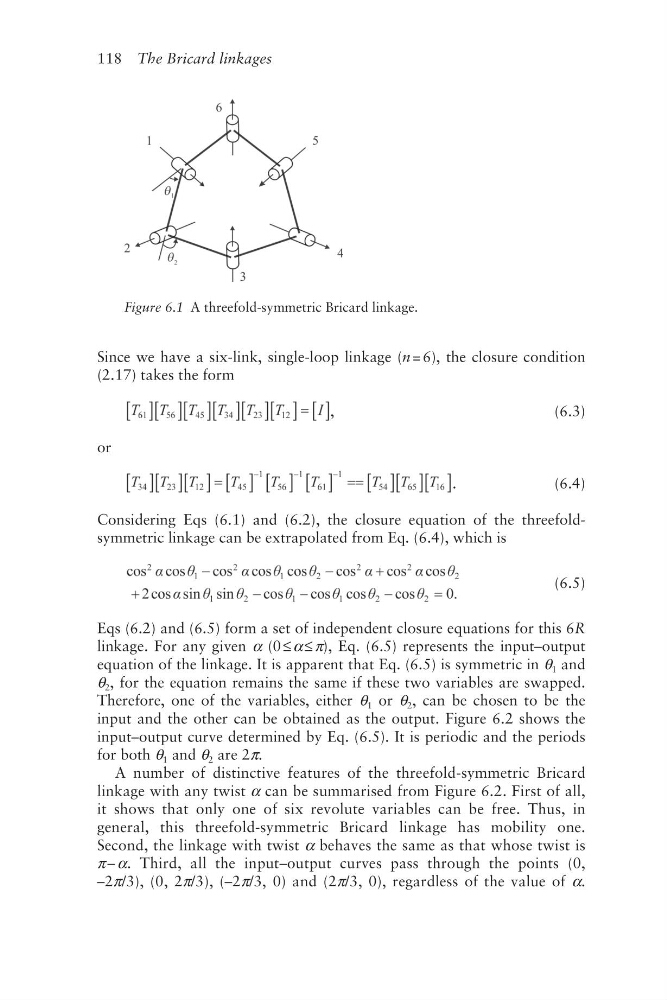
Figure 6.1 A threefold-symmetric Bricard linkage.
Since we have a six- link, single- loop linkage (n = 6), the closure condition
(2.17) takes the form
,
(6.3)
or
.
(6.4)
Considering Eqs (6.1) and (6.2), the closure equation of the threefoldsymmetric linkage can be extrapolated from Eq. (6.4), which is
(6.5)
Eqs (6.2) and (6.5) form a set of independent closure equations for this 6R
linkage. For any given α (0 ≤ α ≤ π), Eq. (6.5) represents the input–output
equation of the linkage. It is apparent that Eq. (6.5) is symmetric in θ 1 and
θ 2 , for the equation remains the same if these two variables are swapped.
Therefore, one of the variables, either θ 1 or θ 2 , can be chosen to be the
input and the other can be obtained as the output. Figure 6.2 shows the
input–output curve determined by Eq. (6.5). It is periodic and the periods
for both θ 1 and θ 2 are 2π.
A number of distinctive features of the threefold- symmetric Bricard
linkage with any twist α can be summarised from Figure 6.2. First of all,
it shows that only one of six revolute variables can be free. Thus, in
general, this threefold- symmetric Bricard linkage has mobility one.
Second, the linkage with twist α behaves the same as that whose twist is
π – α. Third, all the input–output curves pass through the points (0,
–2π/3), (0, 2π/3), (–2π/3, 0) and (2π/3, 0), regardless of the value of α.
Figure 6.1 A threefold-symmetric Bricard linkage.