

The Bennett linkage 99
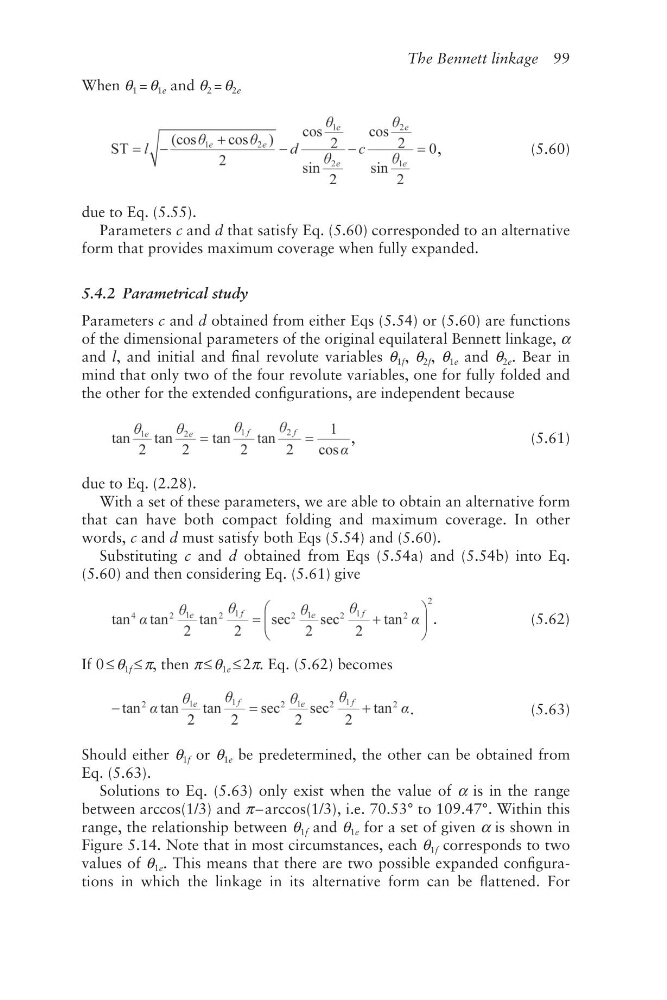
When θ 1 = θ 1e and θ 2 = θ 2e
,
(5.60)
due to Eq. (5.55).
Parameters c and d that satisfy Eq. (5.60) corresponded to an alternative
form that provides maximum coverage when fully expanded.
5.4.2 Parametrical study
Parameters c and d obtained from either Eqs (5.54) or (5.60) are functions
of the dimensional parameters of the original equilateral Bennett linkage, α
and l, and initial and final revolute variables θ 1f , θ 2f , θ 1e and θ 2e . Bear in
mind that only two of the four revolute variables, one for fully folded and
the other for the extended configurations, are independent because
,
(5.61)
due to Eq. (2.28).
With a set of these parameters, we are able to obtain an alternative form
that can have both compact folding and maximum coverage. In other
words, c and d must satisfy both Eqs (5.54) and (5.60).
Substituting c and d obtained from Eqs (5.54a) and (5.54b) into Eq.
(5.60) and then considering Eq. (5.61) give
.
(5.62)
If 0 ≤ θ 1f ≤ π, then π ≤ θ 1e ≤ 2π. Eq. (5.62) becomes
.
(5.63)
Should either θ 1f or θ 1e be predetermined, the other can be obtained from
Eq. (5.63).
Solutions to Eq. (5.63) only exist when the value of α is in the range
between arccos(1/3) and π – arccos(1/3), i.e. 70.53° to 109.47°. Within this
range, the relationship between θ 1f and θ 1e for a set of given α is shown in
Figure 5.14. Note that in most circumstances, each θ 1f corresponds to two
values of θ 1e . This means that there are two possible expanded configurations in which the linkage in its alternative form can be flattened. For
When θ 1 = θ 1e and θ 2 = θ 2e
,
(5.60)
due to Eq. (5.55).
Parameters c and d that satisfy Eq. (5.60) corresponded to an alternative
form that provides maximum coverage when fully expanded.
5.4.2 Parametrical study
Parameters c and d obtained from either Eqs (5.54) or (5.60) are functions
of the dimensional parameters of the original equilateral Bennett linkage, α
and l, and initial and final revolute variables θ 1f , θ 2f , θ 1e and θ 2e . Bear in
mind that only two of the four revolute variables, one for fully folded and
the other for the extended configurations, are independent because
,
(5.61)
due to Eq. (2.28).
With a set of these parameters, we are able to obtain an alternative form
that can have both compact folding and maximum coverage. In other
words, c and d must satisfy both Eqs (5.54) and (5.60).
Substituting c and d obtained from Eqs (5.54a) and (5.54b) into Eq.
(5.60) and then considering Eq. (5.61) give
.
(5.62)
If 0 ≤ θ 1f ≤ π, then π ≤ θ 1e ≤ 2π. Eq. (5.62) becomes
.
(5.63)
Should either θ 1f or θ 1e be predetermined, the other can be obtained from
Eq. (5.63).
Solutions to Eq. (5.63) only exist when the value of α is in the range
between arccos(1/3) and π – arccos(1/3), i.e. 70.53° to 109.47°. Within this
range, the relationship between θ 1f and θ 1e for a set of given α is shown in
Figure 5.14. Note that in most circumstances, each θ 1f corresponds to two
values of θ 1e . This means that there are two possible expanded configurations in which the linkage in its alternative form can be flattened. For