

98 The Bennett linkage
area? To answer this question, it is necessary to find out the geometrical
condition relating to the maximum coverage.
Figure 5.13(c) shows the alternative form of the Bennett linkage EFGH.
Due to symmetry, a line between E with G will intersect MN at T, and that
between F and H will intersect MN at S. The projection of EFGH will
cover a maximum area if
(5.55)
when revolute angles reach θ 1e and θ 2e . This implies that EFGH is completely flattened to a rhombus.
Again, ST can be expressed in term of c, d and deployment angles.
Based on Eqs (5.44) and (5.46),
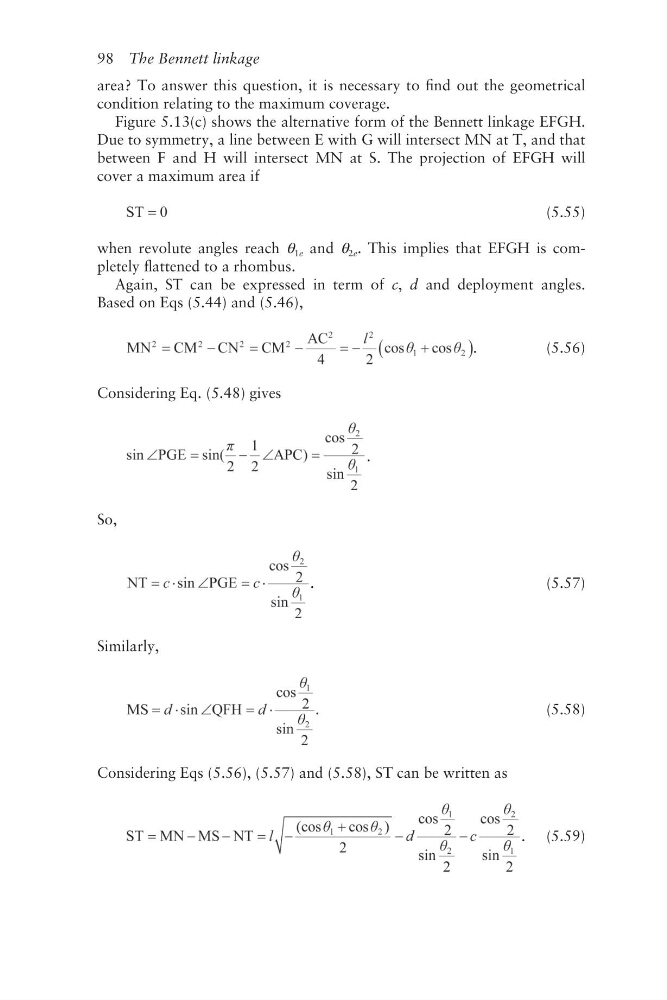
.
(5.56)
Considering Eq. (5.48) gives
.
So,
.
(5.57)
Similarly,
.
(5.58)
Considering Eqs (5.56), (5.57) and (5.58), ST can be written as
. (5.59)
area? To answer this question, it is necessary to find out the geometrical
condition relating to the maximum coverage.
Figure 5.13(c) shows the alternative form of the Bennett linkage EFGH.
Due to symmetry, a line between E with G will intersect MN at T, and that
between F and H will intersect MN at S. The projection of EFGH will
cover a maximum area if
(5.55)
when revolute angles reach θ 1e and θ 2e . This implies that EFGH is completely flattened to a rhombus.
Again, ST can be expressed in term of c, d and deployment angles.
Based on Eqs (5.44) and (5.46),
.
(5.56)
Considering Eq. (5.48) gives
.
So,
.
(5.57)
Similarly,
.
(5.58)
Considering Eqs (5.56), (5.57) and (5.58), ST can be written as
. (5.59)