

96 The Bennett linkage
Substituting Eq. (5.39) into Eqs (5.40a) and (5.40b) gives
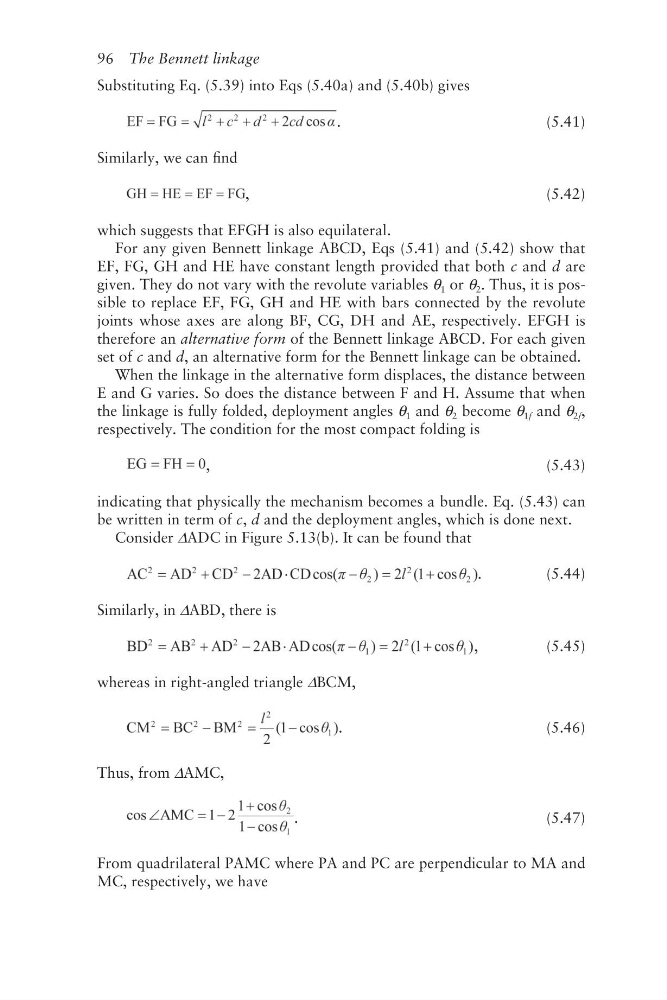
.
(5.41)
Similarly, we can find
,
(5.42)
which suggests that EFGH is also equilateral.
For any given Bennett linkage ABCD, Eqs (5.41) and (5.42) show that
EF, FG, GH and HE have constant length provided that both c and d are
given. They do not vary with the revolute variables θ 1 or θ 2 . Thus, it is possible to replace EF, FG, GH and HE with bars connected by the revolute
joints whose axes are along BF, CG, DH and AE, respectively. EFGH is
therefore an alternative form of the Bennett linkage ABCD. For each given
set of c and d, an alternative form for the Bennett linkage can be obtained.
When the linkage in the alternative form displaces, the distance between
E and G varies. So does the distance between F and H. Assume that when
the linkage is fully folded, deployment angles θ 1 and θ 2 become θ 1f and θ 2f ,
respectively. The condition for the most compact folding is
,
(5.43)
indicating that physically the mechanism becomes a bundle. Eq. (5.43) can
be written in term of c, d and the deployment angles, which is done next.
Consider ΔADC in Figure 5.13(b). It can be found that
.
(5.44)
Similarly, in ΔABD, there is
,
(5.45)
whereas in right- angled triangle ΔBCM,
.
(5.46)
Thus, from ΔAMC,
.
(5.47)
From quadrilateral PAMC where PA and PC are perpendicular to MA and
MC, respectively, we have
Substituting Eq. (5.39) into Eqs (5.40a) and (5.40b) gives
.
(5.41)
Similarly, we can find
,
(5.42)
which suggests that EFGH is also equilateral.
For any given Bennett linkage ABCD, Eqs (5.41) and (5.42) show that
EF, FG, GH and HE have constant length provided that both c and d are
given. They do not vary with the revolute variables θ 1 or θ 2 . Thus, it is possible to replace EF, FG, GH and HE with bars connected by the revolute
joints whose axes are along BF, CG, DH and AE, respectively. EFGH is
therefore an alternative form of the Bennett linkage ABCD. For each given
set of c and d, an alternative form for the Bennett linkage can be obtained.
When the linkage in the alternative form displaces, the distance between
E and G varies. So does the distance between F and H. Assume that when
the linkage is fully folded, deployment angles θ 1 and θ 2 become θ 1f and θ 2f ,
respectively. The condition for the most compact folding is
,
(5.43)
indicating that physically the mechanism becomes a bundle. Eq. (5.43) can
be written in term of c, d and the deployment angles, which is done next.
Consider ΔADC in Figure 5.13(b). It can be found that
.
(5.44)
Similarly, in ΔABD, there is
,
(5.45)
whereas in right- angled triangle ΔBCM,
.
(5.46)
Thus, from ΔAMC,
.
(5.47)
From quadrilateral PAMC where PA and PC are perpendicular to MA and
MC, respectively, we have