

The Bennett linkage 95
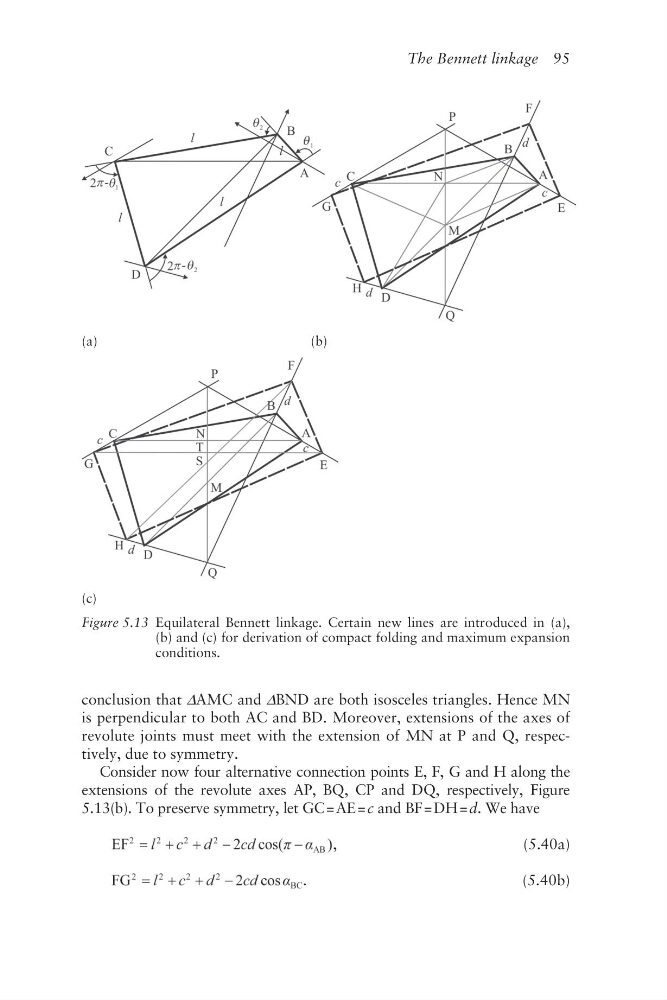
conclusion that ΔAMC and ΔBND are both isosceles triangles. Hence MN
is perpendicular to both AC and BD. Moreover, extensions of the axes of
revolute joints must meet with the extension of MN at P and Q, respectively, due to symmetry.
Consider now four alternative connection points E, F, G and H along the
extensions of the revolute axes AP, BQ, CP and DQ, respectively, Figure
5.13(b). To preserve symmetry, let GC = AE = c and BF = DH = d. We have
,
(5.40a)
.
(5.40b)
(a)
(b)
(c)
Figure 5.13 Equilateral Bennett linkage. Certain new lines are introduced in (a),
(b) and (c) for derivation of compact folding and maximum expansion
conditions.
conclusion that ΔAMC and ΔBND are both isosceles triangles. Hence MN
is perpendicular to both AC and BD. Moreover, extensions of the axes of
revolute joints must meet with the extension of MN at P and Q, respectively, due to symmetry.
Consider now four alternative connection points E, F, G and H along the
extensions of the revolute axes AP, BQ, CP and DQ, respectively, Figure
5.13(b). To preserve symmetry, let GC = AE = c and BF = DH = d. We have
,
(5.40a)
.
(5.40b)
(a)
(b)
(c)
Figure 5.13 Equilateral Bennett linkage. Certain new lines are introduced in (a),
(b) and (c) for derivation of compact folding and maximum expansion
conditions.