

5.4 Collaborating with David Gill
79
often discarded parts, partly from the workshops of other departments of the
university.
Kapteyn’s clever parallactic method was the following. If you now make
the distance between the plate and the measuring telescope exactly equal to
the focal length in the telescope that was used for the exposure of the plates
(137 cm), then the orientation of the telescope on its two axes would directly
correspond to celestial coordinates. The difference with the readings for the
center of the plate were then directly the difference in right ascension and
declination between the star and that center. The set-up can be seen in Fig. 5.7;
the photographic plate was orientated in such a way that the north in that figure
was to the right. Note that the distance between the plate and the telescope is
not to scale. In working order, the plate holder contained two separate plates of
the same part of the sky one behind the other, but slightly shifted. In this way
plate faults and other iniquities could be identified immediately. Also, from
the size of the dark spot that a star left behind in the photographic emulsion,
the brightness of that star was estimated.
David Gill had started exposing plates in 1885 and completed the full set
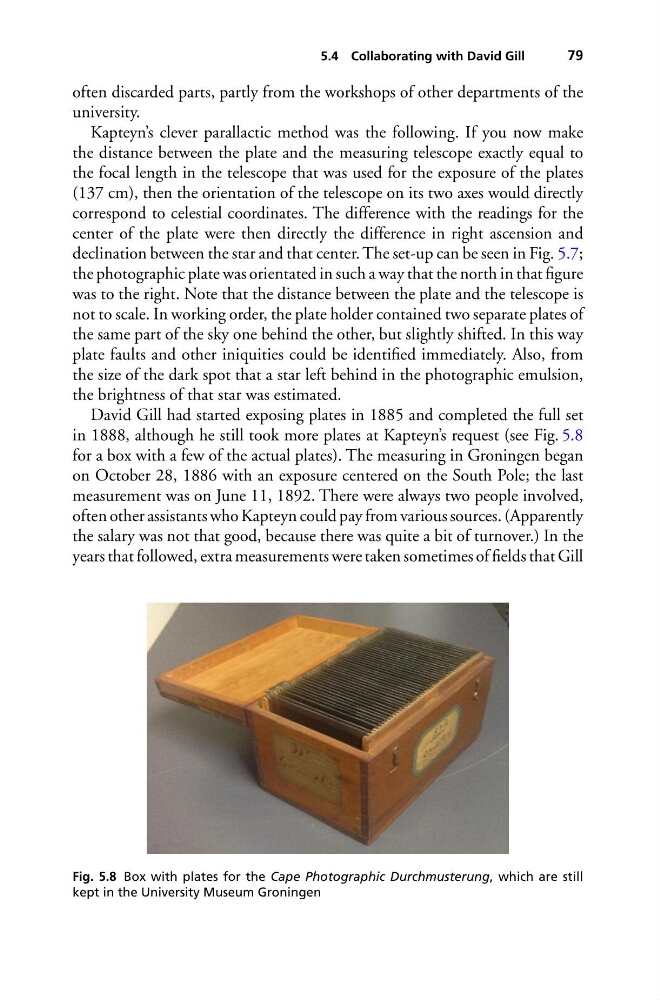
in 1888, although he still took more plates at Kapteyn’s request (see Fig. 5.8
for a box with a few of the actual plates). The measuring in Groningen began
on October 28, 1886 with an exposure centered on the South Pole; the last
measurement was on June 11, 1892. There were always two people involved,
often other assistants who Kapteyn could pay from various sources. (Apparently
the salary was not that good, because there was quite a bit of turnover.) In the
years that followed, extra measurements were taken sometimes of fields that Gill
Fig. 5.8 Box with plates for the Cape Photographic Durchmusterung, which are still
kept in the University Museum Groningen
79
often discarded parts, partly from the workshops of other departments of the
university.
Kapteyn’s clever parallactic method was the following. If you now make
the distance between the plate and the measuring telescope exactly equal to
the focal length in the telescope that was used for the exposure of the plates
(137 cm), then the orientation of the telescope on its two axes would directly
correspond to celestial coordinates. The difference with the readings for the
center of the plate were then directly the difference in right ascension and
declination between the star and that center. The set-up can be seen in Fig. 5.7;
the photographic plate was orientated in such a way that the north in that figure
was to the right. Note that the distance between the plate and the telescope is
not to scale. In working order, the plate holder contained two separate plates of
the same part of the sky one behind the other, but slightly shifted. In this way
plate faults and other iniquities could be identified immediately. Also, from
the size of the dark spot that a star left behind in the photographic emulsion,
the brightness of that star was estimated.
David Gill had started exposing plates in 1885 and completed the full set
in 1888, although he still took more plates at Kapteyn’s request (see Fig. 5.8
for a box with a few of the actual plates). The measuring in Groningen began
on October 28, 1886 with an exposure centered on the South Pole; the last
measurement was on June 11, 1892. There were always two people involved,
often other assistants who Kapteyn could pay from various sources. (Apparently
the salary was not that good, because there was quite a bit of turnover.) In the
years that followed, extra measurements were taken sometimes of fields that Gill
Fig. 5.8 Box with plates for the Cape Photographic Durchmusterung, which are still
kept in the University Museum Groningen