

78
5 Nearly Half a Million Stars
Kapteyn devised a very clever method of measuring the plates. There was
of course no real experience with measurements of star positions from photographic plates. The obvious method was to measure the position of each star
on the plate as the vertical and horizontal distance from one of the corners, or
maybe distance and direction from the center of the plate. This then should
include stars which had a known position on the sky to calibrate the astronomical coordinates. Gill had already asked Kapteyn in one of his letters, even
before Kapteyn had agreed to cooperate, to weigh these two methods against
each other. Kapteyn had chosen the first one at that time. Actually, in neither
of these two cases it was straightforward to convert those measurements on the
plate into coordinates on the sky. That required a lot of calculation, although it
gave the most accurate result. In fact, it was more accurate than was necessary
for a catalog similar to the Bonner Durchmusterung. The method that Kapteyn
devised in the end, and which he called the ‘parallactic method’, was perhaps
somewhat less accurate, but certainly acceptable for the CPD. And a lot faster
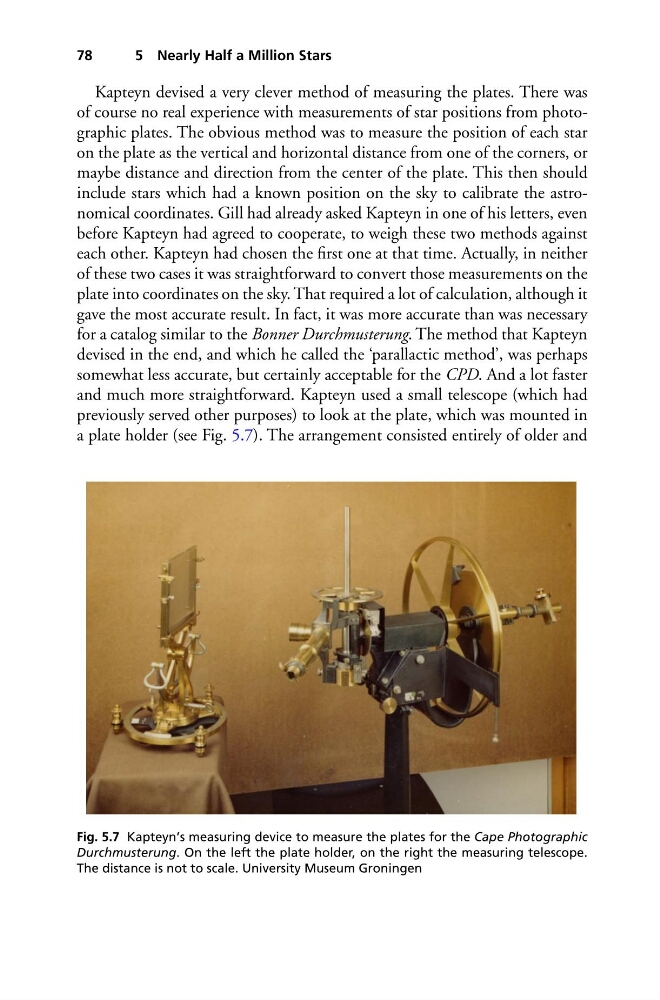
and much more straightforward. Kapteyn used a small telescope (which had
previously served other purposes) to look at the plate, which was mounted in
a plate holder (see Fig. 5.7). The arrangement consisted entirely of older and
Fig. 5.7 Kapteyn’s measuring device to measure the plates for the Cape Photographic
Durchmusterung. On the left the plate holder, on the right the measuring telescope.
The distance is not to scale. University Museum Groningen
5 Nearly Half a Million Stars
Kapteyn devised a very clever method of measuring the plates. There was
of course no real experience with measurements of star positions from photographic plates. The obvious method was to measure the position of each star
on the plate as the vertical and horizontal distance from one of the corners, or
maybe distance and direction from the center of the plate. This then should
include stars which had a known position on the sky to calibrate the astronomical coordinates. Gill had already asked Kapteyn in one of his letters, even
before Kapteyn had agreed to cooperate, to weigh these two methods against
each other. Kapteyn had chosen the first one at that time. Actually, in neither
of these two cases it was straightforward to convert those measurements on the
plate into coordinates on the sky. That required a lot of calculation, although it
gave the most accurate result. In fact, it was more accurate than was necessary
for a catalog similar to the Bonner Durchmusterung. The method that Kapteyn
devised in the end, and which he called the ‘parallactic method’, was perhaps
somewhat less accurate, but certainly acceptable for the CPD. And a lot faster
and much more straightforward. Kapteyn used a small telescope (which had
previously served other purposes) to look at the plate, which was mounted in
a plate holder (see Fig. 5.7). The arrangement consisted entirely of older and
Fig. 5.7 Kapteyn’s measuring device to measure the plates for the Cape Photographic
Durchmusterung. On the left the plate holder, on the right the measuring telescope.
The distance is not to scale. University Museum Groningen