

234
11 The Kapteyn Universe
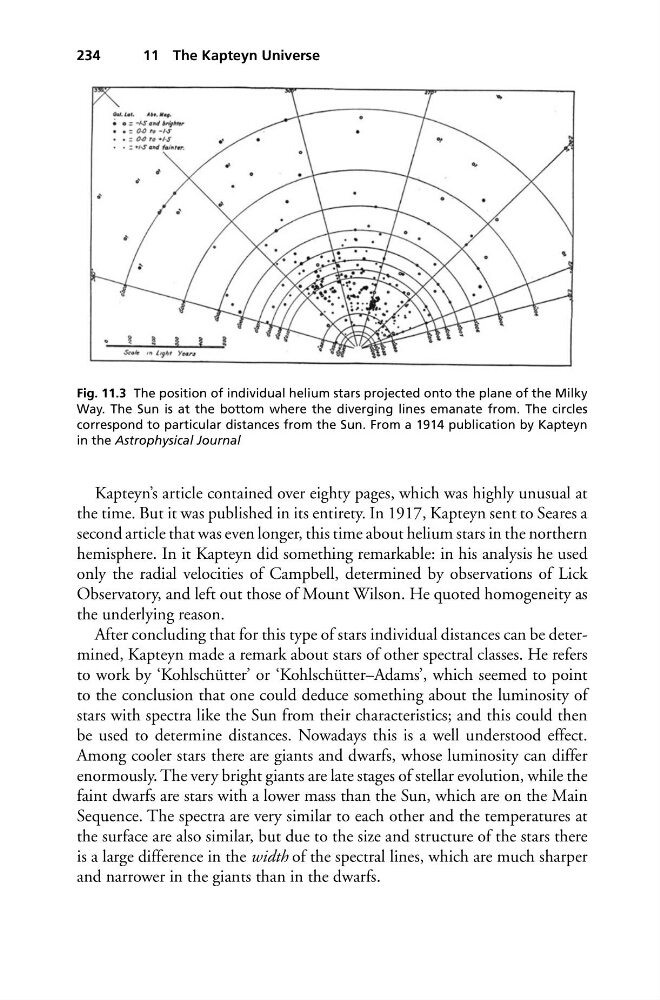
Fig. 11.3 The position of individual helium stars projected onto the plane of the Milky
Way. The Sun is at the bottom where the diverging lines emanate from. The circles
correspond to particular distances from the Sun. From a 1914 publication by Kapteyn
in the Astrophysical Journal
Kapteyn’s article contained over eighty pages, which was highly unusual at
the time. But it was published in its entirety. In 1917, Kapteyn sent to Seares a
second article that was even longer, this time about helium stars in the northern
hemisphere. In it Kapteyn did something remarkable: in his analysis he used
only the radial velocities of Campbell, determined by observations of Lick
Observatory, and left out those of Mount Wilson. He quoted homogeneity as
the underlying reason.
After concluding that for this type of stars individual distances can be determined, Kapteyn made a remark about stars of other spectral classes. He refers
to work by ‘Kohlschütter’ or ‘Kohlschütter–Adams’, which seemed to point
to the conclusion that one could deduce something about the luminosity of
stars with spectra like the Sun from their characteristics; and this could then
be used to determine distances. Nowadays this is a well understood effect.
Among cooler stars there are giants and dwarfs, whose luminosity can differ
enormously. The very bright giants are late stages of stellar evolution, while the
faint dwarfs are stars with a lower mass than the Sun, which are on the Main
Sequence. The spectra are very similar to each other and the temperatures at
the surface are also similar, but due to the size and structure of the stars there
is a large difference in the width of the spectral lines, which are much sharper
and narrower in the giants than in the dwarfs.
11 The Kapteyn Universe
Fig. 11.3 The position of individual helium stars projected onto the plane of the Milky
Way. The Sun is at the bottom where the diverging lines emanate from. The circles
correspond to particular distances from the Sun. From a 1914 publication by Kapteyn
in the Astrophysical Journal
Kapteyn’s article contained over eighty pages, which was highly unusual at
the time. But it was published in its entirety. In 1917, Kapteyn sent to Seares a
second article that was even longer, this time about helium stars in the northern
hemisphere. In it Kapteyn did something remarkable: in his analysis he used
only the radial velocities of Campbell, determined by observations of Lick
Observatory, and left out those of Mount Wilson. He quoted homogeneity as
the underlying reason.
After concluding that for this type of stars individual distances can be determined, Kapteyn made a remark about stars of other spectral classes. He refers
to work by ‘Kohlschütter’ or ‘Kohlschütter–Adams’, which seemed to point
to the conclusion that one could deduce something about the luminosity of
stars with spectra like the Sun from their characteristics; and this could then
be used to determine distances. Nowadays this is a well understood effect.
Among cooler stars there are giants and dwarfs, whose luminosity can differ
enormously. The very bright giants are late stages of stellar evolution, while the
faint dwarfs are stars with a lower mass than the Sun, which are on the Main
Sequence. The spectra are very similar to each other and the temperatures at
the surface are also similar, but due to the size and structure of the stars there
is a large difference in the width of the spectral lines, which are much sharper
and narrower in the giants than in the dwarfs.