

186
9 Mount Wilson
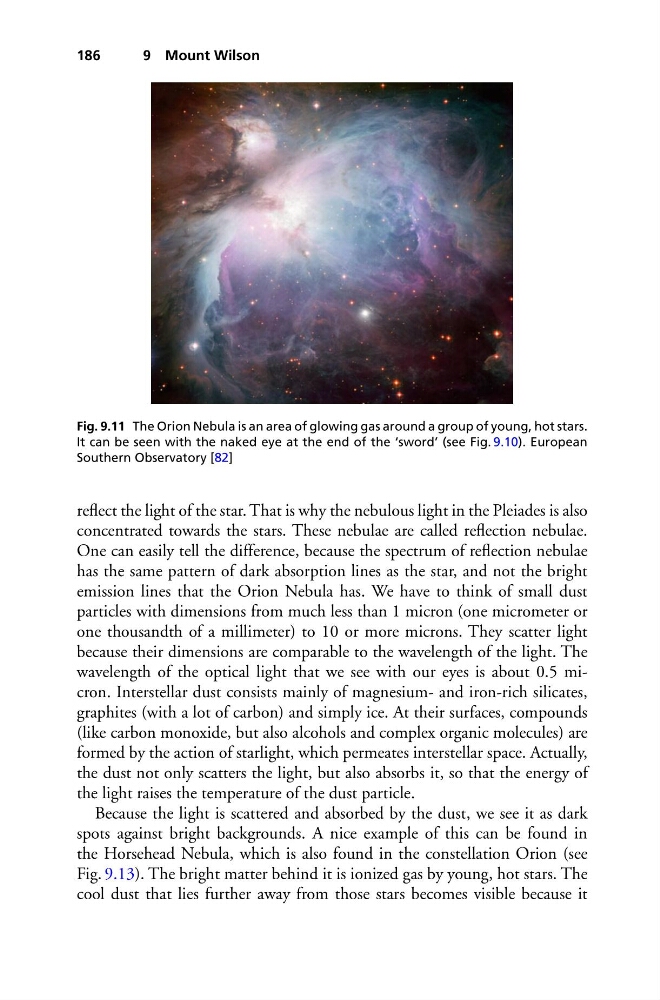
Fig. 9.11 The Orion Nebula is an area of glowing gas around a group of young, hot stars.
It can be seen with the naked eye at the end of the ‘sword’ (see Fig. 9.10). European
Southern Observatory [82]
reflect the light of the star. That is why the nebulous light in the Pleiades is also
concentrated towards the stars. These nebulae are called reflection nebulae.
One can easily tell the difference, because the spectrum of reflection nebulae
has the same pattern of dark absorption lines as the star, and not the bright
emission lines that the Orion Nebula has. We have to think of small dust
particles with dimensions from much less than 1 micron (one micrometer or
one thousandth of a millimeter) to 10 or more microns. They scatter light
because their dimensions are comparable to the wavelength of the light. The
wavelength of the optical light that we see with our eyes is about 0.5 micron. Interstellar dust consists mainly of magnesium- and iron-rich silicates,
graphites (with a lot of carbon) and simply ice. At their surfaces, compounds
(like carbon monoxide, but also alcohols and complex organic molecules) are
formed by the action of starlight, which permeates interstellar space. Actually,
the dust not only scatters the light, but also absorbs it, so that the energy of
the light raises the temperature of the dust particle.
Because the light is scattered and absorbed by the dust, we see it as dark
spots against bright backgrounds. A nice example of this can be found in
the Horsehead Nebula, which is also found in the constellation Orion (see
Fig. 9.13). The bright matter behind it is ionized gas by young, hot stars. The
cool dust that lies further away from those stars becomes visible because it
9 Mount Wilson
Fig. 9.11 The Orion Nebula is an area of glowing gas around a group of young, hot stars.
It can be seen with the naked eye at the end of the ‘sword’ (see Fig. 9.10). European
Southern Observatory [82]
reflect the light of the star. That is why the nebulous light in the Pleiades is also
concentrated towards the stars. These nebulae are called reflection nebulae.
One can easily tell the difference, because the spectrum of reflection nebulae
has the same pattern of dark absorption lines as the star, and not the bright
emission lines that the Orion Nebula has. We have to think of small dust
particles with dimensions from much less than 1 micron (one micrometer or
one thousandth of a millimeter) to 10 or more microns. They scatter light
because their dimensions are comparable to the wavelength of the light. The
wavelength of the optical light that we see with our eyes is about 0.5 micron. Interstellar dust consists mainly of magnesium- and iron-rich silicates,
graphites (with a lot of carbon) and simply ice. At their surfaces, compounds
(like carbon monoxide, but also alcohols and complex organic molecules) are
formed by the action of starlight, which permeates interstellar space. Actually,
the dust not only scatters the light, but also absorbs it, so that the energy of
the light raises the temperature of the dust particle.
Because the light is scattered and absorbed by the dust, we see it as dark
spots against bright backgrounds. A nice example of this can be found in
the Horsehead Nebula, which is also found in the constellation Orion (see
Fig. 9.13). The bright matter behind it is ionized gas by young, hot stars. The
cool dust that lies further away from those stars becomes visible because it