

3.3 Results and Discussion
83
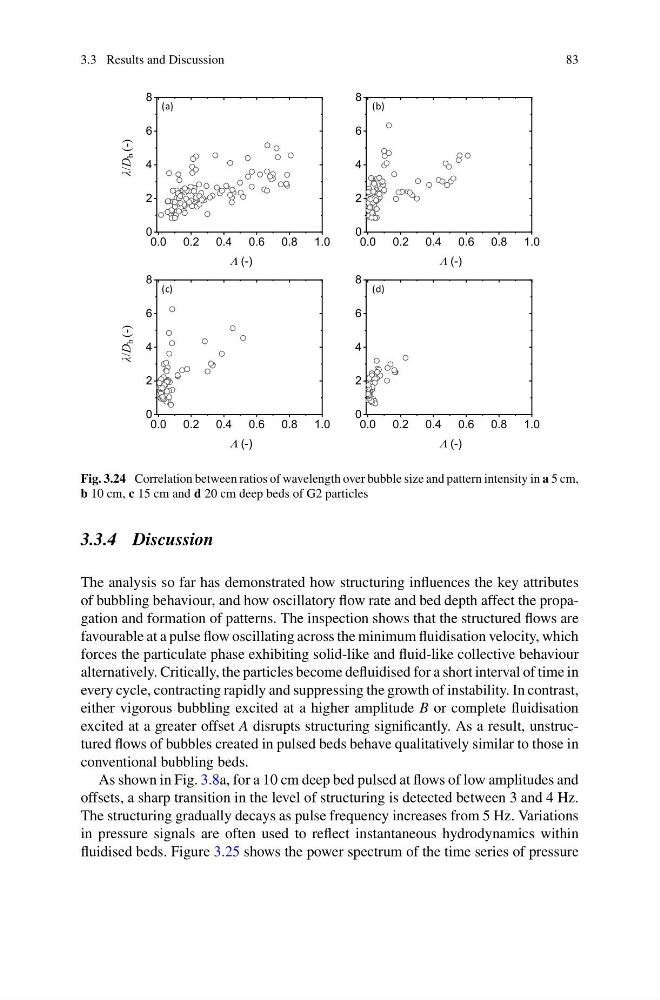
Fig. 3.24 Correlation between ratios of wavelength over bubble size and pattern intensity in a 5 cm,
b 10 cm, c 15 cm and d 20 cm deep beds of G2 particles
3.3.4 Discussion
The analysis so far has demonstrated how structuring influences the key attributes
of bubbling behaviour, and how oscillatory flow rate and bed depth affect the propagation and formation of patterns. The inspection shows that the structured flows are
favourable at a pulse flow oscillating across the minimum fluidisation velocity, which
forces the particulate phase exhibiting solid-like and fluid-like collective behaviour
alternatively. Critically, the particles become defluidised for a short interval of time in
every cycle, contracting rapidly and suppressing the growth of instability. In contrast,
either vigorous bubbling excited at a higher amplitude B or complete fluidisation
excited at a greater offset A disrupts structuring significantly. As a result, unstructured flows of bubbles created in pulsed beds behave qualitatively similar to those in
conventional bubbling beds.
As shown in Fig. 3.8a, for a 10 cm deep bed pulsed at flows of low amplitudes and
offsets, a sharp transition in the level of structuring is detected between 3 and 4 Hz.
The structuring gradually decays as pulse frequency increases from 5 Hz. Variations
in pressure signals are often used to reflect instantaneous hydrodynamics within
fluidised beds. Figure 3.25 shows the power spectrum of the time series of pressure
83
Fig. 3.24 Correlation between ratios of wavelength over bubble size and pattern intensity in a 5 cm,
b 10 cm, c 15 cm and d 20 cm deep beds of G2 particles
3.3.4 Discussion
The analysis so far has demonstrated how structuring influences the key attributes
of bubbling behaviour, and how oscillatory flow rate and bed depth affect the propagation and formation of patterns. The inspection shows that the structured flows are
favourable at a pulse flow oscillating across the minimum fluidisation velocity, which
forces the particulate phase exhibiting solid-like and fluid-like collective behaviour
alternatively. Critically, the particles become defluidised for a short interval of time in
every cycle, contracting rapidly and suppressing the growth of instability. In contrast,
either vigorous bubbling excited at a higher amplitude B or complete fluidisation
excited at a greater offset A disrupts structuring significantly. As a result, unstructured flows of bubbles created in pulsed beds behave qualitatively similar to those in
conventional bubbling beds.
As shown in Fig. 3.8a, for a 10 cm deep bed pulsed at flows of low amplitudes and
offsets, a sharp transition in the level of structuring is detected between 3 and 4 Hz.
The structuring gradually decays as pulse frequency increases from 5 Hz. Variations
in pressure signals are often used to reflect instantaneous hydrodynamics within
fluidised beds. Figure 3.25 shows the power spectrum of the time series of pressure