

76
3 A Structuring Regime to Control Bubbling Beds
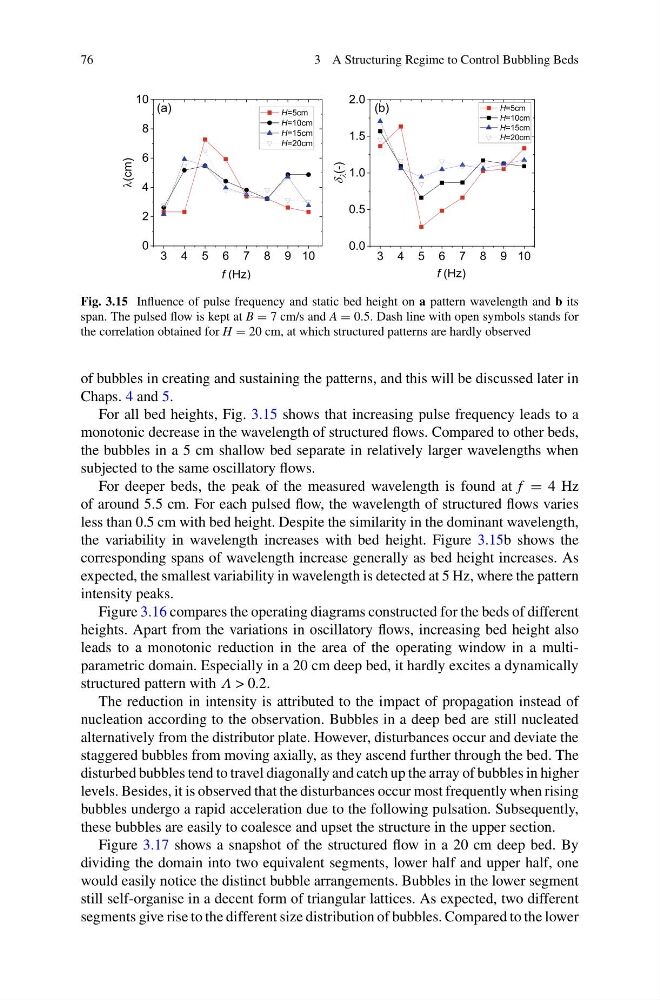
Fig. 3.15 Influence of pulse frequency and static bed height on a pattern wavelength and b its
span. The pulsed flow is kept at B = 7 cm/s and A = 0.5. Dash line with open symbols stands for
the correlation obtained for H = 20 cm, at which structured patterns are hardly observed
of bubbles in creating and sustaining the patterns, and this will be discussed later in
Chaps. 4 and 5.
For all bed heights, Fig. 3.15 shows that increasing pulse frequency leads to a
monotonic decrease in the wavelength of structured flows. Compared to other beds,
the bubbles in a 5 cm shallow bed separate in relatively larger wavelengths when
subjected to the same oscillatory flows.
For deeper beds, the peak of the measured wavelength is found at f = 4 Hz
of around 5.5 cm. For each pulsed flow, the wavelength of structured flows varies
less than 0.5 cm with bed height. Despite the similarity in the dominant wavelength,
the variability in wavelength increases with bed height. Figure 3.15b shows the
corresponding spans of wavelength increase generally as bed height increases. As
expected, the smallest variability in wavelength is detected at 5 Hz, where the pattern
intensity peaks.
Figure 3.16 compares the operating diagrams constructed for the beds of different
heights. Apart from the variations in oscillatory flows, increasing bed height also
leads to a monotonic reduction in the area of the operating window in a multiparametric domain. Especially in a 20 cm deep bed, it hardly excites a dynamically
structured pattern with Λ > 0.2.
The reduction in intensity is attributed to the impact of propagation instead of
nucleation according to the observation. Bubbles in a deep bed are still nucleated
alternatively from the distributor plate. However, disturbances occur and deviate the
staggered bubbles from moving axially, as they ascend further through the bed. The
disturbed bubbles tend to travel diagonally and catch up the array of bubbles in higher
levels. Besides, it is observed that the disturbances occur most frequently when rising
bubbles undergo a rapid acceleration due to the following pulsation. Subsequently,
these bubbles are easily to coalesce and upset the structure in the upper section.
Figure 3.17 shows a snapshot of the structured flow in a 20 cm deep bed. By
dividing the domain into two equivalent segments, lower half and upper half, one
would easily notice the distinct bubble arrangements. Bubbles in the lower segment
still self-organise in a decent form of triangular lattices. As expected, two different
segments give rise to the different size distribution of bubbles. Compared to the lower
3 A Structuring Regime to Control Bubbling Beds
Fig. 3.15 Influence of pulse frequency and static bed height on a pattern wavelength and b its
span. The pulsed flow is kept at B = 7 cm/s and A = 0.5. Dash line with open symbols stands for
the correlation obtained for H = 20 cm, at which structured patterns are hardly observed
of bubbles in creating and sustaining the patterns, and this will be discussed later in
Chaps. 4 and 5.
For all bed heights, Fig. 3.15 shows that increasing pulse frequency leads to a
monotonic decrease in the wavelength of structured flows. Compared to other beds,
the bubbles in a 5 cm shallow bed separate in relatively larger wavelengths when
subjected to the same oscillatory flows.
For deeper beds, the peak of the measured wavelength is found at f = 4 Hz
of around 5.5 cm. For each pulsed flow, the wavelength of structured flows varies
less than 0.5 cm with bed height. Despite the similarity in the dominant wavelength,
the variability in wavelength increases with bed height. Figure 3.15b shows the
corresponding spans of wavelength increase generally as bed height increases. As
expected, the smallest variability in wavelength is detected at 5 Hz, where the pattern
intensity peaks.
Figure 3.16 compares the operating diagrams constructed for the beds of different
heights. Apart from the variations in oscillatory flows, increasing bed height also
leads to a monotonic reduction in the area of the operating window in a multiparametric domain. Especially in a 20 cm deep bed, it hardly excites a dynamically
structured pattern with Λ > 0.2.
The reduction in intensity is attributed to the impact of propagation instead of
nucleation according to the observation. Bubbles in a deep bed are still nucleated
alternatively from the distributor plate. However, disturbances occur and deviate the
staggered bubbles from moving axially, as they ascend further through the bed. The
disturbed bubbles tend to travel diagonally and catch up the array of bubbles in higher
levels. Besides, it is observed that the disturbances occur most frequently when rising
bubbles undergo a rapid acceleration due to the following pulsation. Subsequently,
these bubbles are easily to coalesce and upset the structure in the upper section.
Figure 3.17 shows a snapshot of the structured flow in a 20 cm deep bed. By
dividing the domain into two equivalent segments, lower half and upper half, one
would easily notice the distinct bubble arrangements. Bubbles in the lower segment
still self-organise in a decent form of triangular lattices. As expected, two different
segments give rise to the different size distribution of bubbles. Compared to the lower