

2.3 Results and Discussion
43
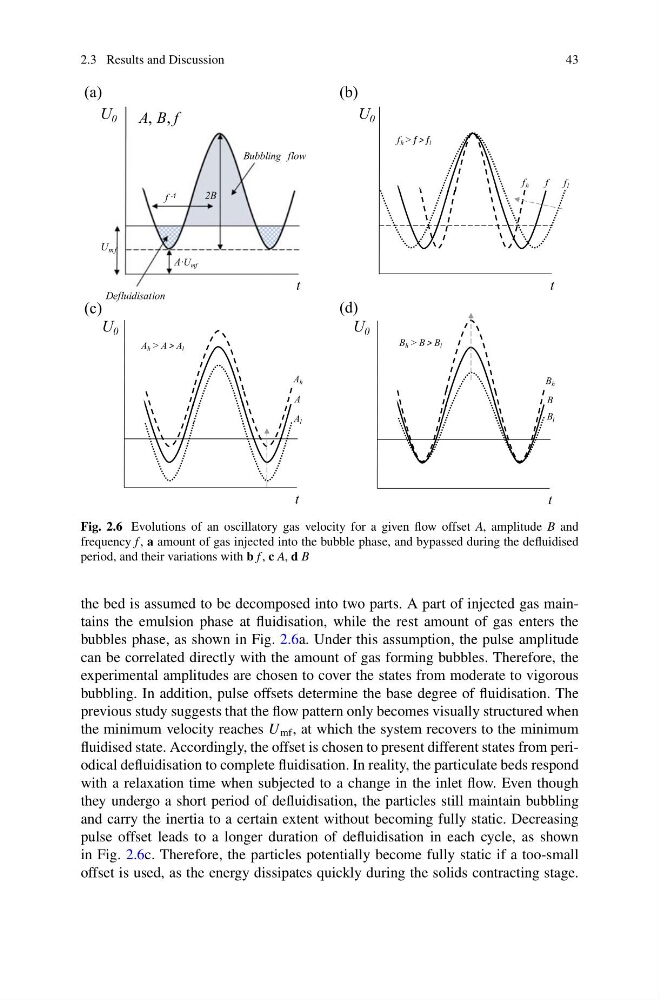
Fig. 2.6 Evolutions of an oscillatory gas velocity for a given flow offset A, amplitude B and
frequency f , a amount of gas injected into the bubble phase, and bypassed during the defluidised
period, and their variations with b f , c A, d B
the bed is assumed to be decomposed into two parts. A part of injected gas maintains the emulsion phase at fluidisation, while the rest amount of gas enters the
bubbles phase, as shown in Fig. 2.6a. Under this assumption, the pulse amplitude
can be correlated directly with the amount of gas forming bubbles. Therefore, the
experimental amplitudes are chosen to cover the states from moderate to vigorous
bubbling. In addition, pulse offsets determine the base degree of fluidisation. The
previous study suggests that the flow pattern only becomes visually structured when
the minimum velocity reaches U mf , at which the system recovers to the minimum
fluidised state. Accordingly, the offset is chosen to present different states from periodical defluidisation to complete fluidisation. In reality, the particulate beds respond
with a relaxation time when subjected to a change in the inlet flow. Even though
they undergo a short period of defluidisation, the particles still maintain bubbling
and carry the inertia to a certain extent without becoming fully static. Decreasing
pulse offset leads to a longer duration of defluidisation in each cycle, as shown
in Fig. 2.6c. Therefore, the particles potentially become fully static if a too-small
offset is used, as the energy dissipates quickly during the solids contracting stage.
43
Fig. 2.6 Evolutions of an oscillatory gas velocity for a given flow offset A, amplitude B and
frequency f , a amount of gas injected into the bubble phase, and bypassed during the defluidised
period, and their variations with b f , c A, d B
the bed is assumed to be decomposed into two parts. A part of injected gas maintains the emulsion phase at fluidisation, while the rest amount of gas enters the
bubbles phase, as shown in Fig. 2.6a. Under this assumption, the pulse amplitude
can be correlated directly with the amount of gas forming bubbles. Therefore, the
experimental amplitudes are chosen to cover the states from moderate to vigorous
bubbling. In addition, pulse offsets determine the base degree of fluidisation. The
previous study suggests that the flow pattern only becomes visually structured when
the minimum velocity reaches U mf , at which the system recovers to the minimum
fluidised state. Accordingly, the offset is chosen to present different states from periodical defluidisation to complete fluidisation. In reality, the particulate beds respond
with a relaxation time when subjected to a change in the inlet flow. Even though
they undergo a short period of defluidisation, the particles still maintain bubbling
and carry the inertia to a certain extent without becoming fully static. Decreasing
pulse offset leads to a longer duration of defluidisation in each cycle, as shown
in Fig. 2.6c. Therefore, the particles potentially become fully static if a too-small
offset is used, as the energy dissipates quickly during the solids contracting stage.