

12
1 Introduction
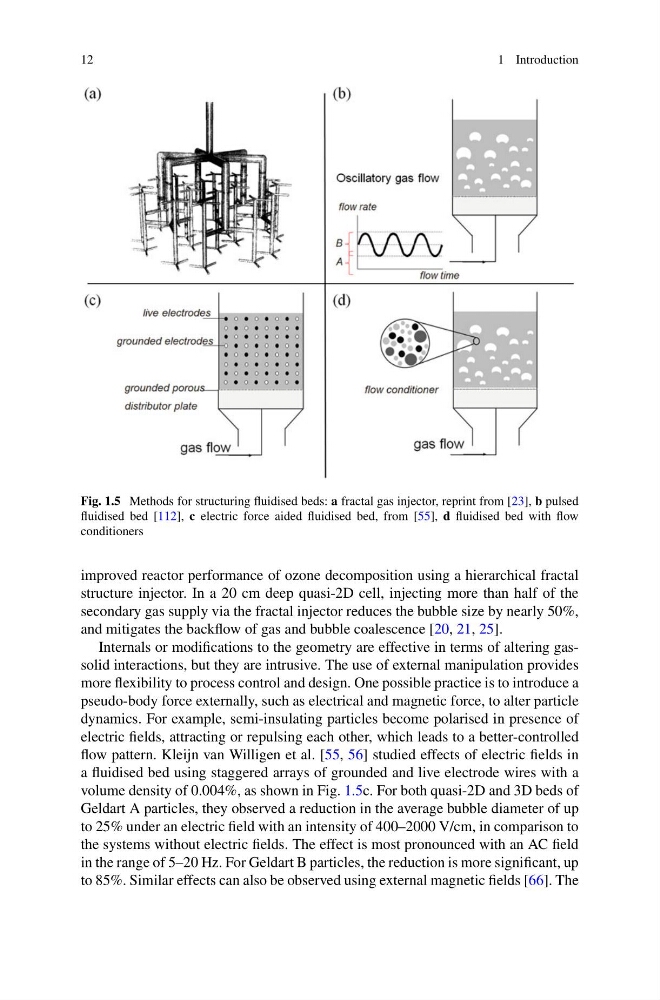
Fig. 1.5 Methods for structuring fluidised beds: a fractal gas injector, reprint from [23], b pulsed
fluidised bed [112], c electric force aided fluidised bed, from [55], d fluidised bed with flow
conditioners
improved reactor performance of ozone decomposition using a hierarchical fractal
structure injector. In a 20 cm deep quasi-2D cell, injecting more than half of the
secondary gas supply via the fractal injector reduces the bubble size by nearly 50%,
and mitigates the backflow of gas and bubble coalescence [20, 21, 25].
Internals or modifications to the geometry are effective in terms of altering gassolid interactions, but they are intrusive. The use of external manipulation provides
more flexibility to process control and design. One possible practice is to introduce a
pseudo-body force externally, such as electrical and magnetic force, to alter particle
dynamics. For example, semi-insulating particles become polarised in presence of
electric fields, attracting or repulsing each other, which leads to a better-controlled
flow pattern. Kleijn van Willigen et al. [55, 56] studied effects of electric fields in
a fluidised bed using staggered arrays of grounded and live electrode wires with a
volume density of 0.004%, as shown in Fig. 1.5c. For both quasi-2D and 3D beds of
Geldart A particles, they observed a reduction in the average bubble diameter of up
to 25% under an electric field with an intensity of 400–2000 V/cm, in comparison to
the systems without electric fields. The effect is most pronounced with an AC field
in the range of 5–20 Hz. For Geldart B particles, the reduction is more significant, up
to 85%. Similar effects can also be observed using external magnetic fields [66]. The
1 Introduction
Fig. 1.5 Methods for structuring fluidised beds: a fractal gas injector, reprint from [23], b pulsed
fluidised bed [112], c electric force aided fluidised bed, from [55], d fluidised bed with flow
conditioners
improved reactor performance of ozone decomposition using a hierarchical fractal
structure injector. In a 20 cm deep quasi-2D cell, injecting more than half of the
secondary gas supply via the fractal injector reduces the bubble size by nearly 50%,
and mitigates the backflow of gas and bubble coalescence [20, 21, 25].
Internals or modifications to the geometry are effective in terms of altering gassolid interactions, but they are intrusive. The use of external manipulation provides
more flexibility to process control and design. One possible practice is to introduce a
pseudo-body force externally, such as electrical and magnetic force, to alter particle
dynamics. For example, semi-insulating particles become polarised in presence of
electric fields, attracting or repulsing each other, which leads to a better-controlled
flow pattern. Kleijn van Willigen et al. [55, 56] studied effects of electric fields in
a fluidised bed using staggered arrays of grounded and live electrode wires with a
volume density of 0.004%, as shown in Fig. 1.5c. For both quasi-2D and 3D beds of
Geldart A particles, they observed a reduction in the average bubble diameter of up
to 25% under an electric field with an intensity of 400–2000 V/cm, in comparison to
the systems without electric fields. The effect is most pronounced with an AC field
in the range of 5–20 Hz. For Geldart B particles, the reduction is more significant, up
to 85%. Similar effects can also be observed using external magnetic fields [66]. The