

1.4 Methods for Structuring Bed Hydrodynamics
11
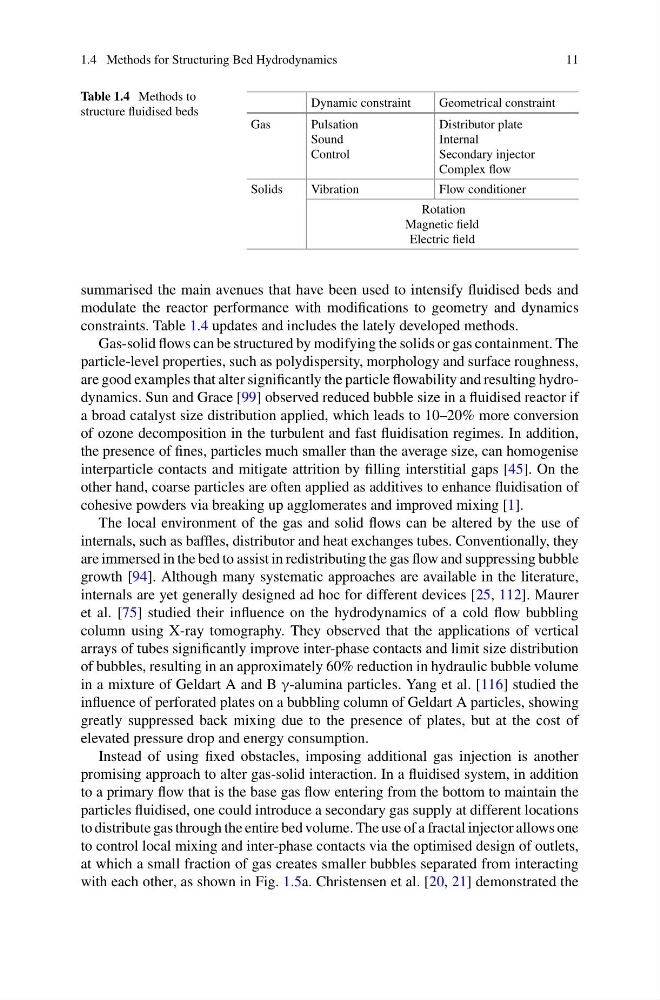
Table 1.4 Methods to
structure fluidised beds
Dynamic constraint
Geometrical constraint
Gas
Pulsation
Sound
Control
Distributor plate
Internal
Secondary injector
Complex flow
Solids
Vibration
Flow conditioner
Rotation
Magnetic field
Electric field
summarised the main avenues that have been used to intensify fluidised beds and
modulate the reactor performance with modifications to geometry and dynamics
constraints. Table 1.4 updates and includes the lately developed methods.
Gas-solid flows can be structured by modifying the solids or gas containment. The
particle-level properties, such as polydispersity, morphology and surface roughness,
are good examples that alter significantly the particle flowability and resulting hydrodynamics. Sun and Grace [99] observed reduced bubble size in a fluidised reactor if
a broad catalyst size distribution applied, which leads to 10–20% more conversion
of ozone decomposition in the turbulent and fast fluidisation regimes. In addition,
the presence of fines, particles much smaller than the average size, can homogenise
interparticle contacts and mitigate attrition by filling interstitial gaps [45]. On the
other hand, coarse particles are often applied as additives to enhance fluidisation of
cohesive powders via breaking up agglomerates and improved mixing [1].
The local environment of the gas and solid flows can be altered by the use of
internals, such as baffles, distributor and heat exchanges tubes. Conventionally, they
are immersed in the bed to assist in redistributing the gas flow and suppressing bubble
growth [94]. Although many systematic approaches are available in the literature,
internals are yet generally designed ad hoc for different devices [25, 112]. Maurer
et al. [75] studied their influence on the hydrodynamics of a cold flow bubbling
column using X-ray tomography. They observed that the applications of vertical
arrays of tubes significantly improve inter-phase contacts and limit size distribution
of bubbles, resulting in an approximately 60% reduction in hydraulic bubble volume
in a mixture of Geldart A and B γ-alumina particles. Yang et al. [116] studied the
influence of perforated plates on a bubbling column of Geldart A particles, showing
greatly suppressed back mixing due to the presence of plates, but at the cost of
elevated pressure drop and energy consumption.
Instead of using fixed obstacles, imposing additional gas injection is another
promising approach to alter gas-solid interaction. In a fluidised system, in addition
to a primary flow that is the base gas flow entering from the bottom to maintain the
particles fluidised, one could introduce a secondary gas supply at different locations
to distribute gas through the entire bed volume. The use of a fractal injector allows one
to control local mixing and inter-phase contacts via the optimised design of outlets,
at which a small fraction of gas creates smaller bubbles separated from interacting
with each other, as shown in Fig. 1.5a. Christensen et al. [20, 21] demonstrated the
11
Table 1.4 Methods to
structure fluidised beds
Dynamic constraint
Geometrical constraint
Gas
Pulsation
Sound
Control
Distributor plate
Internal
Secondary injector
Complex flow
Solids
Vibration
Flow conditioner
Rotation
Magnetic field
Electric field
summarised the main avenues that have been used to intensify fluidised beds and
modulate the reactor performance with modifications to geometry and dynamics
constraints. Table 1.4 updates and includes the lately developed methods.
Gas-solid flows can be structured by modifying the solids or gas containment. The
particle-level properties, such as polydispersity, morphology and surface roughness,
are good examples that alter significantly the particle flowability and resulting hydrodynamics. Sun and Grace [99] observed reduced bubble size in a fluidised reactor if
a broad catalyst size distribution applied, which leads to 10–20% more conversion
of ozone decomposition in the turbulent and fast fluidisation regimes. In addition,
the presence of fines, particles much smaller than the average size, can homogenise
interparticle contacts and mitigate attrition by filling interstitial gaps [45]. On the
other hand, coarse particles are often applied as additives to enhance fluidisation of
cohesive powders via breaking up agglomerates and improved mixing [1].
The local environment of the gas and solid flows can be altered by the use of
internals, such as baffles, distributor and heat exchanges tubes. Conventionally, they
are immersed in the bed to assist in redistributing the gas flow and suppressing bubble
growth [94]. Although many systematic approaches are available in the literature,
internals are yet generally designed ad hoc for different devices [25, 112]. Maurer
et al. [75] studied their influence on the hydrodynamics of a cold flow bubbling
column using X-ray tomography. They observed that the applications of vertical
arrays of tubes significantly improve inter-phase contacts and limit size distribution
of bubbles, resulting in an approximately 60% reduction in hydraulic bubble volume
in a mixture of Geldart A and B γ-alumina particles. Yang et al. [116] studied the
influence of perforated plates on a bubbling column of Geldart A particles, showing
greatly suppressed back mixing due to the presence of plates, but at the cost of
elevated pressure drop and energy consumption.
Instead of using fixed obstacles, imposing additional gas injection is another
promising approach to alter gas-solid interaction. In a fluidised system, in addition
to a primary flow that is the base gas flow entering from the bottom to maintain the
particles fluidised, one could introduce a secondary gas supply at different locations
to distribute gas through the entire bed volume. The use of a fractal injector allows one
to control local mixing and inter-phase contacts via the optimised design of outlets,
at which a small fraction of gas creates smaller bubbles separated from interacting
with each other, as shown in Fig. 1.5a. Christensen et al. [20, 21] demonstrated the