

1.3 Multi-scale Modelling of Gas-Solid Flows
9
The term (−P s I + τ s: ) ∇U s represents the conversion of mean-flow energy into fluctuating kinetic energy, due to the presence of strain; the ∇ · (κ∇) term accounts for
diffusion of fluctuating kinetic energy; γ is the dissipation due to inelastic collisions;
3β d stands for the transfer of fluctuation energy between the gas and solid phase.
The assumption of molecular chaos ensures a mathematical solution for solids
in dilute, rapid flow regimes, but also cease to be valid when solids pack closely,
where particles engage multiple, sustained contacts, resulting in a non-Maxwellian
velocity distribution. Frictional contacts induce massive dissipation of granular
energy, biasing the system towards non-thermal predominant states, and emerge
of anisotropic force chains. KTGF alone, therefore, dramatically underestimates the
effective solid stress, and becomes incapable of predicting the solids shear stress
to fulfil the yield criteria [19]. To address the difference, KTGF is usually applied
in conjunction with solid frictional stress models derived according to the critical
state theory of soil mechanics. The solid stress tensor considers the contributions of
frictional solid stress on top of the viscous terms obtained by KTGF. The models are
only activated when the solid packing φ exceeds a designed frictional packing limit
φ f . The normal frictional stress is modelled solely as a function of solid fraction,
coupling with different frictional shear viscosity models. Classic correlations and
closures for the terms in KTGF are demonstrated and discussed extensively in the
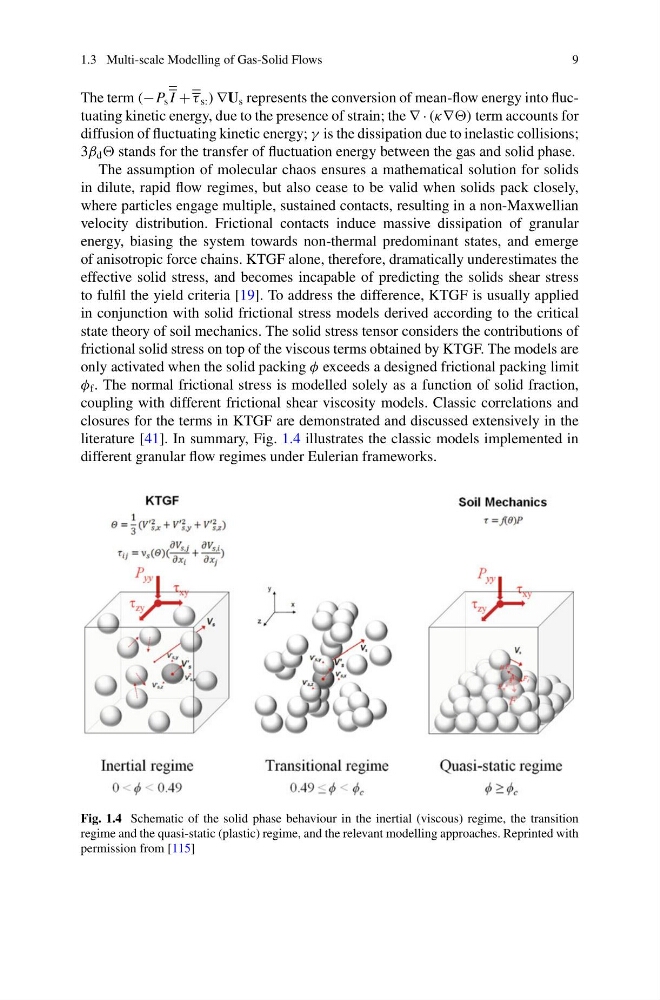
literature [41]. In summary, Fig. 1.4 illustrates the classic models implemented in
different granular flow regimes under Eulerian frameworks.
Fig. 1.4 Schematic of the solid phase behaviour in the inertial (viscous) regime, the transition
regime and the quasi-static (plastic) regime, and the relevant modelling approaches. Reprinted with
permission from [115]
9
The term (−P s I + τ s: ) ∇U s represents the conversion of mean-flow energy into fluctuating kinetic energy, due to the presence of strain; the ∇ · (κ∇) term accounts for
diffusion of fluctuating kinetic energy; γ is the dissipation due to inelastic collisions;
3β d stands for the transfer of fluctuation energy between the gas and solid phase.
The assumption of molecular chaos ensures a mathematical solution for solids
in dilute, rapid flow regimes, but also cease to be valid when solids pack closely,
where particles engage multiple, sustained contacts, resulting in a non-Maxwellian
velocity distribution. Frictional contacts induce massive dissipation of granular
energy, biasing the system towards non-thermal predominant states, and emerge
of anisotropic force chains. KTGF alone, therefore, dramatically underestimates the
effective solid stress, and becomes incapable of predicting the solids shear stress
to fulfil the yield criteria [19]. To address the difference, KTGF is usually applied
in conjunction with solid frictional stress models derived according to the critical
state theory of soil mechanics. The solid stress tensor considers the contributions of
frictional solid stress on top of the viscous terms obtained by KTGF. The models are
only activated when the solid packing φ exceeds a designed frictional packing limit
φ f . The normal frictional stress is modelled solely as a function of solid fraction,
coupling with different frictional shear viscosity models. Classic correlations and
closures for the terms in KTGF are demonstrated and discussed extensively in the
literature [41]. In summary, Fig. 1.4 illustrates the classic models implemented in
different granular flow regimes under Eulerian frameworks.
Fig. 1.4 Schematic of the solid phase behaviour in the inertial (viscous) regime, the transition
regime and the quasi-static (plastic) regime, and the relevant modelling approaches. Reprinted with
permission from [115]