

5.5 Results and Discussion
137
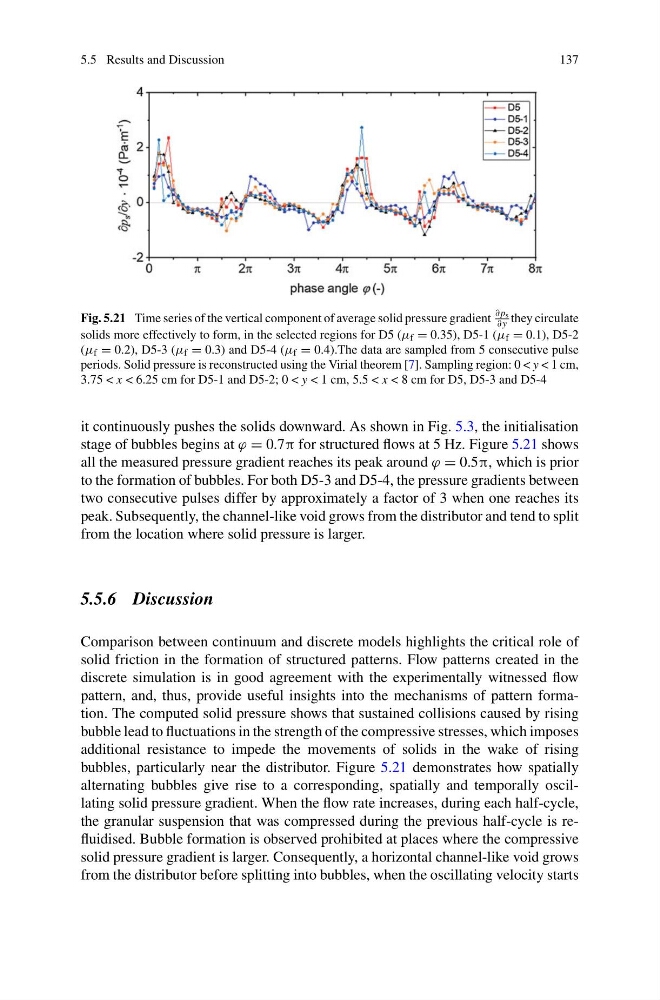
Fig. 5.21 Time series of the vertical component of average solid pressure gradient
∂ ps
∂ y they circulate
solids more effectively to form, in the selected regions for D5 (μ f = 0.35), D5-1 (μ f = 0.1), D5-2
(μ f = 0.2), D5-3 (μ f = 0.3) and D5-4 (μ f = 0.4).The data are sampled from 5 consecutive pulse
periods. Solid pressure is reconstructed using the Virial theorem [7]. Sampling region: 0 < y < 1 cm,
3.75 < x < 6.25 cm for D5-1 and D5-2; 0 < y < 1 cm, 5.5 < x < 8 cm for D5, D5-3 and D5-4
it continuously pushes the solids downward. As shown in Fig. 5.3, the initialisation
stage of bubbles begins at ϕ = 0.7π for structured flows at 5 Hz. Figure 5.21 shows
all the measured pressure gradient reaches its peak around ϕ = 0.5π, which is prior
to the formation of bubbles. For both D5-3 and D5-4, the pressure gradients between
two consecutive pulses differ by approximately a factor of 3 when one reaches its
peak. Subsequently, the channel-like void grows from the distributor and tend to split
from the location where solid pressure is larger.
5.5.6 Discussion
Comparison between continuum and discrete models highlights the critical role of
solid friction in the formation of structured patterns. Flow patterns created in the
discrete simulation is in good agreement with the experimentally witnessed flow
pattern, and, thus, provide useful insights into the mechanisms of pattern formation. The computed solid pressure shows that sustained collisions caused by rising
bubble lead to fluctuations in the strength of the compressive stresses, which imposes
additional resistance to impede the movements of solids in the wake of rising
bubbles, particularly near the distributor. Figure 5.21 demonstrates how spatially
alternating bubbles give rise to a corresponding, spatially and temporally oscillating solid pressure gradient. When the flow rate increases, during each half-cycle,
the granular suspension that was compressed during the previous half-cycle is refluidised. Bubble formation is observed prohibited at places where the compressive
solid pressure gradient is larger. Consequently, a horizontal channel-like void grows
from the distributor before splitting into bubbles, when the oscillating velocity starts
137
Fig. 5.21 Time series of the vertical component of average solid pressure gradient
∂ ps
∂ y they circulate
solids more effectively to form, in the selected regions for D5 (μ f = 0.35), D5-1 (μ f = 0.1), D5-2
(μ f = 0.2), D5-3 (μ f = 0.3) and D5-4 (μ f = 0.4).The data are sampled from 5 consecutive pulse
periods. Solid pressure is reconstructed using the Virial theorem [7]. Sampling region: 0 < y < 1 cm,
3.75 < x < 6.25 cm for D5-1 and D5-2; 0 < y < 1 cm, 5.5 < x < 8 cm for D5, D5-3 and D5-4
it continuously pushes the solids downward. As shown in Fig. 5.3, the initialisation
stage of bubbles begins at ϕ = 0.7π for structured flows at 5 Hz. Figure 5.21 shows
all the measured pressure gradient reaches its peak around ϕ = 0.5π, which is prior
to the formation of bubbles. For both D5-3 and D5-4, the pressure gradients between
two consecutive pulses differ by approximately a factor of 3 when one reaches its
peak. Subsequently, the channel-like void grows from the distributor and tend to split
from the location where solid pressure is larger.
5.5.6 Discussion
Comparison between continuum and discrete models highlights the critical role of
solid friction in the formation of structured patterns. Flow patterns created in the
discrete simulation is in good agreement with the experimentally witnessed flow
pattern, and, thus, provide useful insights into the mechanisms of pattern formation. The computed solid pressure shows that sustained collisions caused by rising
bubble lead to fluctuations in the strength of the compressive stresses, which imposes
additional resistance to impede the movements of solids in the wake of rising
bubbles, particularly near the distributor. Figure 5.21 demonstrates how spatially
alternating bubbles give rise to a corresponding, spatially and temporally oscillating solid pressure gradient. When the flow rate increases, during each half-cycle,
the granular suspension that was compressed during the previous half-cycle is refluidised. Bubble formation is observed prohibited at places where the compressive
solid pressure gradient is larger. Consequently, a horizontal channel-like void grows
from the distributor before splitting into bubbles, when the oscillating velocity starts