

98
4 Modelling Dynamically Structured Fluidisation
Young’s modulus E is implemented to avoid an infeasibly small DEM time step.
It is known that, for non-cohesive Geldart B particles, the precise value of the spring
stiffness has no significant influence on the bubbling behaviour if it is sufficiently
large [36, 37, 58]. The verification showed that bubble size is independent of Young’s
modulus when the latter is above 10 MPa. Particle-wall contacts follow the same
mechanics as interparticle contacts.
The refinement of CFD mesh allows for the description of local features in the
gas phase, but a too-small mesh size also induces unphysical estimates for the solid
packing and, thus, errors in the interphase momentum exchange. A structured mesh
consisting of a single layer of cubic cells with an edge of 2 mm is employed
to maximise the resolution. The verification tests showed that the computed solid
packing becomes grid-independent once the mesh size is greater than 2 mm, maintaining at a designed packing. A time step of 1 × 10
−4 s is employed to fulfil the
Courant-Friedrichs-Lewy condition [10], and renders an accurate description of the
gas phase dynamics. The solid phase time step is set to 1 × 10
−6 s, approximately
3% of the characteristic collision time, according to the criterion proposed by van
der Hoef et al. [54] and Silbert et al. [45].
In order to approximate the quasi-2D nature in CFD-DEM simulations, zero-flux
conditions are imposed on the front and rear walls. Given a fixed bed thickness, the
number of cells in the third dimension is observed to have a negligible influence on
the simulation results, which agrees with the discovery by Kuipers and colleagues
[21, 62].
For two-fluid model, the pressure-based solver is selected for low-speed incompressible flows, and phase-coupled Semi-Implicit Method for Pressure Linked Equations (SIMPLE) algorithm for the relation between pressure and velocity, secondorder upwind for momentum and granular temperature, first-order upwind for volume
fraction, and a first-order implicit scheme for temporal discretization. Gradients and
Laplacian terms are calculated with the Green-Gauss node-based scheme, which
adopts the arithmetic average of the nodal values on each grid cell. On the other
hand, Pressure Implicit with Splitting of Operator (PISO) algorithm is used for
solving the gas phase in CFD-DEM. Temporal discretization is treated with a firstorder Euler implicit scheme, and discretization of gradients and divergences is treated
with second-order schemes. Table 4.5 summarises the physical properties applied.
4.2.6 Analysis Methodology
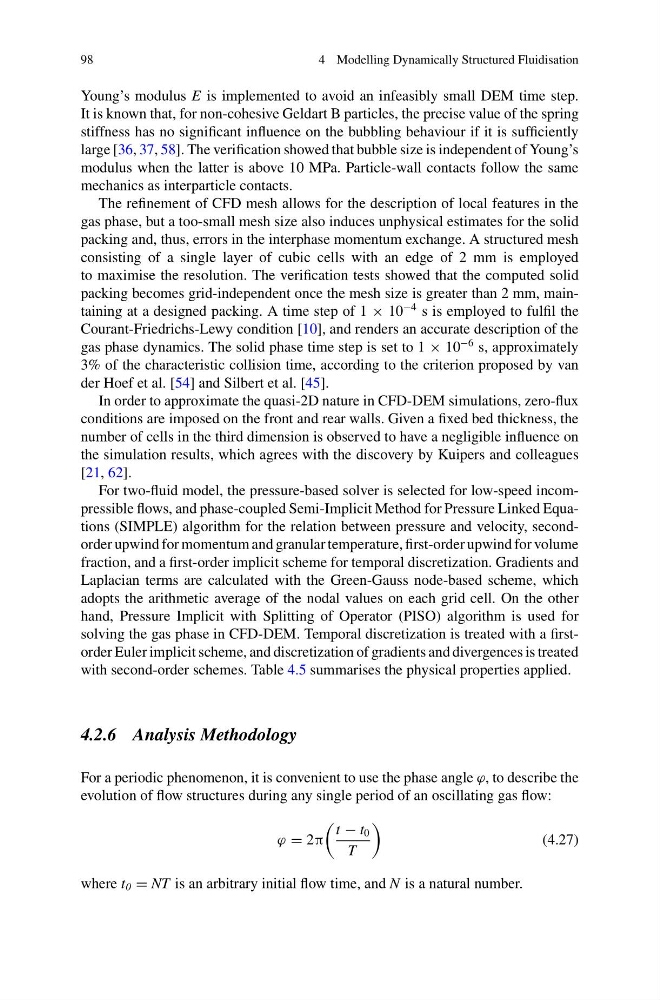
For a periodic phenomenon, it is convenient to use the phase angle ϕ, to describe the
evolution of flow structures during any single period of an oscillating gas flow:
ϕ = 2π
t − t 0
T
(4.27)
where t 0 = NT is an arbitrary initial flow time, and N is a natural number.
4 Modelling Dynamically Structured Fluidisation
Young’s modulus E is implemented to avoid an infeasibly small DEM time step.
It is known that, for non-cohesive Geldart B particles, the precise value of the spring
stiffness has no significant influence on the bubbling behaviour if it is sufficiently
large [36, 37, 58]. The verification showed that bubble size is independent of Young’s
modulus when the latter is above 10 MPa. Particle-wall contacts follow the same
mechanics as interparticle contacts.
The refinement of CFD mesh allows for the description of local features in the
gas phase, but a too-small mesh size also induces unphysical estimates for the solid
packing and, thus, errors in the interphase momentum exchange. A structured mesh
consisting of a single layer of cubic cells with an edge of 2 mm is employed
to maximise the resolution. The verification tests showed that the computed solid
packing becomes grid-independent once the mesh size is greater than 2 mm, maintaining at a designed packing. A time step of 1 × 10
−4 s is employed to fulfil the
Courant-Friedrichs-Lewy condition [10], and renders an accurate description of the
gas phase dynamics. The solid phase time step is set to 1 × 10
−6 s, approximately
3% of the characteristic collision time, according to the criterion proposed by van
der Hoef et al. [54] and Silbert et al. [45].
In order to approximate the quasi-2D nature in CFD-DEM simulations, zero-flux
conditions are imposed on the front and rear walls. Given a fixed bed thickness, the
number of cells in the third dimension is observed to have a negligible influence on
the simulation results, which agrees with the discovery by Kuipers and colleagues
[21, 62].
For two-fluid model, the pressure-based solver is selected for low-speed incompressible flows, and phase-coupled Semi-Implicit Method for Pressure Linked Equations (SIMPLE) algorithm for the relation between pressure and velocity, secondorder upwind for momentum and granular temperature, first-order upwind for volume
fraction, and a first-order implicit scheme for temporal discretization. Gradients and
Laplacian terms are calculated with the Green-Gauss node-based scheme, which
adopts the arithmetic average of the nodal values on each grid cell. On the other
hand, Pressure Implicit with Splitting of Operator (PISO) algorithm is used for
solving the gas phase in CFD-DEM. Temporal discretization is treated with a firstorder Euler implicit scheme, and discretization of gradients and divergences is treated
with second-order schemes. Table 4.5 summarises the physical properties applied.
4.2.6 Analysis Methodology
For a periodic phenomenon, it is convenient to use the phase angle ϕ, to describe the
evolution of flow structures during any single period of an oscillating gas flow:
ϕ = 2π
t − t 0
T
(4.27)
where t 0 = NT is an arbitrary initial flow time, and N is a natural number.