

4.2 Model Implementation
93
4.2.1 Governing Equations and Closures of Two-Fluid Model
The governing equations describe the conservation of mass and linear momentum
for each phase, and two phases are coupled via the interphase momentum exchange.
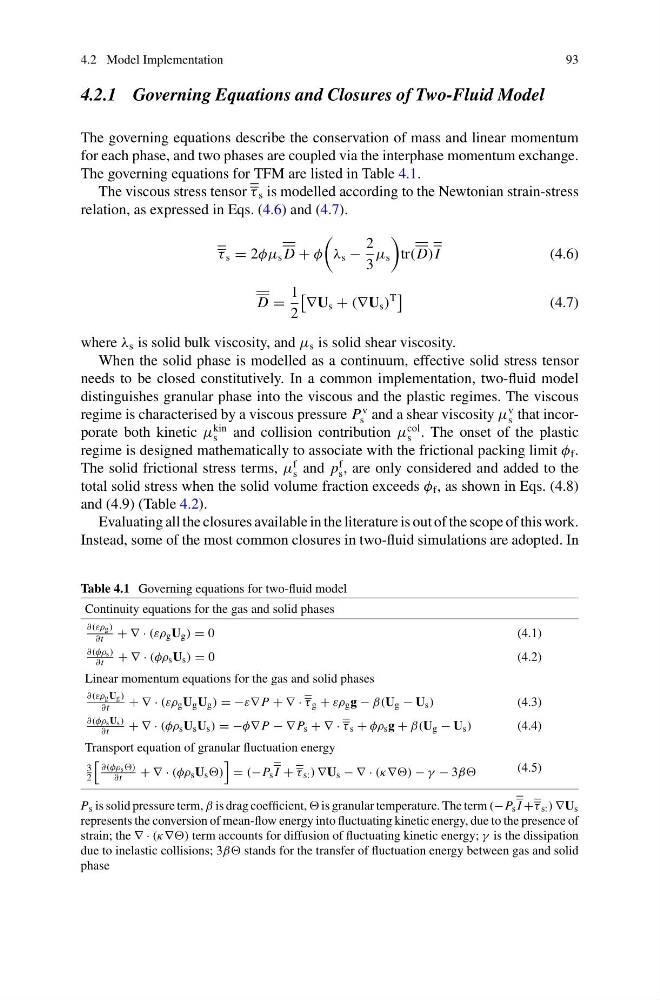
The governing equations for TFM are listed in Table 4.1.
The viscous stress tensor τ s is modelled according to the Newtonian strain-stress
relation, as expressed in Eqs. (4.6) and (4.7).
τ s = 2φμ s D + φ
λ s −
2
3
μ s
tr(D)I
(4.6)
D =
1
2
∇U s + (∇U s )
T
(4.7)
where λ s is solid bulk viscosity, and μ s is solid shear viscosity.
When the solid phase is modelled as a continuum, effective solid stress tensor
needs to be closed constitutively. In a common implementation, two-fluid model
distinguishes granular phase into the viscous and the plastic regimes. The viscous
regime is characterised by a viscous pressure P
v
s and a shear viscosity μ
v
s that incorporate both kinetic μ
kin
s
and collision contribution μ
col
s . The onset of the plastic
regime is designed mathematically to associate with the frictional packing limit φ f .
The solid frictional stress terms, μ
f
s and p
f
s , are only considered and added to the
total solid stress when the solid volume fraction exceeds φ f , as shown in Eqs. (4.8)
and (4.9) (Table 4.2).
Evaluating all the closures available in the literature is out of the scope of this work.
Instead, some of the most common closures in two-fluid simulations are adopted. In
Table 4.1 Governing equations for two-fluid model
Continuity equations for the gas and solid phases
∂(ερg)
∂t + ∇ · (ερ g U g ) = 0
(4.1)
∂(φρs)
∂t + ∇ · (φρ s U s ) = 0
(4.2)
Linear momentum equations for the gas and solid phases
∂(ερgUg)
∂t
+ ∇ · (ερ g U g U g ) = −ε∇ P + ∇ · τ g + ερ g g − β(U g − U s )
(4.3)
∂(φρsUs)
∂t
+ ∇ · (φρ s U s U s ) = −φ∇ P − ∇ P s + ∇ · τ s + φρ s g + β(U g − U s )
(4.4)
Transport equation of granular fluctuation energy
3
2
∂(φρs)
∂t
+ ∇ · (φρ s U s )
= (−P s I + τ s: ) ∇U s − ∇ · (κ∇) − γ − 3ββ
(4.5)
P s is solid pressure term, β is drag coefficient, is granular temperature. The term (−P s I +τ s: ) ∇U s
represents the conversion of mean-flow energy into fluctuating kinetic energy, due to the presence of
strain; the ∇ · (κ∇) term accounts for diffusion of fluctuating kinetic energy; γ is the dissipation
due to inelastic collisions; 3ββ stands for the transfer of fluctuation energy between gas and solid
phase
93
4.2.1 Governing Equations and Closures of Two-Fluid Model
The governing equations describe the conservation of mass and linear momentum
for each phase, and two phases are coupled via the interphase momentum exchange.
The governing equations for TFM are listed in Table 4.1.
The viscous stress tensor τ s is modelled according to the Newtonian strain-stress
relation, as expressed in Eqs. (4.6) and (4.7).
τ s = 2φμ s D + φ
λ s −
2
3
μ s
tr(D)I
(4.6)
D =
1
2
∇U s + (∇U s )
T
(4.7)
where λ s is solid bulk viscosity, and μ s is solid shear viscosity.
When the solid phase is modelled as a continuum, effective solid stress tensor
needs to be closed constitutively. In a common implementation, two-fluid model
distinguishes granular phase into the viscous and the plastic regimes. The viscous
regime is characterised by a viscous pressure P
v
s and a shear viscosity μ
v
s that incorporate both kinetic μ
kin
s
and collision contribution μ
col
s . The onset of the plastic
regime is designed mathematically to associate with the frictional packing limit φ f .
The solid frictional stress terms, μ
f
s and p
f
s , are only considered and added to the
total solid stress when the solid volume fraction exceeds φ f , as shown in Eqs. (4.8)
and (4.9) (Table 4.2).
Evaluating all the closures available in the literature is out of the scope of this work.
Instead, some of the most common closures in two-fluid simulations are adopted. In
Table 4.1 Governing equations for two-fluid model
Continuity equations for the gas and solid phases
∂(ερg)
∂t + ∇ · (ερ g U g ) = 0
(4.1)
∂(φρs)
∂t + ∇ · (φρ s U s ) = 0
(4.2)
Linear momentum equations for the gas and solid phases
∂(ερgUg)
∂t
+ ∇ · (ερ g U g U g ) = −ε∇ P + ∇ · τ g + ερ g g − β(U g − U s )
(4.3)
∂(φρsUs)
∂t
+ ∇ · (φρ s U s U s ) = −φ∇ P − ∇ P s + ∇ · τ s + φρ s g + β(U g − U s )
(4.4)
Transport equation of granular fluctuation energy
3
2
∂(φρs)
∂t
+ ∇ · (φρ s U s )
= (−P s I + τ s: ) ∇U s − ∇ · (κ∇) − γ − 3ββ
(4.5)
P s is solid pressure term, β is drag coefficient, is granular temperature. The term (−P s I +τ s: ) ∇U s
represents the conversion of mean-flow energy into fluctuating kinetic energy, due to the presence of
strain; the ∇ · (κ∇) term accounts for diffusion of fluctuating kinetic energy; γ is the dissipation
due to inelastic collisions; 3ββ stands for the transfer of fluctuation energy between gas and solid
phase