

1.2.4 Hydrogen Transfer
The oxidation of organic compounds requires the removal of hydrogen. Activated
sludge treatment, being an aerobic process, utilizes oxygen as the final hydrogen
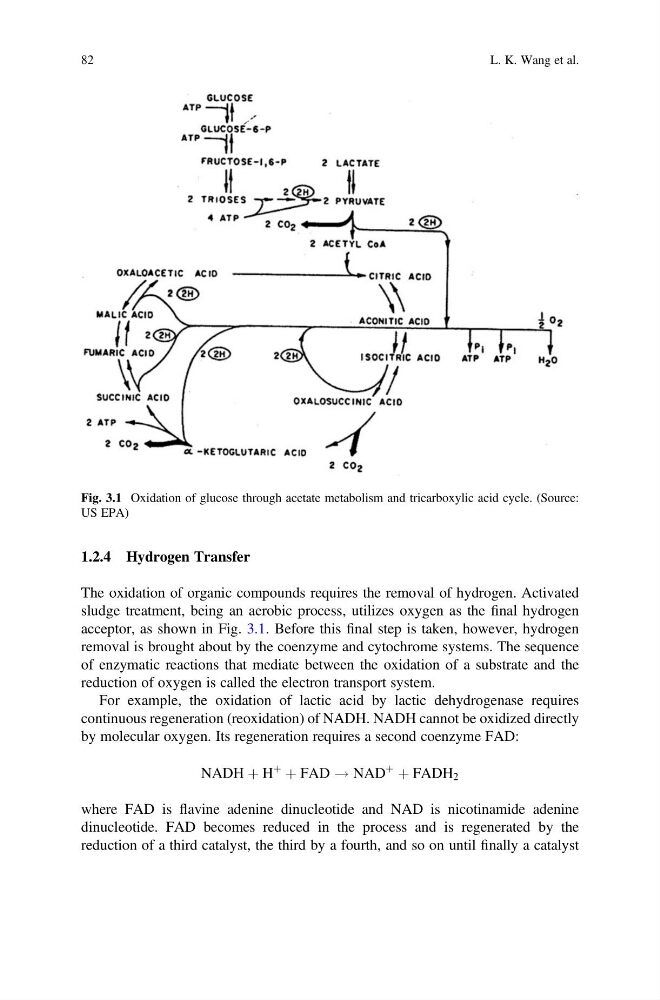
acceptor, as shown in Fig. 3.1. Before this final step is taken, however, hydrogen
removal is brought about by the coenzyme and cytochrome systems. The sequence
of enzymatic reactions that mediate between the oxidation of a substrate and the
reduction of oxygen is called the electron transport system.
For example, the oxidation of lactic acid by lactic dehydrogenase requires
continuous regeneration (reoxidation) of NADH. NADH cannot be oxidized directly
by molecular oxygen. Its regeneration requires a second coenzyme FAD:
NADH þ H
þ
þ FAD ! NAD
þ
þ FADH 2
where FAD is flavine adenine dinucleotide and NAD is nicotinamide adenine
dinucleotide. FAD becomes reduced in the process and is regenerated by the
reduction of a third catalyst, the third by a fourth, and so on until finally a catalyst
Fig. 3.1 Oxidation of glucose through acetate metabolism and tricarboxylic acid cycle. (Source:
US EPA)
82
L. K. Wang et al.
The oxidation of organic compounds requires the removal of hydrogen. Activated
sludge treatment, being an aerobic process, utilizes oxygen as the final hydrogen
acceptor, as shown in Fig. 3.1. Before this final step is taken, however, hydrogen
removal is brought about by the coenzyme and cytochrome systems. The sequence
of enzymatic reactions that mediate between the oxidation of a substrate and the
reduction of oxygen is called the electron transport system.
For example, the oxidation of lactic acid by lactic dehydrogenase requires
continuous regeneration (reoxidation) of NADH. NADH cannot be oxidized directly
by molecular oxygen. Its regeneration requires a second coenzyme FAD:
NADH þ H
þ
þ FAD ! NAD
þ
þ FADH 2
where FAD is flavine adenine dinucleotide and NAD is nicotinamide adenine
dinucleotide. FAD becomes reduced in the process and is regenerated by the
reduction of a third catalyst, the third by a fourth, and so on until finally a catalyst
Fig. 3.1 Oxidation of glucose through acetate metabolism and tricarboxylic acid cycle. (Source:
US EPA)
82
L. K. Wang et al.