

high enough for discharge to a watercourse. Therefore, an aerobic system is usually
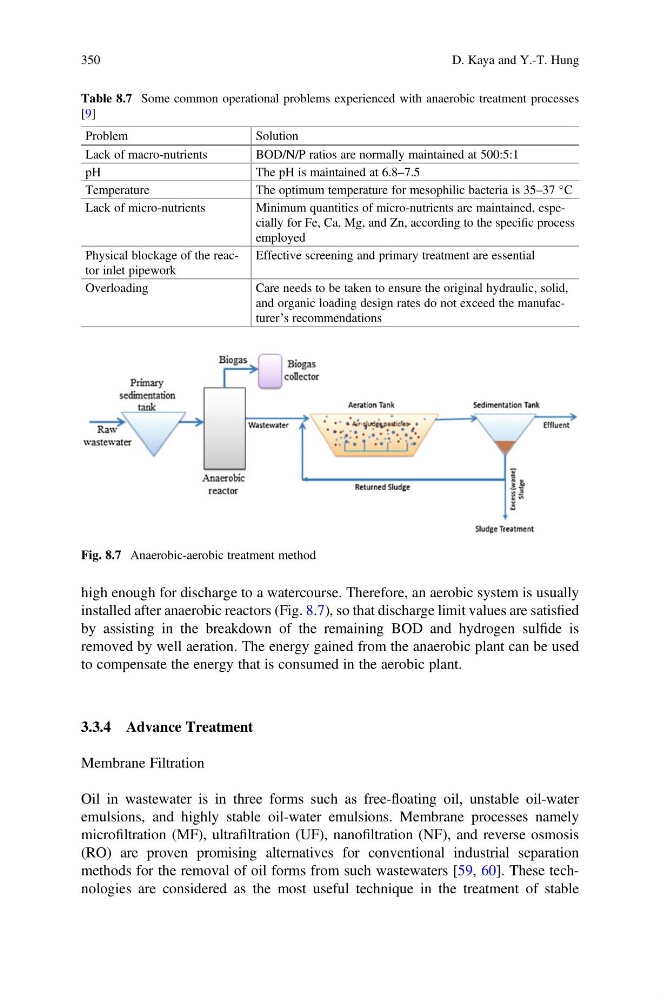
installed after anaerobic reactors (Fig. 8.7), so that discharge limit values are satisfied
by assisting in the breakdown of the remaining BOD and hydrogen sulfide is
removed by well aeration. The energy gained from the anaerobic plant can be used
to compensate the energy that is consumed in the aerobic plant.
3.3.4 Advance Treatment
Membrane Filtration
Oil in wastewater is in three forms such as free-floating oil, unstable oil-water
emulsions, and highly stable oil-water emulsions. Membrane processes namely
microfiltration (MF), ultrafiltration (UF), nanofiltration (NF), and reverse osmosis
(RO) are proven promising alternatives for conventional industrial separation
methods for the removal of oil forms from such wastewaters [59, 60]. These technologies are considered as the most useful technique in the treatment of stable
Table 8.7 Some common operational problems experienced with anaerobic treatment processes
[9]
Problem
Solution
Lack of macro-nutrients
BOD/N/P ratios are normally maintained at 500:5:1
pH
The pH is maintained at 6.8–7.5
Temperature
The optimum temperature for mesophilic bacteria is 35–37
C
Lack of micro-nutrients
Minimum quantities of micro-nutrients are maintained, especially for Fe, Ca, Mg, and Zn, according to the specific process
employed
Physical blockage of the reactor inlet pipework
Effective screening and primary treatment are essential
Overloading
Care needs to be taken to ensure the original hydraulic, solid,
and organic loading design rates do not exceed the manufacturer’s recommendations
Fig. 8.7 Anaerobic-aerobic treatment method
350
D. Kaya and Y.-T. Hung
installed after anaerobic reactors (Fig. 8.7), so that discharge limit values are satisfied
by assisting in the breakdown of the remaining BOD and hydrogen sulfide is
removed by well aeration. The energy gained from the anaerobic plant can be used
to compensate the energy that is consumed in the aerobic plant.
3.3.4 Advance Treatment
Membrane Filtration
Oil in wastewater is in three forms such as free-floating oil, unstable oil-water
emulsions, and highly stable oil-water emulsions. Membrane processes namely
microfiltration (MF), ultrafiltration (UF), nanofiltration (NF), and reverse osmosis
(RO) are proven promising alternatives for conventional industrial separation
methods for the removal of oil forms from such wastewaters [59, 60]. These technologies are considered as the most useful technique in the treatment of stable
Table 8.7 Some common operational problems experienced with anaerobic treatment processes
[9]
Problem
Solution
Lack of macro-nutrients
BOD/N/P ratios are normally maintained at 500:5:1
pH
The pH is maintained at 6.8–7.5
Temperature
The optimum temperature for mesophilic bacteria is 35–37
C
Lack of micro-nutrients
Minimum quantities of micro-nutrients are maintained, especially for Fe, Ca, Mg, and Zn, according to the specific process
employed
Physical blockage of the reactor inlet pipework
Effective screening and primary treatment are essential
Overloading
Care needs to be taken to ensure the original hydraulic, solid,
and organic loading design rates do not exceed the manufacturer’s recommendations
Fig. 8.7 Anaerobic-aerobic treatment method
350
D. Kaya and Y.-T. Hung