

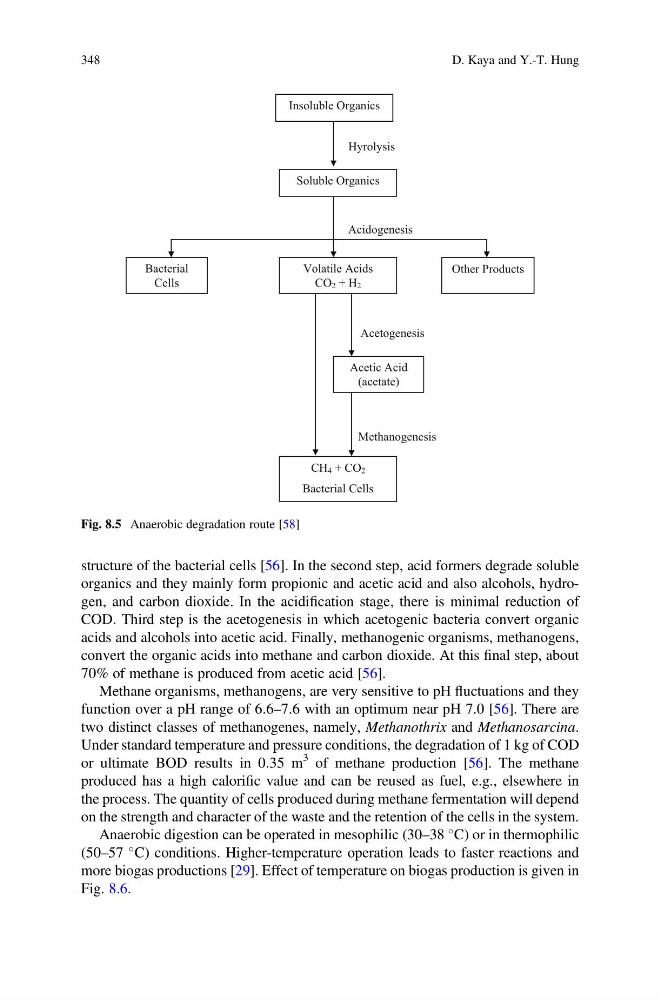
structure of the bacterial cells [56]. In the second step, acid formers degrade soluble
organics and they mainly form propionic and acetic acid and also alcohols, hydrogen, and carbon dioxide. In the acidification stage, there is minimal reduction of
COD. Third step is the acetogenesis in which acetogenic bacteria convert organic
acids and alcohols into acetic acid. Finally, methanogenic organisms, methanogens,
convert the organic acids into methane and carbon dioxide. At this final step, about
70% of methane is produced from acetic acid [56].
Methane organisms, methanogens, are very sensitive to pH fluctuations and they
function over a pH range of 6.6–7.6 with an optimum near pH 7.0 [56]. There are
two distinct classes of methanogenes, namely, Methanothrix and Methanosarcina.
Under standard temperature and pressure conditions, the degradation of 1 kg of COD
or ultimate BOD results in 0.35 m
3 of methane production [56]. The methane
produced has a high calorific value and can be reused as fuel, e.g., elsewhere in
the process. The quantity of cells produced during methane fermentation will depend
on the strength and character of the waste and the retention of the cells in the system.
Anaerobic digestion can be operated in mesophilic (30–38
C) or in thermophilic
(50–57
C) conditions. Higher-temperature operation leads to faster reactions and
more biogas productions [29]. Effect of temperature on biogas production is given in
Fig. 8.6.
Hyrolysis
Acidogenesis
Acetogenesis
Methanogenesis
Insoluble Organics
Soluble Organics
Bacterial
Cells
Other Products
Volatile Acids
CO 2 + H 2
Acetic Acid
(acetate)
CH 4 + CO 2
Bacterial Cells
Fig. 8.5 Anaerobic degradation route [58]
348
D. Kaya and Y.-T. Hung
organics and they mainly form propionic and acetic acid and also alcohols, hydrogen, and carbon dioxide. In the acidification stage, there is minimal reduction of
COD. Third step is the acetogenesis in which acetogenic bacteria convert organic
acids and alcohols into acetic acid. Finally, methanogenic organisms, methanogens,
convert the organic acids into methane and carbon dioxide. At this final step, about
70% of methane is produced from acetic acid [56].
Methane organisms, methanogens, are very sensitive to pH fluctuations and they
function over a pH range of 6.6–7.6 with an optimum near pH 7.0 [56]. There are
two distinct classes of methanogenes, namely, Methanothrix and Methanosarcina.
Under standard temperature and pressure conditions, the degradation of 1 kg of COD
or ultimate BOD results in 0.35 m
3 of methane production [56]. The methane
produced has a high calorific value and can be reused as fuel, e.g., elsewhere in
the process. The quantity of cells produced during methane fermentation will depend
on the strength and character of the waste and the retention of the cells in the system.
Anaerobic digestion can be operated in mesophilic (30–38
C) or in thermophilic
(50–57
C) conditions. Higher-temperature operation leads to faster reactions and
more biogas productions [29]. Effect of temperature on biogas production is given in
Fig. 8.6.
Hyrolysis
Acidogenesis
Acetogenesis
Methanogenesis
Insoluble Organics
Soluble Organics
Bacterial
Cells
Other Products
Volatile Acids
CO 2 + H 2
Acetic Acid
(acetate)
CH 4 + CO 2
Bacterial Cells
Fig. 8.5 Anaerobic degradation route [58]
348
D. Kaya and Y.-T. Hung