

2.1 Degumming
Degumming is a water-washing process to remove phosphatides. At this step, free
fatty acids are converted to water-soluble soaps, soap-stock. Phosphatides can
hydrate from moisture in the air during storage or in the headspace; thus, phosphatides become insoluble in the oil and precipitate, resulting in an oil that is unattractive because of unpleasant sludge or gums [7]. It is vital to remove the phosphatide
content in the crude oil because the presence of this component will result in
undesirable flavor and color and shorten the shelf life of oil. Phosphatides, also
known as lecithin, are important food emulsifiers and have an economical value.
Therefore, they should be recovered where possible.
During degumming, the phosphatide portion of oil is either removed or conditioned by the addition of phosphoric acid or citric acid. Hot water is added to hydrate
any gums present in crude oil prior to centrifugal separation. Non-hydratable gums
are removed by converting them first to a hydratable form using phosphoric or citric
acid, followed by the addition of water. This causes the separation of phosphatides
from oil and they are removed after certain settling time. Occasionally, segregated
gums are not directly removed but with soap-stock formed during neutralization
[9]. During degumming, caustic soda preheated to between 90
C and 110
C is
added to the oil to saponify the FFA. The dosage of phosphoric acid is normally
within the range of 0.05–0.1% of oil weight and the acid concentration is about
80–85%. Excessive use of phosphoric acid should be avoided since it increases
phosphorus acid concentration that may cause further refining problems. However,
degumming is not as reliable for bleached oils. Degumming may be conducted either
as a separate process or concurrently with neutralization.
2.2 Neutralization
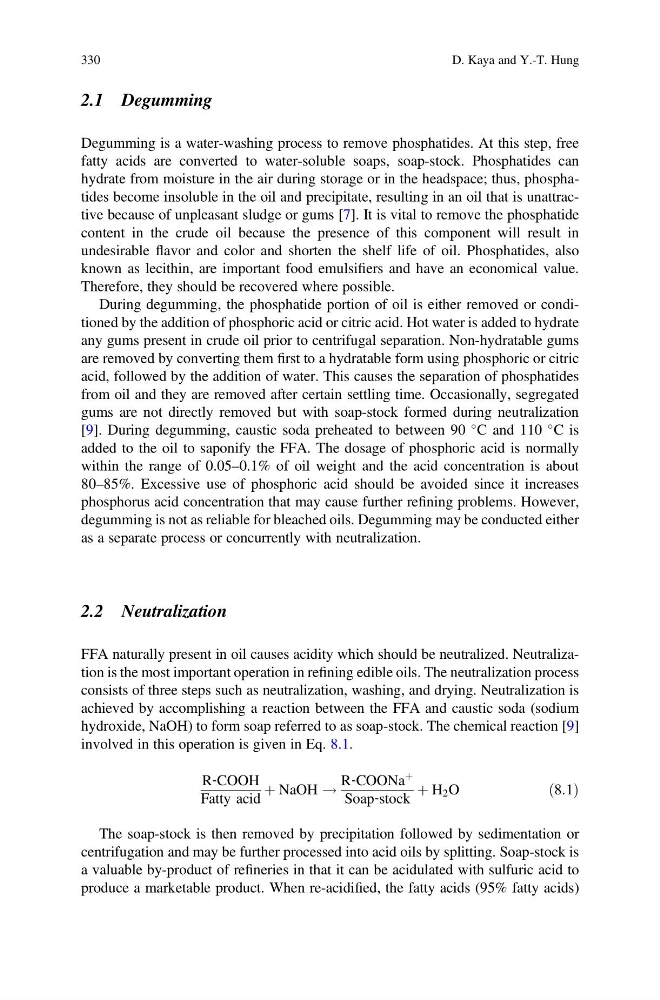
FFA naturally present in oil causes acidity which should be neutralized. Neutralization is the most important operation in refining edible oils. The neutralization process
consists of three steps such as neutralization, washing, and drying. Neutralization is
achieved by accomplishing a reaction between the FFA and caustic soda (sodium
hydroxide, NaOH) to form soap referred to as soap-stock. The chemical reaction [9]
involved in this operation is given in Eq. 8.1.
R‐COOH
Fatty acid
þ NaOH !
R‐COONa
þ
Soap‐stock
þ H 2 O
ð8:1Þ
The soap-stock is then removed by precipitation followed by sedimentation or
centrifugation and may be further processed into acid oils by splitting. Soap-stock is
a valuable by-product of refineries in that it can be acidulated with sulfuric acid to
produce a marketable product. When re-acidified, the fatty acids (95% fatty acids)
330
D. Kaya and Y.-T. Hung
Degumming is a water-washing process to remove phosphatides. At this step, free
fatty acids are converted to water-soluble soaps, soap-stock. Phosphatides can
hydrate from moisture in the air during storage or in the headspace; thus, phosphatides become insoluble in the oil and precipitate, resulting in an oil that is unattractive because of unpleasant sludge or gums [7]. It is vital to remove the phosphatide
content in the crude oil because the presence of this component will result in
undesirable flavor and color and shorten the shelf life of oil. Phosphatides, also
known as lecithin, are important food emulsifiers and have an economical value.
Therefore, they should be recovered where possible.
During degumming, the phosphatide portion of oil is either removed or conditioned by the addition of phosphoric acid or citric acid. Hot water is added to hydrate
any gums present in crude oil prior to centrifugal separation. Non-hydratable gums
are removed by converting them first to a hydratable form using phosphoric or citric
acid, followed by the addition of water. This causes the separation of phosphatides
from oil and they are removed after certain settling time. Occasionally, segregated
gums are not directly removed but with soap-stock formed during neutralization
[9]. During degumming, caustic soda preheated to between 90
C and 110
C is
added to the oil to saponify the FFA. The dosage of phosphoric acid is normally
within the range of 0.05–0.1% of oil weight and the acid concentration is about
80–85%. Excessive use of phosphoric acid should be avoided since it increases
phosphorus acid concentration that may cause further refining problems. However,
degumming is not as reliable for bleached oils. Degumming may be conducted either
as a separate process or concurrently with neutralization.
2.2 Neutralization
FFA naturally present in oil causes acidity which should be neutralized. Neutralization is the most important operation in refining edible oils. The neutralization process
consists of three steps such as neutralization, washing, and drying. Neutralization is
achieved by accomplishing a reaction between the FFA and caustic soda (sodium
hydroxide, NaOH) to form soap referred to as soap-stock. The chemical reaction [9]
involved in this operation is given in Eq. 8.1.
R‐COOH
Fatty acid
þ NaOH !
R‐COONa
þ
Soap‐stock
þ H 2 O
ð8:1Þ
The soap-stock is then removed by precipitation followed by sedimentation or
centrifugation and may be further processed into acid oils by splitting. Soap-stock is
a valuable by-product of refineries in that it can be acidulated with sulfuric acid to
produce a marketable product. When re-acidified, the fatty acids (95% fatty acids)
330
D. Kaya and Y.-T. Hung