

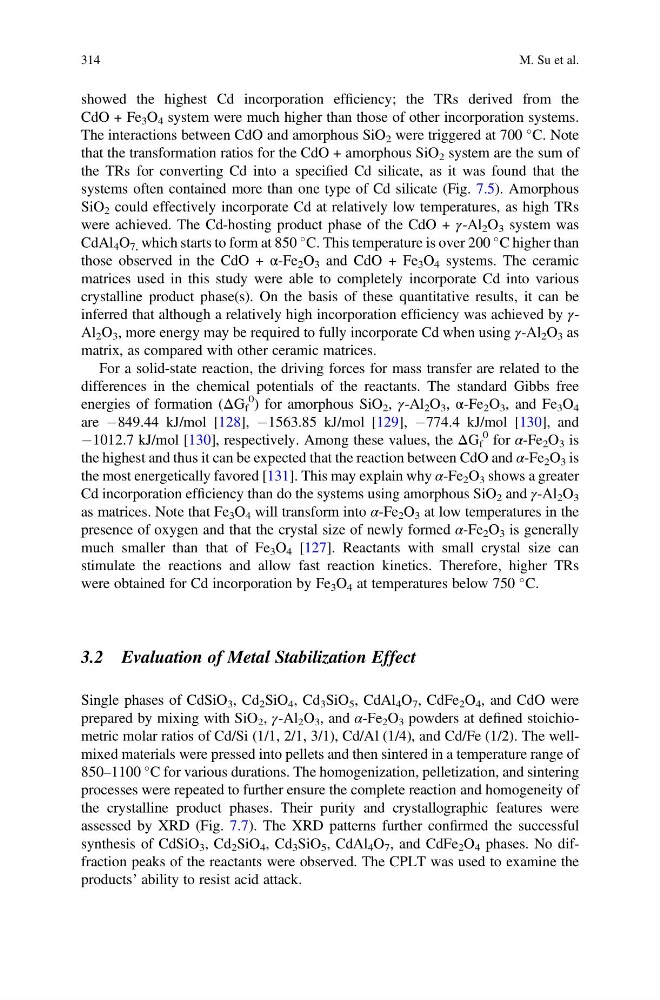
showed the highest Cd incorporation efficiency; the TRs derived from the
CdO + Fe 3 O 4 system were much higher than those of other incorporation systems.
The interactions between CdO and amorphous SiO 2 were triggered at 700
C. Note
that the transformation ratios for the CdO + amorphous SiO 2 system are the sum of
the TRs for converting Cd into a specified Cd silicate, as it was found that the
systems often contained more than one type of Cd silicate (Fig. 7.5). Amorphous
SiO 2 could effectively incorporate Cd at relatively low temperatures, as high TRs
were achieved. The Cd-hosting product phase of the CdO + γ-Al 2 O 3 system was
CdAl 4 O 7, which starts to form at 850
C. This temperature is over 200
C higher than
those observed in the CdO + α-Fe 2 O 3 and CdO + Fe 3 O 4 systems. The ceramic
matrices used in this study were able to completely incorporate Cd into various
crystalline product phase(s). On the basis of these quantitative results, it can be
inferred that although a relatively high incorporation efficiency was achieved by γAl 2 O 3 , more energy may be required to fully incorporate Cd when using γ-Al 2 O 3 as
matrix, as compared with other ceramic matrices.
For a solid-state reaction, the driving forces for mass transfer are related to the
differences in the chemical potentials of the reactants. The standard Gibbs free
energies of formation (ΔG f
0 ) for amorphous SiO 2 , γ-Al 2 O 3 , α-Fe 2 O 3 , and Fe 3 O 4
are À849.44 kJ/mol [128], À1563.85 kJ/mol [129], À774.4 kJ/mol [130], and
À1012.7 kJ/mol [130], respectively. Among these values, the ΔG f
0 for α-Fe 2 O 3 is
the highest and thus it can be expected that the reaction between CdO and α-Fe 2 O 3 is
the most energetically favored [131]. This may explain why α-Fe 2 O 3 shows a greater
Cd incorporation efficiency than do the systems using amorphous SiO 2 and γ-Al 2 O 3
as matrices. Note that Fe 3 O 4 will transform into α-Fe 2 O 3 at low temperatures in the
presence of oxygen and that the crystal size of newly formed α-Fe 2 O 3 is generally
much smaller than that of Fe 3 O 4 [127]. Reactants with small crystal size can
stimulate the reactions and allow fast reaction kinetics. Therefore, higher TRs
were obtained for Cd incorporation by Fe 3 O 4 at temperatures below 750
C.
3.2 Evaluation of Metal Stabilization Effect
Single phases of CdSiO 3 , Cd 2 SiO 4 , Cd 3 SiO 5 , CdAl 4 O 7 , CdFe 2 O 4 , and CdO were
prepared by mixing with SiO 2 , γ-Al 2 O 3 , and α-Fe 2 O 3 powders at defined stoichiometric molar ratios of Cd/Si (1/1, 2/1, 3/1), Cd/Al (1/4), and Cd/Fe (1/2). The wellmixed materials were pressed into pellets and then sintered in a temperature range of
850–1100
C for various durations. The homogenization, pelletization, and sintering
processes were repeated to further ensure the complete reaction and homogeneity of
the crystalline product phases. Their purity and crystallographic features were
assessed by XRD (Fig. 7.7). The XRD patterns further confirmed the successful
synthesis of CdSiO 3 , Cd 2 SiO 4 , Cd 3 SiO 5 , CdAl 4 O 7 , and CdFe 2 O 4 phases. No diffraction peaks of the reactants were observed. The CPLT was used to examine the
products’ ability to resist acid attack.
314
M. Su et al.
CdO + Fe 3 O 4 system were much higher than those of other incorporation systems.
The interactions between CdO and amorphous SiO 2 were triggered at 700
C. Note
that the transformation ratios for the CdO + amorphous SiO 2 system are the sum of
the TRs for converting Cd into a specified Cd silicate, as it was found that the
systems often contained more than one type of Cd silicate (Fig. 7.5). Amorphous
SiO 2 could effectively incorporate Cd at relatively low temperatures, as high TRs
were achieved. The Cd-hosting product phase of the CdO + γ-Al 2 O 3 system was
CdAl 4 O 7, which starts to form at 850
C. This temperature is over 200
C higher than
those observed in the CdO + α-Fe 2 O 3 and CdO + Fe 3 O 4 systems. The ceramic
matrices used in this study were able to completely incorporate Cd into various
crystalline product phase(s). On the basis of these quantitative results, it can be
inferred that although a relatively high incorporation efficiency was achieved by γAl 2 O 3 , more energy may be required to fully incorporate Cd when using γ-Al 2 O 3 as
matrix, as compared with other ceramic matrices.
For a solid-state reaction, the driving forces for mass transfer are related to the
differences in the chemical potentials of the reactants. The standard Gibbs free
energies of formation (ΔG f
0 ) for amorphous SiO 2 , γ-Al 2 O 3 , α-Fe 2 O 3 , and Fe 3 O 4
are À849.44 kJ/mol [128], À1563.85 kJ/mol [129], À774.4 kJ/mol [130], and
À1012.7 kJ/mol [130], respectively. Among these values, the ΔG f
0 for α-Fe 2 O 3 is
the highest and thus it can be expected that the reaction between CdO and α-Fe 2 O 3 is
the most energetically favored [131]. This may explain why α-Fe 2 O 3 shows a greater
Cd incorporation efficiency than do the systems using amorphous SiO 2 and γ-Al 2 O 3
as matrices. Note that Fe 3 O 4 will transform into α-Fe 2 O 3 at low temperatures in the
presence of oxygen and that the crystal size of newly formed α-Fe 2 O 3 is generally
much smaller than that of Fe 3 O 4 [127]. Reactants with small crystal size can
stimulate the reactions and allow fast reaction kinetics. Therefore, higher TRs
were obtained for Cd incorporation by Fe 3 O 4 at temperatures below 750
C.
3.2 Evaluation of Metal Stabilization Effect
Single phases of CdSiO 3 , Cd 2 SiO 4 , Cd 3 SiO 5 , CdAl 4 O 7 , CdFe 2 O 4 , and CdO were
prepared by mixing with SiO 2 , γ-Al 2 O 3 , and α-Fe 2 O 3 powders at defined stoichiometric molar ratios of Cd/Si (1/1, 2/1, 3/1), Cd/Al (1/4), and Cd/Fe (1/2). The wellmixed materials were pressed into pellets and then sintered in a temperature range of
850–1100
C for various durations. The homogenization, pelletization, and sintering
processes were repeated to further ensure the complete reaction and homogeneity of
the crystalline product phases. Their purity and crystallographic features were
assessed by XRD (Fig. 7.7). The XRD patterns further confirmed the successful
synthesis of CdSiO 3 , Cd 2 SiO 4 , Cd 3 SiO 5 , CdAl 4 O 7 , and CdFe 2 O 4 phases. No diffraction peaks of the reactants were observed. The CPLT was used to examine the
products’ ability to resist acid attack.
314
M. Su et al.