

(Fig. 7.5). For the system of CdO + SiO 2 , the Cd-hosting product phases were
identified to be monoclinic CdSiO 3 (Eq. 7.5), orthorhombic Cd 2 SiO 4 (Eq. 7.6), and
tetragonal Cd 3 SiO 5 (Eq. 7.7). The Cd incorporation by amorphous SiO 2 was highly
influenced by the mixing ratios of the raw materials and by the sintering temperature.
In the CdO + γ-Al 2 O 3 system, the product phase was only CdAl 4 O 7 with a monoclinic structure (Eq. 7.8), after 900
C treatment for 3 h [126]. In the CdO + α-Fe 2 O 3
and CdO + Fe 3 O 4 systems, only CdFe 2 O 4 spinel was formed as a Cd-hosting product
(Eq. 7.9) [127].
CdO þ SiO 2 ! CdSiO 3
ð7:5Þ
2CdO þ SiO 2 ! Cd 2 SiO 4
ð7:6Þ
3CdO þ SiO 2 ! Cd 3 SiO 5
ð7:7Þ
CdO þ 2γ‐Al 2 O 3 ! CdAl 4 O 7
ð7:8Þ
CdO þ α‐Fe 2 O 3 ! CdFe 2 O 4
ð7:9Þ
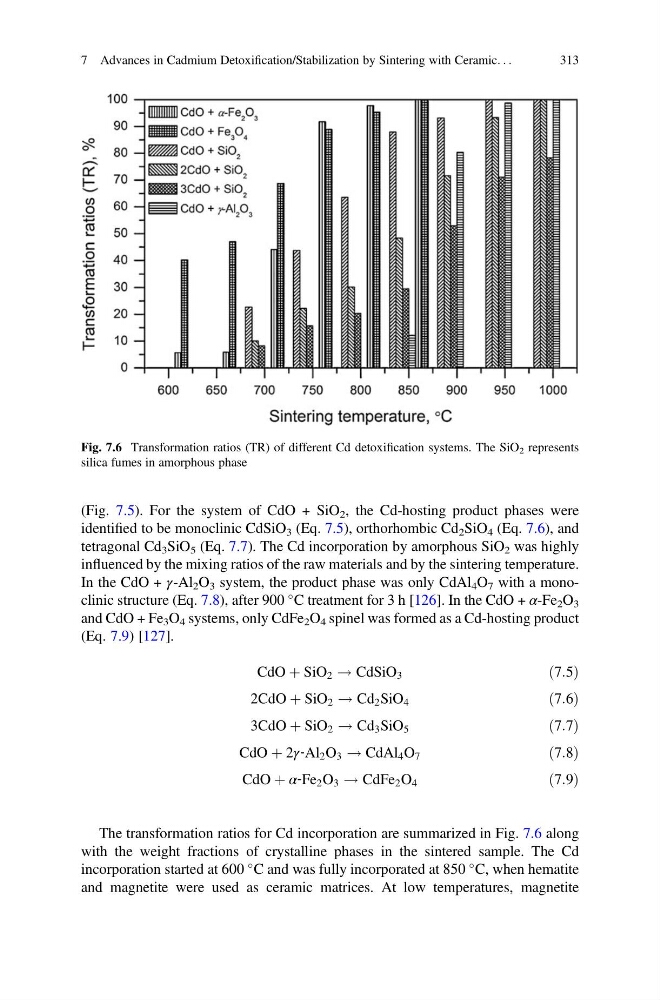
The transformation ratios for Cd incorporation are summarized in Fig. 7.6 along
with the weight fractions of crystalline phases in the sintered sample. The Cd
incorporation started at 600
C and was fully incorporated at 850
C, when hematite
and magnetite were used as ceramic matrices. At low temperatures, magnetite
Fig. 7.6 Transformation ratios (TR) of different Cd detoxification systems. The SiO 2 represents
silica fumes in amorphous phase
7 Advances in Cadmium Detoxification/Stabilization by Sintering with Ceramic. . .
313
identified to be monoclinic CdSiO 3 (Eq. 7.5), orthorhombic Cd 2 SiO 4 (Eq. 7.6), and
tetragonal Cd 3 SiO 5 (Eq. 7.7). The Cd incorporation by amorphous SiO 2 was highly
influenced by the mixing ratios of the raw materials and by the sintering temperature.
In the CdO + γ-Al 2 O 3 system, the product phase was only CdAl 4 O 7 with a monoclinic structure (Eq. 7.8), after 900
C treatment for 3 h [126]. In the CdO + α-Fe 2 O 3
and CdO + Fe 3 O 4 systems, only CdFe 2 O 4 spinel was formed as a Cd-hosting product
(Eq. 7.9) [127].
CdO þ SiO 2 ! CdSiO 3
ð7:5Þ
2CdO þ SiO 2 ! Cd 2 SiO 4
ð7:6Þ
3CdO þ SiO 2 ! Cd 3 SiO 5
ð7:7Þ
CdO þ 2γ‐Al 2 O 3 ! CdAl 4 O 7
ð7:8Þ
CdO þ α‐Fe 2 O 3 ! CdFe 2 O 4
ð7:9Þ
The transformation ratios for Cd incorporation are summarized in Fig. 7.6 along
with the weight fractions of crystalline phases in the sintered sample. The Cd
incorporation started at 600
C and was fully incorporated at 850
C, when hematite
and magnetite were used as ceramic matrices. At low temperatures, magnetite
Fig. 7.6 Transformation ratios (TR) of different Cd detoxification systems. The SiO 2 represents
silica fumes in amorphous phase
7 Advances in Cadmium Detoxification/Stabilization by Sintering with Ceramic. . .
313