

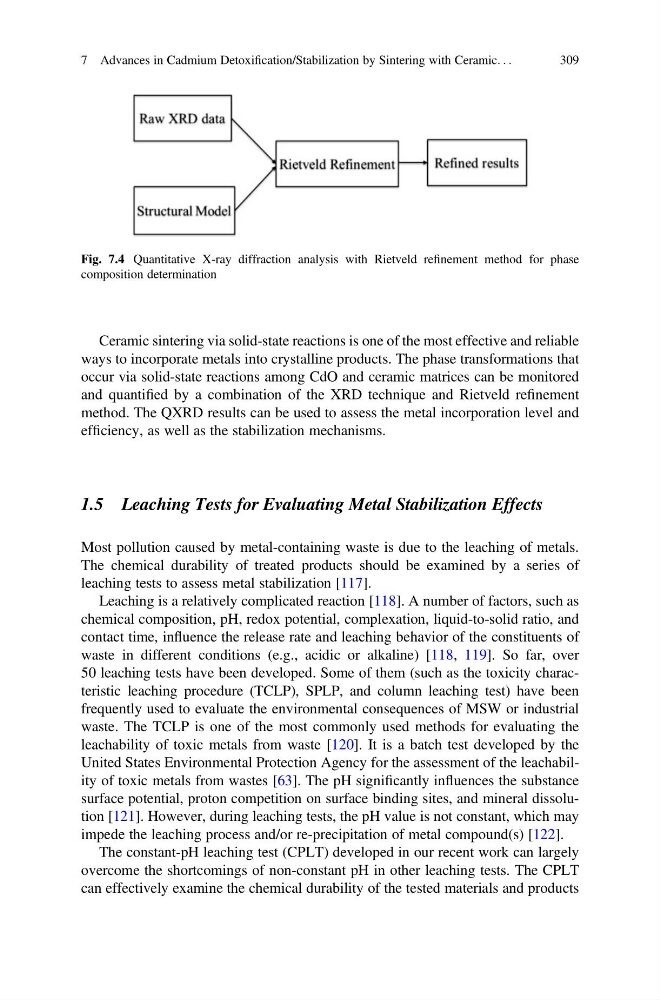
Ceramic sintering via solid-state reactions is one of the most effective and reliable
ways to incorporate metals into crystalline products. The phase transformations that
occur via solid-state reactions among CdO and ceramic matrices can be monitored
and quantified by a combination of the XRD technique and Rietveld refinement
method. The QXRD results can be used to assess the metal incorporation level and
efficiency, as well as the stabilization mechanisms.
1.5 Leaching Tests for Evaluating Metal Stabilization Effects
Most pollution caused by metal-containing waste is due to the leaching of metals.
The chemical durability of treated products should be examined by a series of
leaching tests to assess metal stabilization [117].
Leaching is a relatively complicated reaction [118]. A number of factors, such as
chemical composition, pH, redox potential, complexation, liquid-to-solid ratio, and
contact time, influence the release rate and leaching behavior of the constituents of
waste in different conditions (e.g., acidic or alkaline) [118, 119]. So far, over
50 leaching tests have been developed. Some of them (such as the toxicity characteristic leaching procedure (TCLP), SPLP, and column leaching test) have been
frequently used to evaluate the environmental consequences of MSW or industrial
waste. The TCLP is one of the most commonly used methods for evaluating the
leachability of toxic metals from waste [120]. It is a batch test developed by the
United States Environmental Protection Agency for the assessment of the leachability of toxic metals from wastes [63]. The pH significantly influences the substance
surface potential, proton competition on surface binding sites, and mineral dissolution [121]. However, during leaching tests, the pH value is not constant, which may
impede the leaching process and/or re-precipitation of metal compound(s) [122].
The constant-pH leaching test (CPLT) developed in our recent work can largely
overcome the shortcomings of non-constant pH in other leaching tests. The CPLT
can effectively examine the chemical durability of the tested materials and products
Fig. 7.4 Quantitative X-ray diffraction analysis with Rietveld refinement method for phase
composition determination
7 Advances in Cadmium Detoxification/Stabilization by Sintering with Ceramic. . .
309
ways to incorporate metals into crystalline products. The phase transformations that
occur via solid-state reactions among CdO and ceramic matrices can be monitored
and quantified by a combination of the XRD technique and Rietveld refinement
method. The QXRD results can be used to assess the metal incorporation level and
efficiency, as well as the stabilization mechanisms.
1.5 Leaching Tests for Evaluating Metal Stabilization Effects
Most pollution caused by metal-containing waste is due to the leaching of metals.
The chemical durability of treated products should be examined by a series of
leaching tests to assess metal stabilization [117].
Leaching is a relatively complicated reaction [118]. A number of factors, such as
chemical composition, pH, redox potential, complexation, liquid-to-solid ratio, and
contact time, influence the release rate and leaching behavior of the constituents of
waste in different conditions (e.g., acidic or alkaline) [118, 119]. So far, over
50 leaching tests have been developed. Some of them (such as the toxicity characteristic leaching procedure (TCLP), SPLP, and column leaching test) have been
frequently used to evaluate the environmental consequences of MSW or industrial
waste. The TCLP is one of the most commonly used methods for evaluating the
leachability of toxic metals from waste [120]. It is a batch test developed by the
United States Environmental Protection Agency for the assessment of the leachability of toxic metals from wastes [63]. The pH significantly influences the substance
surface potential, proton competition on surface binding sites, and mineral dissolution [121]. However, during leaching tests, the pH value is not constant, which may
impede the leaching process and/or re-precipitation of metal compound(s) [122].
The constant-pH leaching test (CPLT) developed in our recent work can largely
overcome the shortcomings of non-constant pH in other leaching tests. The CPLT
can effectively examine the chemical durability of the tested materials and products
Fig. 7.4 Quantitative X-ray diffraction analysis with Rietveld refinement method for phase
composition determination
7 Advances in Cadmium Detoxification/Stabilization by Sintering with Ceramic. . .
309