

Many models have been derived to correlate certain specific parameters with the
trophic state of a lake. However, two stand out as being quite reliable and simple.
These both relate total phosphorus loading to the trophic state of the lake as a
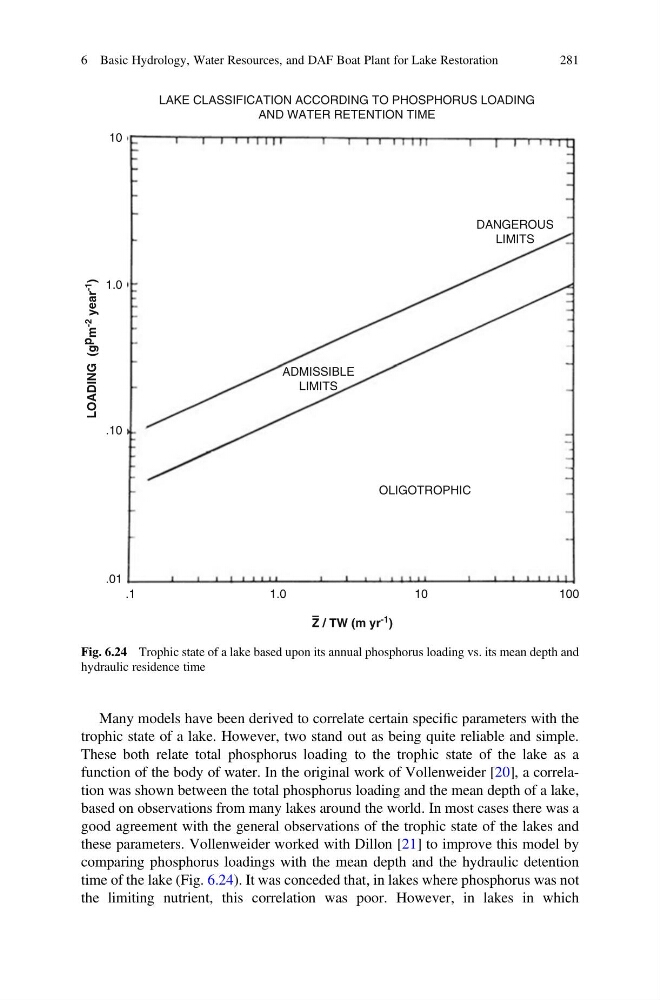
function of the body of water. In the original work of Vollenweider [20], a correlation was shown between the total phosphorus loading and the mean depth of a lake,
based on observations from many lakes around the world. In most cases there was a
good agreement with the general observations of the trophic state of the lakes and
these parameters. Vollenweider worked with Dillon [21] to improve this model by
comparing phosphorus loadings with the mean depth and the hydraulic detention
time of the lake (Fig. 6.24). It was conceded that, in lakes where phosphorus was not
the limiting nutrient, this correlation was poor. However, in lakes in which
.1
.01
10
100
Z / TW (m yr -1 )
–
LOADING (g p
m
-2
year
-1
)
.10
1.0
10
LAKE CLASSIFICATION ACCORDING TO PHOSPHORUS LOADING
AND WATER RETENTION TIME
DANGEROUS
LIMITS
ADMISSIBLE
LIMITS
OLIGOTROPHIC
1.0
Fig. 6.24 Trophic state of a lake based upon its annual phosphorus loading vs. its mean depth and
hydraulic residence time
6 Basic Hydrology, Water Resources, and DAF Boat Plant for Lake Restoration
281
trophic state of a lake. However, two stand out as being quite reliable and simple.
These both relate total phosphorus loading to the trophic state of the lake as a
function of the body of water. In the original work of Vollenweider [20], a correlation was shown between the total phosphorus loading and the mean depth of a lake,
based on observations from many lakes around the world. In most cases there was a
good agreement with the general observations of the trophic state of the lakes and
these parameters. Vollenweider worked with Dillon [21] to improve this model by
comparing phosphorus loadings with the mean depth and the hydraulic detention
time of the lake (Fig. 6.24). It was conceded that, in lakes where phosphorus was not
the limiting nutrient, this correlation was poor. However, in lakes in which
.1
.01
10
100
Z / TW (m yr -1 )
–
LOADING (g p
m
-2
year
-1
)
.10
1.0
10
LAKE CLASSIFICATION ACCORDING TO PHOSPHORUS LOADING
AND WATER RETENTION TIME
DANGEROUS
LIMITS
ADMISSIBLE
LIMITS
OLIGOTROPHIC
1.0
Fig. 6.24 Trophic state of a lake based upon its annual phosphorus loading vs. its mean depth and
hydraulic residence time
6 Basic Hydrology, Water Resources, and DAF Boat Plant for Lake Restoration
281