

fixation that may be needed in most lakes. Thus phosphorus has received the greatest
attention in terms of a method for controlling excessive productivity. It has been
shown that controlling phosphorus to concentrations of less than 10 μg/L at the time
of spring overturn, and 5 μg/L under summer growing conditions, will result in the
control of excess productivity in most lakes [18].
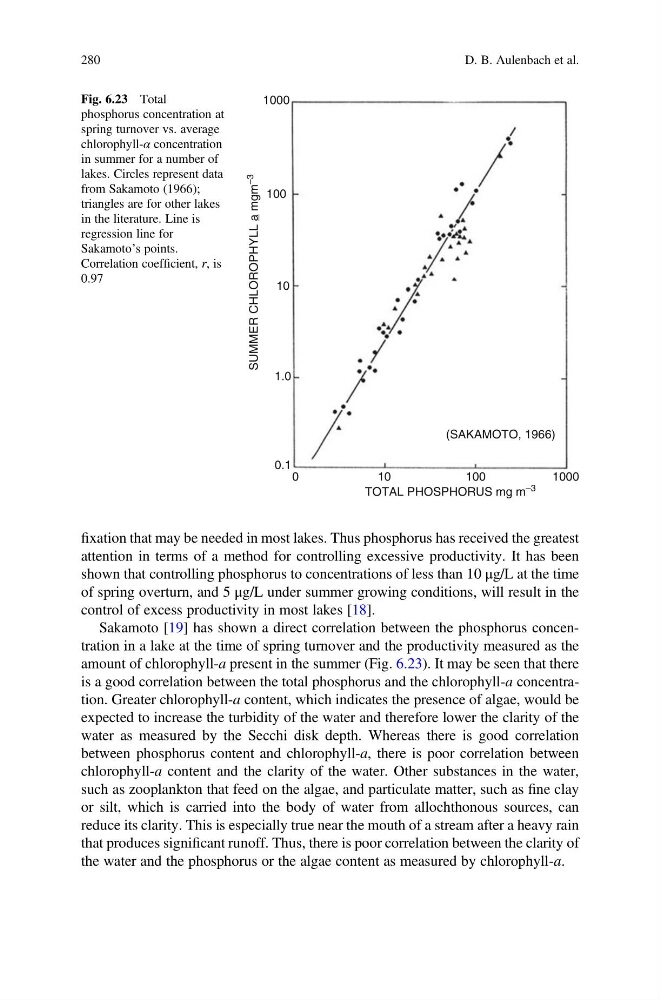
Sakamoto [19] has shown a direct correlation between the phosphorus concentration in a lake at the time of spring turnover and the productivity measured as the
amount of chlorophyll-a present in the summer (Fig. 6.23). It may be seen that there
is a good correlation between the total phosphorus and the chlorophyll-a concentration. Greater chlorophyll-a content, which indicates the presence of algae, would be
expected to increase the turbidity of the water and therefore lower the clarity of the
water as measured by the Secchi disk depth. Whereas there is good correlation
between phosphorus content and chlorophyll-a, there is poor correlation between
chlorophyll-a content and the clarity of the water. Other substances in the water,
such as zooplankton that feed on the algae, and particulate matter, such as fine clay
or silt, which is carried into the body of water from allochthonous sources, can
reduce its clarity. This is especially true near the mouth of a stream after a heavy rain
that produces significant runoff. Thus, there is poor correlation between the clarity of
the water and the phosphorus or the algae content as measured by chlorophyll-a.
0
1 0
10
1.0
0.1
TOTAL PHOSPHORUS mg m
–3
SUMMER CHLOROPHYLL a mgm
–3
(SAKAMOTO, 1966)
100
100
1000
1000
Fig. 6.23 Total
phosphorus concentration at
spring turnover vs. average
chlorophyll-α concentration
in summer for a number of
lakes. Circles represent data
from Sakamoto (1966);
triangles are for other lakes
in the literature. Line is
regression line for
Sakamoto’s points.
Correlation coefficient, r, is
0.97
280
D. B. Aulenbach et al.
attention in terms of a method for controlling excessive productivity. It has been
shown that controlling phosphorus to concentrations of less than 10 μg/L at the time
of spring overturn, and 5 μg/L under summer growing conditions, will result in the
control of excess productivity in most lakes [18].
Sakamoto [19] has shown a direct correlation between the phosphorus concentration in a lake at the time of spring turnover and the productivity measured as the
amount of chlorophyll-a present in the summer (Fig. 6.23). It may be seen that there
is a good correlation between the total phosphorus and the chlorophyll-a concentration. Greater chlorophyll-a content, which indicates the presence of algae, would be
expected to increase the turbidity of the water and therefore lower the clarity of the
water as measured by the Secchi disk depth. Whereas there is good correlation
between phosphorus content and chlorophyll-a, there is poor correlation between
chlorophyll-a content and the clarity of the water. Other substances in the water,
such as zooplankton that feed on the algae, and particulate matter, such as fine clay
or silt, which is carried into the body of water from allochthonous sources, can
reduce its clarity. This is especially true near the mouth of a stream after a heavy rain
that produces significant runoff. Thus, there is poor correlation between the clarity of
the water and the phosphorus or the algae content as measured by chlorophyll-a.
0
1 0
10
1.0
0.1
TOTAL PHOSPHORUS mg m
–3
SUMMER CHLOROPHYLL a mgm
–3
(SAKAMOTO, 1966)
100
100
1000
1000
Fig. 6.23 Total
phosphorus concentration at
spring turnover vs. average
chlorophyll-α concentration
in summer for a number of
lakes. Circles represent data
from Sakamoto (1966);
triangles are for other lakes
in the literature. Line is
regression line for
Sakamoto’s points.
Correlation coefficient, r, is
0.97
280
D. B. Aulenbach et al.