

occurs when a storm occurs shortly after a previous storm that has saturated the
ground with water. Then a greater portion of the new precipitation occurs as runoff
instead of infiltration.
There are numerous methods available for estimating storm runoff. The statistical
method implies a Type III Pearsonian family curve. This is valid when large amounts
of data are available from previous runoff data. Frequently insufficient data are
available and other methods must be used to estimate the storm runoff.
The most common method for measuring runoff is the rational method using the
equation:
Q ¼ CiA
ð6:7Þ
Q ¼ the rate of runoff at a given location and time.
C ¼ the coefficient of runoff, which is equal to the ratio of runoff to precipitation
for the individual area at a specific time and usually averages about 0.3.
However, if there was a recent antecedent storm that has saturated the ground,
the value may approach 0.9, and it may be greater than 1 with melting ice
and snow.
i ¼ the average intensity of rainfall for the specified period of time and may be
expressed as cm/h (in/h). It may also be calculated by the equation:
i ¼
KF
x
a þ t n
in which K ¼ 5–50, a ¼ 0–30, n ¼ 0.5–1.0, and x ¼ 0.1–0.5. All of the values K, a,
n, and x vary with geographical location. F is the recurrence interval or frequency in
RUNOFF
TIME
0 1 2 3 4 5
6 7 8
9 10
t c
Area increasing
Intensity decreasing
Area constant
Intensity decreasing
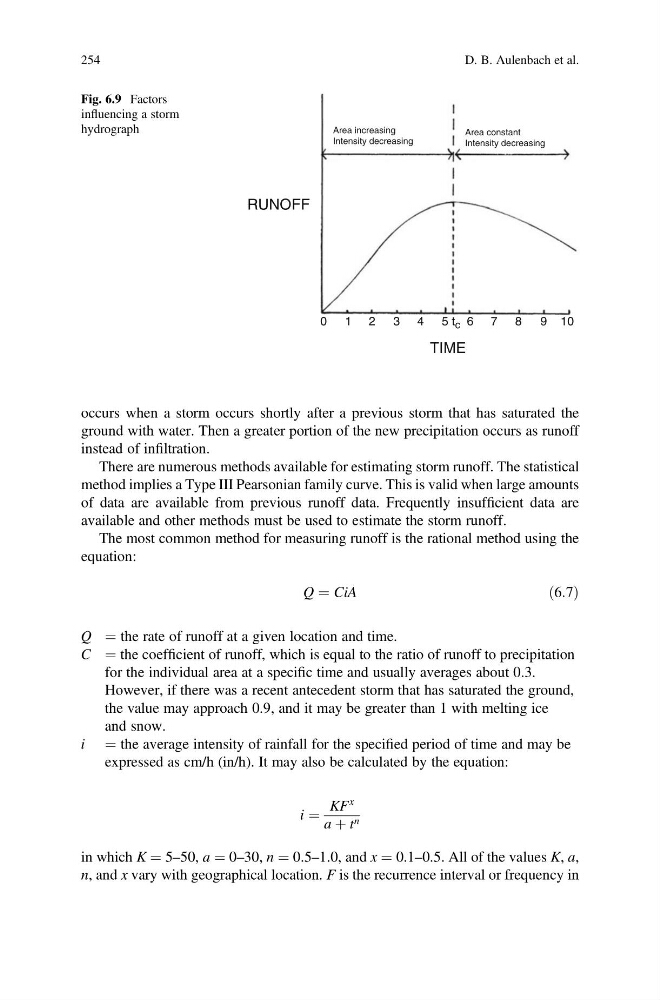
Fig. 6.9 Factors
influencing a storm
hydrograph
254
D. B. Aulenbach et al.
ground with water. Then a greater portion of the new precipitation occurs as runoff
instead of infiltration.
There are numerous methods available for estimating storm runoff. The statistical
method implies a Type III Pearsonian family curve. This is valid when large amounts
of data are available from previous runoff data. Frequently insufficient data are
available and other methods must be used to estimate the storm runoff.
The most common method for measuring runoff is the rational method using the
equation:
Q ¼ CiA
ð6:7Þ
Q ¼ the rate of runoff at a given location and time.
C ¼ the coefficient of runoff, which is equal to the ratio of runoff to precipitation
for the individual area at a specific time and usually averages about 0.3.
However, if there was a recent antecedent storm that has saturated the ground,
the value may approach 0.9, and it may be greater than 1 with melting ice
and snow.
i ¼ the average intensity of rainfall for the specified period of time and may be
expressed as cm/h (in/h). It may also be calculated by the equation:
i ¼
KF
x
a þ t n
in which K ¼ 5–50, a ¼ 0–30, n ¼ 0.5–1.0, and x ¼ 0.1–0.5. All of the values K, a,
n, and x vary with geographical location. F is the recurrence interval or frequency in
RUNOFF
TIME
0 1 2 3 4 5
6 7 8
9 10
t c
Area increasing
Intensity decreasing
Area constant
Intensity decreasing
Fig. 6.9 Factors
influencing a storm
hydrograph
254
D. B. Aulenbach et al.