

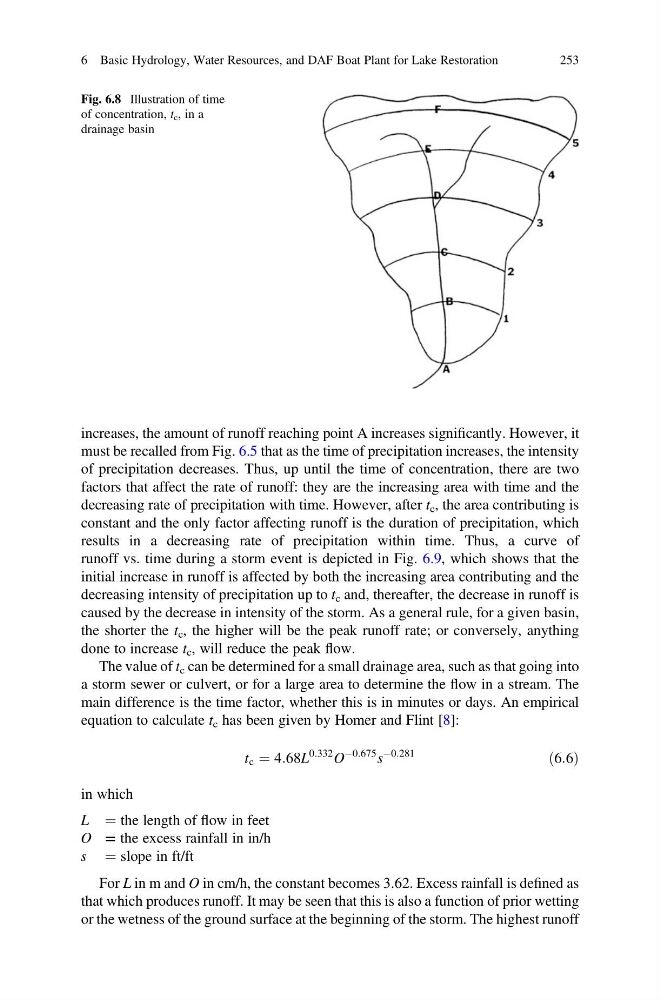
increases, the amount of runoff reaching point A increases significantly. However, it
must be recalled from Fig. 6.5 that as the time of precipitation increases, the intensity
of precipitation decreases. Thus, up until the time of concentration, there are two
factors that affect the rate of runoff: they are the increasing area with time and the
decreasing rate of precipitation with time. However, after t c , the area contributing is
constant and the only factor affecting runoff is the duration of precipitation, which
results in a decreasing rate of precipitation within time. Thus, a curve of
runoff vs. time during a storm event is depicted in Fig. 6.9, which shows that the
initial increase in runoff is affected by both the increasing area contributing and the
decreasing intensity of precipitation up to t c and, thereafter, the decrease in runoff is
caused by the decrease in intensity of the storm. As a general rule, for a given basin,
the shorter the t c , the higher will be the peak runoff rate; or conversely, anything
done to increase t c , will reduce the peak flow.
The value of t c can be determined for a small drainage area, such as that going into
a storm sewer or culvert, or for a large area to determine the flow in a stream. The
main difference is the time factor, whether this is in minutes or days. An empirical
equation to calculate t c has been given by Homer and Flint [8]:
t c ¼ 4:68L
0:332 O
À0:675 s
À0:281
ð6:6Þ
in which
L ¼ the length of flow in feet
O = the excess rainfall in in/h
s ¼ slope in ft/ft
For L in m and O in cm/h, the constant becomes 3.62. Excess rainfall is defined as
that which produces runoff. It may be seen that this is also a function of prior wetting
or the wetness of the ground surface at the beginning of the storm. The highest runoff
Fig. 6.8 Illustration of time
of concentration, t c , in a
drainage basin
6 Basic Hydrology, Water Resources, and DAF Boat Plant for Lake Restoration
253
must be recalled from Fig. 6.5 that as the time of precipitation increases, the intensity
of precipitation decreases. Thus, up until the time of concentration, there are two
factors that affect the rate of runoff: they are the increasing area with time and the
decreasing rate of precipitation with time. However, after t c , the area contributing is
constant and the only factor affecting runoff is the duration of precipitation, which
results in a decreasing rate of precipitation within time. Thus, a curve of
runoff vs. time during a storm event is depicted in Fig. 6.9, which shows that the
initial increase in runoff is affected by both the increasing area contributing and the
decreasing intensity of precipitation up to t c and, thereafter, the decrease in runoff is
caused by the decrease in intensity of the storm. As a general rule, for a given basin,
the shorter the t c , the higher will be the peak runoff rate; or conversely, anything
done to increase t c , will reduce the peak flow.
The value of t c can be determined for a small drainage area, such as that going into
a storm sewer or culvert, or for a large area to determine the flow in a stream. The
main difference is the time factor, whether this is in minutes or days. An empirical
equation to calculate t c has been given by Homer and Flint [8]:
t c ¼ 4:68L
0:332 O
À0:675 s
À0:281
ð6:6Þ
in which
L ¼ the length of flow in feet
O = the excess rainfall in in/h
s ¼ slope in ft/ft
For L in m and O in cm/h, the constant becomes 3.62. Excess rainfall is defined as
that which produces runoff. It may be seen that this is also a function of prior wetting
or the wetness of the ground surface at the beginning of the storm. The highest runoff
Fig. 6.8 Illustration of time
of concentration, t c , in a
drainage basin
6 Basic Hydrology, Water Resources, and DAF Boat Plant for Lake Restoration
253