

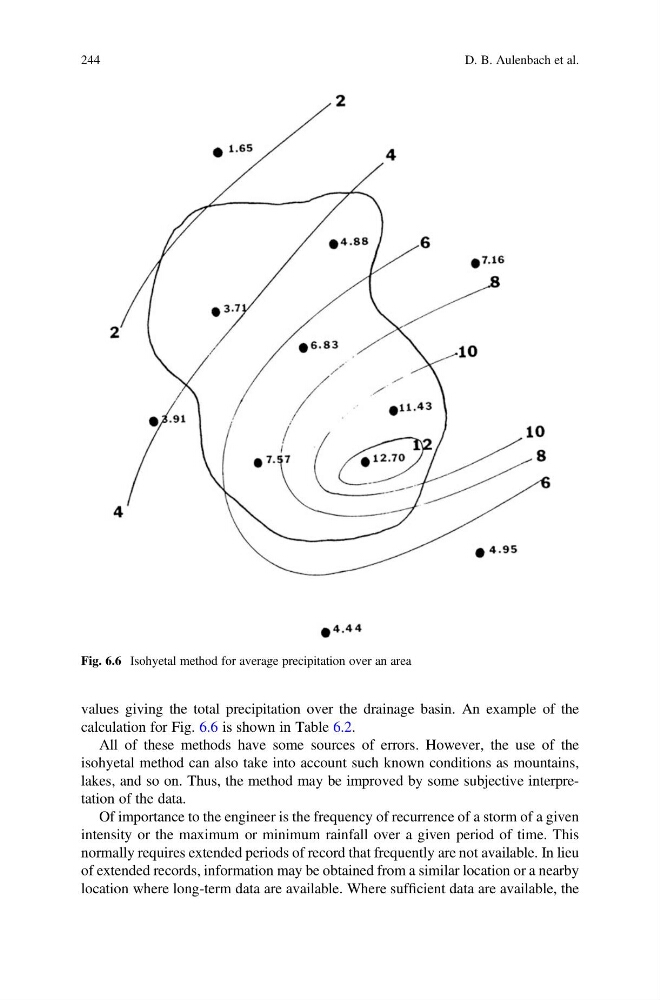
values giving the total precipitation over the drainage basin. An example of the
calculation for Fig. 6.6 is shown in Table 6.2.
All of these methods have some sources of errors. However, the use of the
isohyetal method can also take into account such known conditions as mountains,
lakes, and so on. Thus, the method may be improved by some subjective interpretation of the data.
Of importance to the engineer is the frequency of recurrence of a storm of a given
intensity or the maximum or minimum rainfall over a given period of time. This
normally requires extended periods of record that frequently are not available. In lieu
of extended records, information may be obtained from a similar location or a nearby
location where long-term data are available. Where sufficient data are available, the
Fig. 6.6 Isohyetal method for average precipitation over an area
244
D. B. Aulenbach et al.
calculation for Fig. 6.6 is shown in Table 6.2.
All of these methods have some sources of errors. However, the use of the
isohyetal method can also take into account such known conditions as mountains,
lakes, and so on. Thus, the method may be improved by some subjective interpretation of the data.
Of importance to the engineer is the frequency of recurrence of a storm of a given
intensity or the maximum or minimum rainfall over a given period of time. This
normally requires extended periods of record that frequently are not available. In lieu
of extended records, information may be obtained from a similar location or a nearby
location where long-term data are available. Where sufficient data are available, the
Fig. 6.6 Isohyetal method for average precipitation over an area
244
D. B. Aulenbach et al.