

3.8.7 Legionnaires’ Disease
Legionnaires’ is a form of pneumonia. The bacterium that causes this disease will
flourish in cooling tower water if conditions are favorable [18, 28]. As no amount of
drift elimination will prevent sub-micron particles of water from leaving a cooling
tower, it is important to stress that a proper water control program be followed for
normal cooling tower operation. As previously noted, a qualified water treatment
service company should be engaged to assure that such bacterial growth is prevented
in the operations of a cooling tower. To prevent airborne Legionnaires’ and other
diseases, the cooling water can be treated by specially formulated chemicals [18],
filtration, copper ionization, UV [15], ozone [10, 14–17], or dissolved air-ozone
flotation [19]. Controlling hydrogen sulfide emissions from cooling tower water has
been discussed by Nagl [20]. Center for Disease and Control and Prevention (CDC)
has developed program to implementing control measures for corrective actions to
control the development of legionella species in cooling towers and other water
using units. These measures are implemented when temperature and disinfectant
control levels are not met in the cooling towers [29].
3.8.8 Reuse of Thermal Discharges
Reclaimed water (reuse) from Miami-Dade County, Florida, will be used for cooling
after additional treatment for the two new nuclear units at Turkey Point Power Plant.
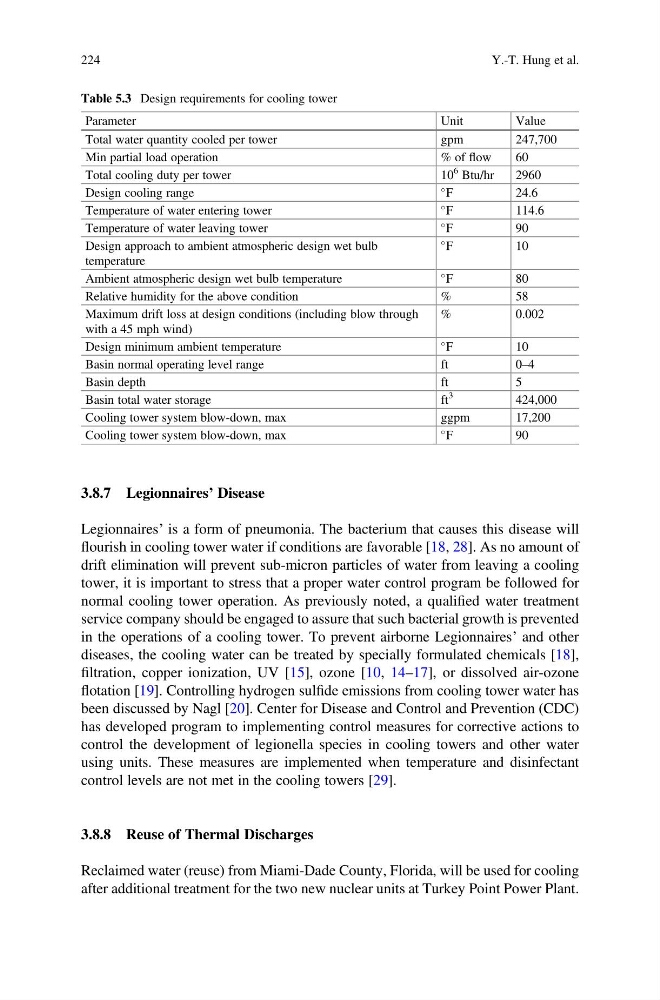
Table 5.3 Design requirements for cooling tower
Parameter
Unit
Value
Total water quantity cooled per tower
gpm
247,700
Min partial load operation
% of flow
60
Total cooling duty per tower
10
6 Btu/hr
2960
Design cooling range
F
24.6
Temperature of water entering tower
F
114.6
Temperature of water leaving tower
F
9 0
Design approach to ambient atmospheric design wet bulb
temperature
F
1 0
Ambient atmospheric design wet bulb temperature
F
8 0
Relative humidity for the above condition
%
58
Maximum drift loss at design conditions (including blow through
with a 45 mph wind)
%
0.002
Design minimum ambient temperature
F
1 0
Basin normal operating level range
ft
0–4
Basin depth
ft
5
Basin total water storage
ft
3
424,000
Cooling tower system blow-down, max
ggpm
17,200
Cooling tower system blow-down, max
F
9 0
224
Y.-T. Hung et al.
Legionnaires’ is a form of pneumonia. The bacterium that causes this disease will
flourish in cooling tower water if conditions are favorable [18, 28]. As no amount of
drift elimination will prevent sub-micron particles of water from leaving a cooling
tower, it is important to stress that a proper water control program be followed for
normal cooling tower operation. As previously noted, a qualified water treatment
service company should be engaged to assure that such bacterial growth is prevented
in the operations of a cooling tower. To prevent airborne Legionnaires’ and other
diseases, the cooling water can be treated by specially formulated chemicals [18],
filtration, copper ionization, UV [15], ozone [10, 14–17], or dissolved air-ozone
flotation [19]. Controlling hydrogen sulfide emissions from cooling tower water has
been discussed by Nagl [20]. Center for Disease and Control and Prevention (CDC)
has developed program to implementing control measures for corrective actions to
control the development of legionella species in cooling towers and other water
using units. These measures are implemented when temperature and disinfectant
control levels are not met in the cooling towers [29].
3.8.8 Reuse of Thermal Discharges
Reclaimed water (reuse) from Miami-Dade County, Florida, will be used for cooling
after additional treatment for the two new nuclear units at Turkey Point Power Plant.
Table 5.3 Design requirements for cooling tower
Parameter
Unit
Value
Total water quantity cooled per tower
gpm
247,700
Min partial load operation
% of flow
60
Total cooling duty per tower
10
6 Btu/hr
2960
Design cooling range
F
24.6
Temperature of water entering tower
F
114.6
Temperature of water leaving tower
F
9 0
Design approach to ambient atmospheric design wet bulb
temperature
F
1 0
Ambient atmospheric design wet bulb temperature
F
8 0
Relative humidity for the above condition
%
58
Maximum drift loss at design conditions (including blow through
with a 45 mph wind)
%
0.002
Design minimum ambient temperature
F
1 0
Basin normal operating level range
ft
0–4
Basin depth
ft
5
Basin total water storage
ft
3
424,000
Cooling tower system blow-down, max
ggpm
17,200
Cooling tower system blow-down, max
F
9 0
224
Y.-T. Hung et al.