

3.2 Highly Chlorinated Compounds
3.2.1 Polychlorinated Biphenyls (PCBs)
Polychlorinated biphenyls are a group of manufactured organic compounds that
include 209 different chemical forms known as congeners. This high number of
many different chemical forms is possible because from one to ten chlorine atoms
can attach to the carbon atoms that make up the basic chemical structure of this
family of compounds. PCBs are thermally stable and resistant to oxidation, acids,
bases, and other chemical agents. PCBs tend to be more soluble in lipid-based
solvents than in water; however, among the 209 congeners, there is a wide range
of water solubility and lipid solubility with the lesser chlorinated congeners being
more water soluble [9].
In the environment, PCBs can be contaminated with dibenzofurans, dioxins, and
polychlorinated naphthalenes. Since 1974, all PCB manufacturing has been banned
and previous use in electrical capacitors and transformers has been greatly reduced.
Because of their chemical-resistant properties, PCBs have persisted in the environment in large quantities despite the manufacturing ban. The primary routes of
potential human exposure to PCBs are ingestion of food and water as well as through
dermal contact. There is extensive human data which shows a strong association of
low birth weights and shortened gestation with PCB exposure in humans [18, 19]. In
addition, extensive neurologic testing of children who experienced exposure to
PCBs prior to birth revealed impaired motor function and learning disorders
[20]. Studies have indicated that PCBs concentrate in human breast milk.
PCB releases from prior industrial uses and the persistence of the compounds in
the environment have resulted in widespread water and soil contamination. They
have been found in at least 383 of the 1430 National Priorities List sites identified by
the USEPA [9]. The PCBs with a high degree of chlorination are resistant to
biodegradation and appear to be degraded very slowly in the environment. PCB
concentrations in water are higher for the lower chlorinated PCBs because of their
greater water solubility. PCBs have been found in runoff, sediments, soil, creek
water, leachate, underground oil-water layer, and pond effluents. Concentrations in
these locations have ranged from 4 to 440,000μg/L [9]. In water, small amounts of
PCBs may remain dissolved, but most adhere to organic particles and sediments.
PCBs in water bioaccumulate in fish and marine mammals and can reach levels
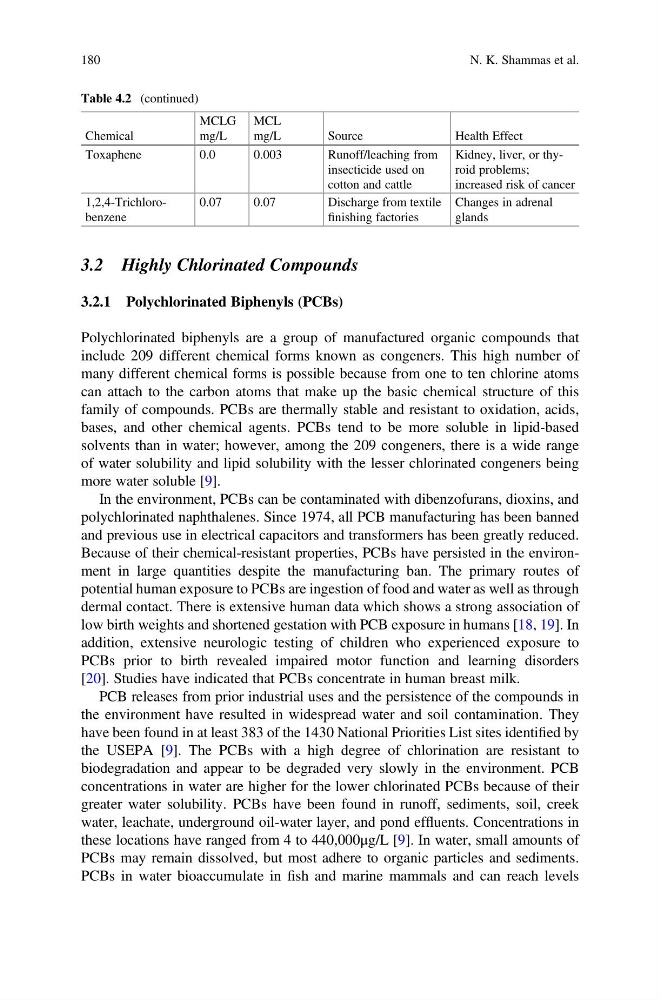
Table 4.2 (continued)
Chemical
MCLG
mg/L
MCL
mg/L
Source
Health Effect
Toxaphene
0.0
0.003
Runoff/leaching from
insecticide used on
cotton and cattle
Kidney, liver, or thyroid problems;
increased risk of cancer
1,2,4-Trichlorobenzene
0.07
0.07
Discharge from textile
finishing factories
Changes in adrenal
glands
180
N. K. Shammas et al.
3.2.1 Polychlorinated Biphenyls (PCBs)
Polychlorinated biphenyls are a group of manufactured organic compounds that
include 209 different chemical forms known as congeners. This high number of
many different chemical forms is possible because from one to ten chlorine atoms
can attach to the carbon atoms that make up the basic chemical structure of this
family of compounds. PCBs are thermally stable and resistant to oxidation, acids,
bases, and other chemical agents. PCBs tend to be more soluble in lipid-based
solvents than in water; however, among the 209 congeners, there is a wide range
of water solubility and lipid solubility with the lesser chlorinated congeners being
more water soluble [9].
In the environment, PCBs can be contaminated with dibenzofurans, dioxins, and
polychlorinated naphthalenes. Since 1974, all PCB manufacturing has been banned
and previous use in electrical capacitors and transformers has been greatly reduced.
Because of their chemical-resistant properties, PCBs have persisted in the environment in large quantities despite the manufacturing ban. The primary routes of
potential human exposure to PCBs are ingestion of food and water as well as through
dermal contact. There is extensive human data which shows a strong association of
low birth weights and shortened gestation with PCB exposure in humans [18, 19]. In
addition, extensive neurologic testing of children who experienced exposure to
PCBs prior to birth revealed impaired motor function and learning disorders
[20]. Studies have indicated that PCBs concentrate in human breast milk.
PCB releases from prior industrial uses and the persistence of the compounds in
the environment have resulted in widespread water and soil contamination. They
have been found in at least 383 of the 1430 National Priorities List sites identified by
the USEPA [9]. The PCBs with a high degree of chlorination are resistant to
biodegradation and appear to be degraded very slowly in the environment. PCB
concentrations in water are higher for the lower chlorinated PCBs because of their
greater water solubility. PCBs have been found in runoff, sediments, soil, creek
water, leachate, underground oil-water layer, and pond effluents. Concentrations in
these locations have ranged from 4 to 440,000μg/L [9]. In water, small amounts of
PCBs may remain dissolved, but most adhere to organic particles and sediments.
PCBs in water bioaccumulate in fish and marine mammals and can reach levels
Table 4.2 (continued)
Chemical
MCLG
mg/L
MCL
mg/L
Source
Health Effect
Toxaphene
0.0
0.003
Runoff/leaching from
insecticide used on
cotton and cattle
Kidney, liver, or thyroid problems;
increased risk of cancer
1,2,4-Trichlorobenzene
0.07
0.07
Discharge from textile
finishing factories
Changes in adrenal
glands
180
N. K. Shammas et al.