

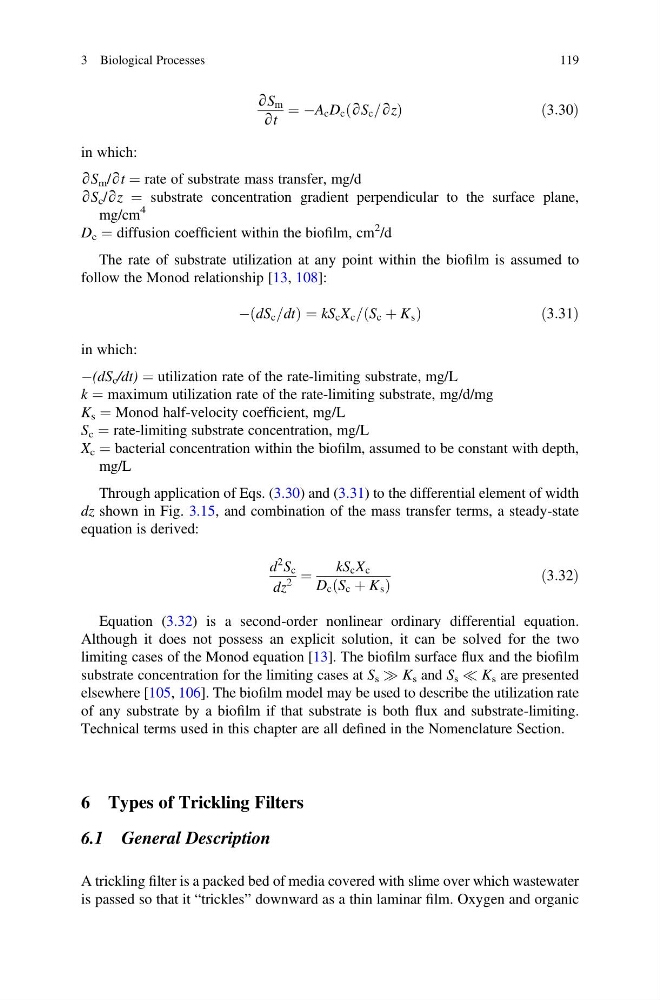
∂S m
∂t
¼ ÀA c D c ∂S c =∂z
ð
Þ
ð 3:30Þ
in which:
∂S m /∂t ¼ rate of substrate mass transfer, mg/d
∂S c /∂z ¼ substrate concentration gradient perpendicular to the surface plane,
mg/cm
4
D c ¼ diffusion coefficient within the biofilm, cm
2 /d
The rate of substrate utilization at any point within the biofilm is assumed to
follow the Monod relationship [13, 108]:
À dS c =dt
ð
Þ¼kS c X c = S c þ K s
ð
Þ
ð 3:31Þ
in which:
À(dS c /dt) ¼ utilization rate of the rate-limiting substrate, mg/L
k ¼ maximum utilization rate of the rate-limiting substrate, mg/d/mg
K s ¼ Monod half-velocity coefficient, mg/L
S c ¼ rate-limiting substrate concentration, mg/L
X c ¼ bacterial concentration within the biofilm, assumed to be constant with depth,
mg/L
Through application of Eqs. (3.30) and (3.31) to the differential element of width
dz shown in Fig. 3.15, and combination of the mass transfer terms, a steady-state
equation is derived:
d
2 S c
dz
2
¼
kS c X c
D c S c þ K s
ð
Þ
ð3:32Þ
Equation (3.32) is a second-order nonlinear ordinary differential equation.
Although it does not possess an explicit solution, it can be solved for the two
limiting cases of the Monod equation [13]. The biofilm surface flux and the biofilm
substrate concentration for the limiting cases at S s ) K s and S s ( K s are presented
elsewhere [105, 106]. The biofilm model may be used to describe the utilization rate
of any substrate by a biofilm if that substrate is both flux and substrate-limiting.
Technical terms used in this chapter are all defined in the Nomenclature Section.
6 Types of Trickling Filters
6.1 General Description
A trickling filter is a packed bed of media covered with slime over which wastewater
is passed so that it “trickles” downward as a thin laminar film. Oxygen and organic
3 Biological Processes
119
∂t
¼ ÀA c D c ∂S c =∂z
ð
Þ
ð 3:30Þ
in which:
∂S m /∂t ¼ rate of substrate mass transfer, mg/d
∂S c /∂z ¼ substrate concentration gradient perpendicular to the surface plane,
mg/cm
4
D c ¼ diffusion coefficient within the biofilm, cm
2 /d
The rate of substrate utilization at any point within the biofilm is assumed to
follow the Monod relationship [13, 108]:
À dS c =dt
ð
Þ¼kS c X c = S c þ K s
ð
Þ
ð 3:31Þ
in which:
À(dS c /dt) ¼ utilization rate of the rate-limiting substrate, mg/L
k ¼ maximum utilization rate of the rate-limiting substrate, mg/d/mg
K s ¼ Monod half-velocity coefficient, mg/L
S c ¼ rate-limiting substrate concentration, mg/L
X c ¼ bacterial concentration within the biofilm, assumed to be constant with depth,
mg/L
Through application of Eqs. (3.30) and (3.31) to the differential element of width
dz shown in Fig. 3.15, and combination of the mass transfer terms, a steady-state
equation is derived:
d
2 S c
dz
2
¼
kS c X c
D c S c þ K s
ð
Þ
ð3:32Þ
Equation (3.32) is a second-order nonlinear ordinary differential equation.
Although it does not possess an explicit solution, it can be solved for the two
limiting cases of the Monod equation [13]. The biofilm surface flux and the biofilm
substrate concentration for the limiting cases at S s ) K s and S s ( K s are presented
elsewhere [105, 106]. The biofilm model may be used to describe the utilization rate
of any substrate by a biofilm if that substrate is both flux and substrate-limiting.
Technical terms used in this chapter are all defined in the Nomenclature Section.
6 Types of Trickling Filters
6.1 General Description
A trickling filter is a packed bed of media covered with slime over which wastewater
is passed so that it “trickles” downward as a thin laminar film. Oxygen and organic
3 Biological Processes
119