

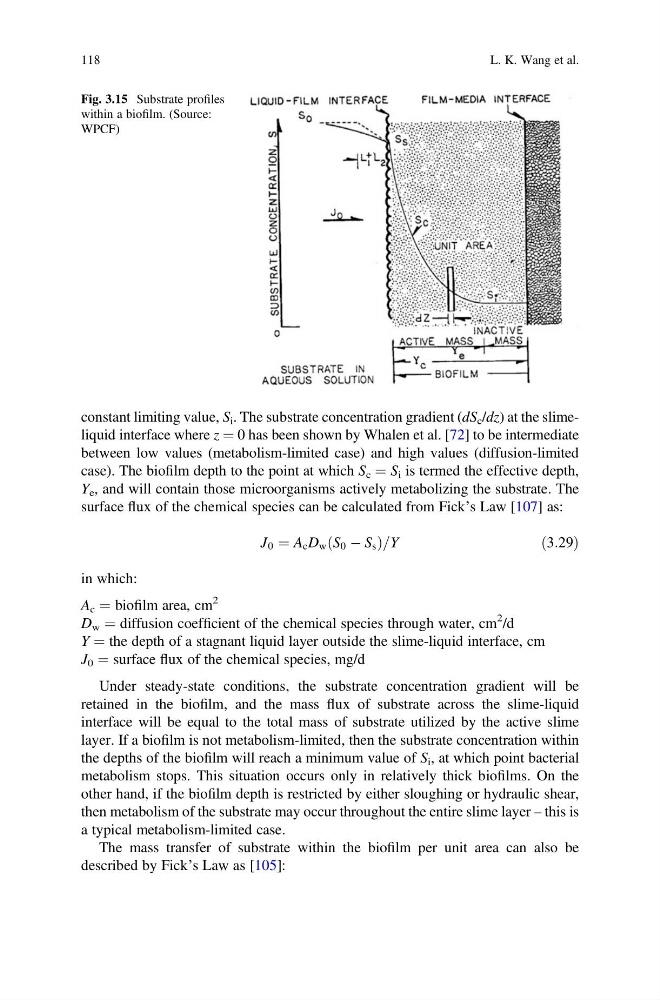
constant limiting value, S i . The substrate concentration gradient (dS c /dz) at the slimeliquid interface where z ¼ 0 has been shown by Whalen et al. [72] to be intermediate
between low values (metabolism-limited case) and high values (diffusion-limited
case). The biofilm depth to the point at which S c ¼ S i is termed the effective depth,
Y e , and will contain those microorganisms actively metabolizing the substrate. The
surface flux of the chemical species can be calculated from Fick’s Law [107] as:
J 0 ¼ A c D w S 0 À S s
ð
Þ=Y
ð3:29Þ
in which:
A c ¼ biofilm area, cm
2
D w ¼ diffusion coefficient of the chemical species through water, cm
2 /d
Y ¼ the depth of a stagnant liquid layer outside the slime-liquid interface, cm
J 0 ¼ surface flux of the chemical species, mg/d
Under steady-state conditions, the substrate concentration gradient will be
retained in the biofilm, and the mass flux of substrate across the slime-liquid
interface will be equal to the total mass of substrate utilized by the active slime
layer. If a biofilm is not metabolism-limited, then the substrate concentration within
the depths of the biofilm will reach a minimum value of S i , at which point bacterial
metabolism stops. This situation occurs only in relatively thick biofilms. On the
other hand, if the biofilm depth is restricted by either sloughing or hydraulic shear,
then metabolism of the substrate may occur throughout the entire slime layer – this is
a typical metabolism-limited case.
The mass transfer of substrate within the biofilm per unit area can also be
described by Fick’s Law as [105]:
Fig. 3.15 Substrate profiles
within a biofilm. (Source:
WPCF)
118
L. K. Wang et al.
between low values (metabolism-limited case) and high values (diffusion-limited
case). The biofilm depth to the point at which S c ¼ S i is termed the effective depth,
Y e , and will contain those microorganisms actively metabolizing the substrate. The
surface flux of the chemical species can be calculated from Fick’s Law [107] as:
J 0 ¼ A c D w S 0 À S s
ð
Þ=Y
ð3:29Þ
in which:
A c ¼ biofilm area, cm
2
D w ¼ diffusion coefficient of the chemical species through water, cm
2 /d
Y ¼ the depth of a stagnant liquid layer outside the slime-liquid interface, cm
J 0 ¼ surface flux of the chemical species, mg/d
Under steady-state conditions, the substrate concentration gradient will be
retained in the biofilm, and the mass flux of substrate across the slime-liquid
interface will be equal to the total mass of substrate utilized by the active slime
layer. If a biofilm is not metabolism-limited, then the substrate concentration within
the depths of the biofilm will reach a minimum value of S i , at which point bacterial
metabolism stops. This situation occurs only in relatively thick biofilms. On the
other hand, if the biofilm depth is restricted by either sloughing or hydraulic shear,
then metabolism of the substrate may occur throughout the entire slime layer – this is
a typical metabolism-limited case.
The mass transfer of substrate within the biofilm per unit area can also be
described by Fick’s Law as [105]:
Fig. 3.15 Substrate profiles
within a biofilm. (Source:
WPCF)
118
L. K. Wang et al.