

60
M. Vasilakaki et al.
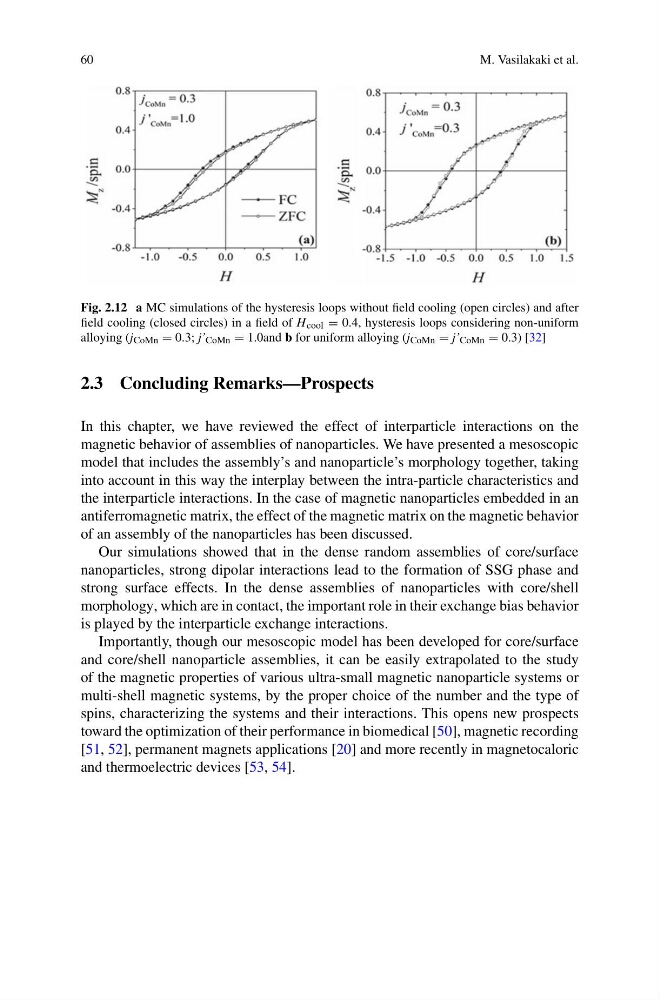
Fig. 2.12 a MC simulations of the hysteresis loops without field cooling (open circles) and after
field cooling (closed circles) in a field of H cool = 0.4, hysteresis loops considering non-uniform
alloying (j CoMn = 0.3; j’ CoMn = 1.0and b for uniform alloying (j CoMn = j’ CoMn = 0.3) [32]
2.3 Concluding Remarks—Prospects
In this chapter, we have reviewed the effect of interparticle interactions on the
magnetic behavior of assemblies of nanoparticles. We have presented a mesoscopic
model that includes the assembly’s and nanoparticle’s morphology together, taking
into account in this way the interplay between the intra-particle characteristics and
the interparticle interactions. In the case of magnetic nanoparticles embedded in an
antiferromagnetic matrix, the effect of the magnetic matrix on the magnetic behavior
of an assembly of the nanoparticles has been discussed.
Our simulations showed that in the dense random assemblies of core/surface
nanoparticles, strong dipolar interactions lead to the formation of SSG phase and
strong surface effects. In the dense assemblies of nanoparticles with core/shell
morphology, which are in contact, the important role in their exchange bias behavior
is played by the interparticle exchange interactions.
Importantly, though our mesoscopic model has been developed for core/surface
and core/shell nanoparticle assemblies, it can be easily extrapolated to the study
of the magnetic properties of various ultra-small magnetic nanoparticle systems or
multi-shell magnetic systems, by the proper choice of the number and the type of
spins, characterizing the systems and their interactions. This opens new prospects
toward the optimization of their performance in biomedical [50], magnetic recording
[51, 52], permanent magnets applications [20] and more recently in magnetocaloric
and thermoelectric devices [53, 54].
M. Vasilakaki et al.
Fig. 2.12 a MC simulations of the hysteresis loops without field cooling (open circles) and after
field cooling (closed circles) in a field of H cool = 0.4, hysteresis loops considering non-uniform
alloying (j CoMn = 0.3; j’ CoMn = 1.0and b for uniform alloying (j CoMn = j’ CoMn = 0.3) [32]
2.3 Concluding Remarks—Prospects
In this chapter, we have reviewed the effect of interparticle interactions on the
magnetic behavior of assemblies of nanoparticles. We have presented a mesoscopic
model that includes the assembly’s and nanoparticle’s morphology together, taking
into account in this way the interplay between the intra-particle characteristics and
the interparticle interactions. In the case of magnetic nanoparticles embedded in an
antiferromagnetic matrix, the effect of the magnetic matrix on the magnetic behavior
of an assembly of the nanoparticles has been discussed.
Our simulations showed that in the dense random assemblies of core/surface
nanoparticles, strong dipolar interactions lead to the formation of SSG phase and
strong surface effects. In the dense assemblies of nanoparticles with core/shell
morphology, which are in contact, the important role in their exchange bias behavior
is played by the interparticle exchange interactions.
Importantly, though our mesoscopic model has been developed for core/surface
and core/shell nanoparticle assemblies, it can be easily extrapolated to the study
of the magnetic properties of various ultra-small magnetic nanoparticle systems or
multi-shell magnetic systems, by the proper choice of the number and the type of
spins, characterizing the systems and their interactions. This opens new prospects
toward the optimization of their performance in biomedical [50], magnetic recording
[51, 52], permanent magnets applications [20] and more recently in magnetocaloric
and thermoelectric devices [53, 54].