

58
M. Vasilakaki et al.
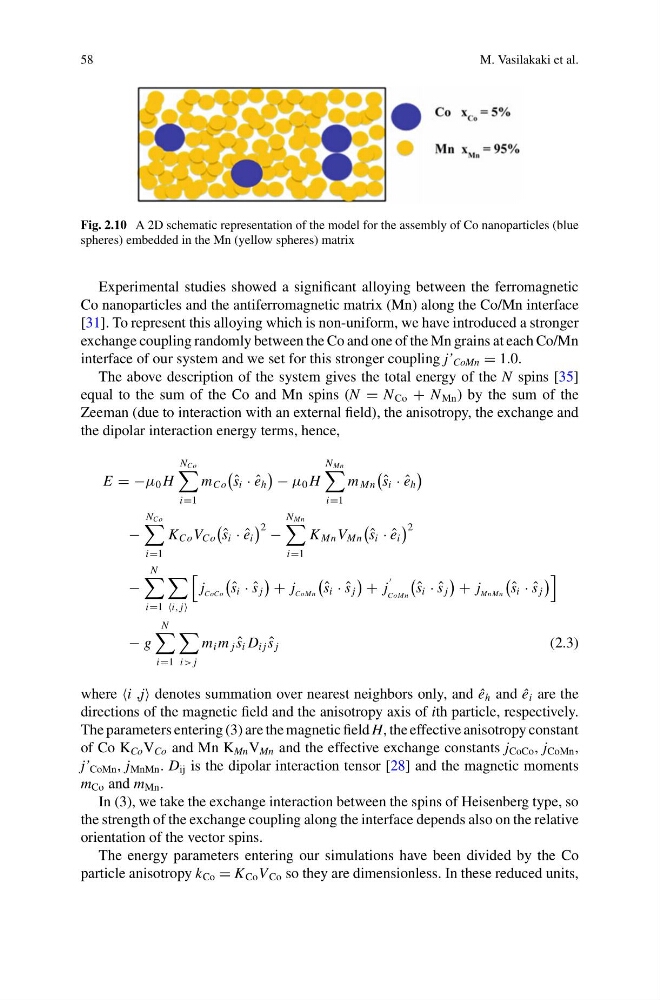
Fig. 2.10 A 2D schematic representation of the model for the assembly of Co nanoparticles (blue
spheres) embedded in the Mn (yellow spheres) matrix
Experimental studies showed a significant alloying between the ferromagnetic
Co nanoparticles and the antiferromagnetic matrix (Mn) along the Co/Mn interface
[31]. To represent this alloying which is non-uniform, we have introduced a stronger
exchange coupling randomly between the Co and one of the Mn grains at each Co/Mn
interface of our system and we set for this stronger coupling j’ CoMn = 1.0.
The above description of the system gives the total energy of the N spins [35]
equal to the sum of the Co and Mn spins (N = N Co + N Mn ) by the sum of the
Zeeman (due to interaction with an external field), the anisotropy, the exchange and
the dipolar interaction energy terms, hence,
E = −μ 0 H
N Co
i=1
m Co
ˆ
s i · ˆ
e h
− μ 0 H
N Mn
i=1
m Mn
ˆ
s i · ˆ
e h
−
N Co
i=1
K Co V Co
ˆ
s i · ˆ
e i
2 −
N Mn
i=1
K Mn V Mn
ˆ
s i · ˆ
e i
2
−
N
i=1
i, j
j CoCo
ˆ
s i · ˆ
s j
+ j CoMn
ˆ
s i · ˆ
s j
+ j
CoMn
ˆ
s i · ˆ
s j
+ j MnMn
ˆ
s i · ˆ
s j
− g
N
i=1
i> j
m i m j ˆ
s i D i j ˆ
s j
(2.3)
where i ,j denotes summation over nearest neighbors only, and ê h and ê i are the
directions of the magnetic field and the anisotropy axis of ith particle, respectively.
The parameters entering (3) are the magnetic field H, the effective anisotropy constant
of Co K Co V Co and Mn K Mn V Mn and the effective exchange constants j CoCo , j CoMn ,
j’ CoMn , j MnMn . D ij is the dipolar interaction tensor [28] and the magnetic moments
m Co and m Mn .
In (3), we take the exchange interaction between the spins of Heisenberg type, so
the strength of the exchange coupling along the interface depends also on the relative
orientation of the vector spins.
The energy parameters entering our simulations have been divided by the Co
particle anisotropy k Co = K Co V Co so they are dimensionless. In these reduced units,
M. Vasilakaki et al.
Fig. 2.10 A 2D schematic representation of the model for the assembly of Co nanoparticles (blue
spheres) embedded in the Mn (yellow spheres) matrix
Experimental studies showed a significant alloying between the ferromagnetic
Co nanoparticles and the antiferromagnetic matrix (Mn) along the Co/Mn interface
[31]. To represent this alloying which is non-uniform, we have introduced a stronger
exchange coupling randomly between the Co and one of the Mn grains at each Co/Mn
interface of our system and we set for this stronger coupling j’ CoMn = 1.0.
The above description of the system gives the total energy of the N spins [35]
equal to the sum of the Co and Mn spins (N = N Co + N Mn ) by the sum of the
Zeeman (due to interaction with an external field), the anisotropy, the exchange and
the dipolar interaction energy terms, hence,
E = −μ 0 H
N Co
i=1
m Co
ˆ
s i · ˆ
e h
− μ 0 H
N Mn
i=1
m Mn
ˆ
s i · ˆ
e h
−
N Co
i=1
K Co V Co
ˆ
s i · ˆ
e i
2 −
N Mn
i=1
K Mn V Mn
ˆ
s i · ˆ
e i
2
−
N
i=1
i, j
j CoCo
ˆ
s i · ˆ
s j
+ j CoMn
ˆ
s i · ˆ
s j
+ j
CoMn
ˆ
s i · ˆ
s j
+ j MnMn
ˆ
s i · ˆ
s j
− g
N
i=1
i> j
m i m j ˆ
s i D i j ˆ
s j
(2.3)
where i ,j denotes summation over nearest neighbors only, and ê h and ê i are the
directions of the magnetic field and the anisotropy axis of ith particle, respectively.
The parameters entering (3) are the magnetic field H, the effective anisotropy constant
of Co K Co V Co and Mn K Mn V Mn and the effective exchange constants j CoCo , j CoMn ,
j’ CoMn , j MnMn . D ij is the dipolar interaction tensor [28] and the magnetic moments
m Co and m Mn .
In (3), we take the exchange interaction between the spins of Heisenberg type, so
the strength of the exchange coupling along the interface depends also on the relative
orientation of the vector spins.
The energy parameters entering our simulations have been divided by the Co
particle anisotropy k Co = K Co V Co so they are dimensionless. In these reduced units,