

56
M. Vasilakaki et al.
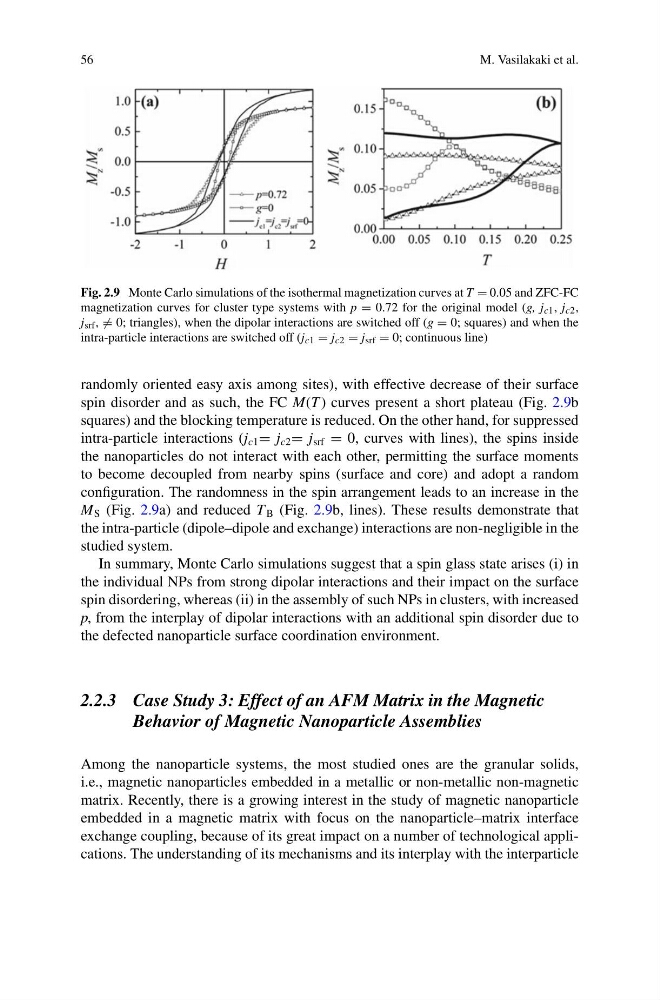
Fig. 2.9 Monte Carlo simulations of the isothermal magnetization curves at T = 0.05 and ZFC-FC
magnetization curves for cluster type systems with p = 0.72 for the original model (g, j c1 , j c2 ,
j srf , = 0; triangles), when the dipolar interactions are switched off (g = 0; squares) and when the
intra-particle interactions are switched off (j c1 = j c2 = j srf = 0; continuous line)
randomly oriented easy axis among sites), with effective decrease of their surface
spin disorder and as such, the FC M(T ) curves present a short plateau (Fig. 2.9b
squares) and the blocking temperature is reduced. On the other hand, for suppressed
intra-particle interactions (j c1 = j c2 = j srf = 0, curves with lines), the spins inside
the nanoparticles do not interact with each other, permitting the surface moments
to become decoupled from nearby spins (surface and core) and adopt a random
configuration. The randomness in the spin arrangement leads to an increase in the
M S (Fig. 2.9a) and reduced T B (Fig. 2.9b, lines). These results demonstrate that
the intra-particle (dipole–dipole and exchange) interactions are non-negligible in the
studied system.
In summary, Monte Carlo simulations suggest that a spin glass state arises (i) in
the individual NPs from strong dipolar interactions and their impact on the surface
spin disordering, whereas (ii) in the assembly of such NPs in clusters, with increased
p, from the interplay of dipolar interactions with an additional spin disorder due to
the defected nanoparticle surface coordination environment.
2.2.3 Case Study 3: Effect of an AFM Matrix in the Magnetic
Behavior of Magnetic Nanoparticle Assemblies
Among the nanoparticle systems, the most studied ones are the granular solids,
i.e., magnetic nanoparticles embedded in a metallic or non-metallic non-magnetic
matrix. Recently, there is a growing interest in the study of magnetic nanoparticle
embedded in a magnetic matrix with focus on the nanoparticle–matrix interface
exchange coupling, because of its great impact on a number of technological applications. The understanding of its mechanisms and its interplay with the interparticle
M. Vasilakaki et al.
Fig. 2.9 Monte Carlo simulations of the isothermal magnetization curves at T = 0.05 and ZFC-FC
magnetization curves for cluster type systems with p = 0.72 for the original model (g, j c1 , j c2 ,
j srf , = 0; triangles), when the dipolar interactions are switched off (g = 0; squares) and when the
intra-particle interactions are switched off (j c1 = j c2 = j srf = 0; continuous line)
randomly oriented easy axis among sites), with effective decrease of their surface
spin disorder and as such, the FC M(T ) curves present a short plateau (Fig. 2.9b
squares) and the blocking temperature is reduced. On the other hand, for suppressed
intra-particle interactions (j c1 = j c2 = j srf = 0, curves with lines), the spins inside
the nanoparticles do not interact with each other, permitting the surface moments
to become decoupled from nearby spins (surface and core) and adopt a random
configuration. The randomness in the spin arrangement leads to an increase in the
M S (Fig. 2.9a) and reduced T B (Fig. 2.9b, lines). These results demonstrate that
the intra-particle (dipole–dipole and exchange) interactions are non-negligible in the
studied system.
In summary, Monte Carlo simulations suggest that a spin glass state arises (i) in
the individual NPs from strong dipolar interactions and their impact on the surface
spin disordering, whereas (ii) in the assembly of such NPs in clusters, with increased
p, from the interplay of dipolar interactions with an additional spin disorder due to
the defected nanoparticle surface coordination environment.
2.2.3 Case Study 3: Effect of an AFM Matrix in the Magnetic
Behavior of Magnetic Nanoparticle Assemblies
Among the nanoparticle systems, the most studied ones are the granular solids,
i.e., magnetic nanoparticles embedded in a metallic or non-metallic non-magnetic
matrix. Recently, there is a growing interest in the study of magnetic nanoparticle
embedded in a magnetic matrix with focus on the nanoparticle–matrix interface
exchange coupling, because of its great impact on a number of technological applications. The understanding of its mechanisms and its interplay with the interparticle