

30
Ò. Iglesias and H. Kachkachi
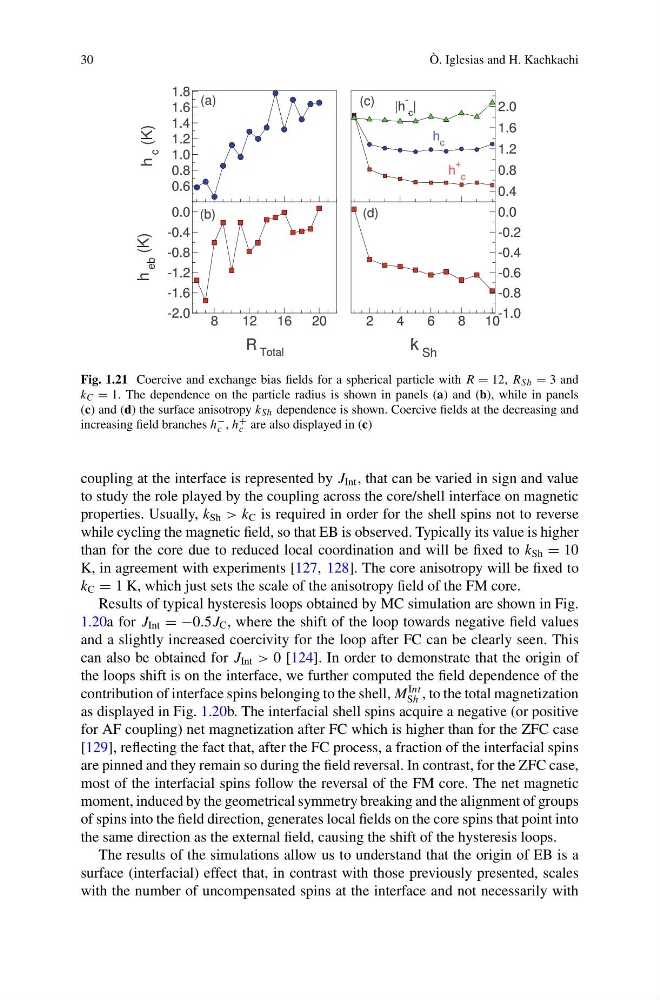
Fig. 1.21 Coercive and exchange bias fields for a spherical particle with R = 12, R Sh = 3 and
k C = 1. The dependence on the particle radius is shown in panels (a) and (b), while in panels
(c) and (d) the surface anisotropy k Sh dependence is shown. Coercive fields at the decreasing and
increasing field branches h −
c , h +
c are also displayed in (c)
coupling at the interface is represented by J Int , that can be varied in sign and value
to study the role played by the coupling across the core/shell interface on magnetic
properties. Usually, k Sh > k C is required in order for the shell spins not to reverse
while cycling the magnetic field, so that EB is observed. Typically its value is higher
than for the core due to reduced local coordination and will be fixed to k Sh = 10
K, in agreement with experiments [127, 128]. The core anisotropy will be fixed to
k C = 1 K, which just sets the scale of the anisotropy field of the FM core.
Results of typical hysteresis loops obtained by MC simulation are shown in Fig.
1.20a for J Int = −0.5J C , where the shift of the loop towards negative field values
and a slightly increased coercivity for the loop after FC can be clearly seen. This
can also be obtained for J Int > 0 [124]. In order to demonstrate that the origin of
the loops shift is on the interface, we further computed the field dependence of the
contribution of interface spins belonging to the shell, M
Int
Sh , to the total magnetization
as displayed in Fig. 1.20b. The interfacial shell spins acquire a negative (or positive
for AF coupling) net magnetization after FC which is higher than for the ZFC case
[129], reflecting the fact that, after the FC process, a fraction of the interfacial spins
are pinned and they remain so during the field reversal. In contrast, for the ZFC case,
most of the interfacial spins follow the reversal of the FM core. The net magnetic
moment, induced by the geometrical symmetry breaking and the alignment of groups
of spins into the field direction, generates local fields on the core spins that point into
the same direction as the external field, causing the shift of the hysteresis loops.
The results of the simulations allow us to understand that the origin of EB is a
surface (interfacial) effect that, in contrast with those previously presented, scales
with the number of uncompensated spins at the interface and not necessarily with
Ò. Iglesias and H. Kachkachi
Fig. 1.21 Coercive and exchange bias fields for a spherical particle with R = 12, R Sh = 3 and
k C = 1. The dependence on the particle radius is shown in panels (a) and (b), while in panels
(c) and (d) the surface anisotropy k Sh dependence is shown. Coercive fields at the decreasing and
increasing field branches h −
c , h +
c are also displayed in (c)
coupling at the interface is represented by J Int , that can be varied in sign and value
to study the role played by the coupling across the core/shell interface on magnetic
properties. Usually, k Sh > k C is required in order for the shell spins not to reverse
while cycling the magnetic field, so that EB is observed. Typically its value is higher
than for the core due to reduced local coordination and will be fixed to k Sh = 10
K, in agreement with experiments [127, 128]. The core anisotropy will be fixed to
k C = 1 K, which just sets the scale of the anisotropy field of the FM core.
Results of typical hysteresis loops obtained by MC simulation are shown in Fig.
1.20a for J Int = −0.5J C , where the shift of the loop towards negative field values
and a slightly increased coercivity for the loop after FC can be clearly seen. This
can also be obtained for J Int > 0 [124]. In order to demonstrate that the origin of
the loops shift is on the interface, we further computed the field dependence of the
contribution of interface spins belonging to the shell, M
Int
Sh , to the total magnetization
as displayed in Fig. 1.20b. The interfacial shell spins acquire a negative (or positive
for AF coupling) net magnetization after FC which is higher than for the ZFC case
[129], reflecting the fact that, after the FC process, a fraction of the interfacial spins
are pinned and they remain so during the field reversal. In contrast, for the ZFC case,
most of the interfacial spins follow the reversal of the FM core. The net magnetic
moment, induced by the geometrical symmetry breaking and the alignment of groups
of spins into the field direction, generates local fields on the core spins that point into
the same direction as the external field, causing the shift of the hysteresis loops.
The results of the simulations allow us to understand that the origin of EB is a
surface (interfacial) effect that, in contrast with those previously presented, scales
with the number of uncompensated spins at the interface and not necessarily with