

17 Nanocomposites for Permanent Magnets
423
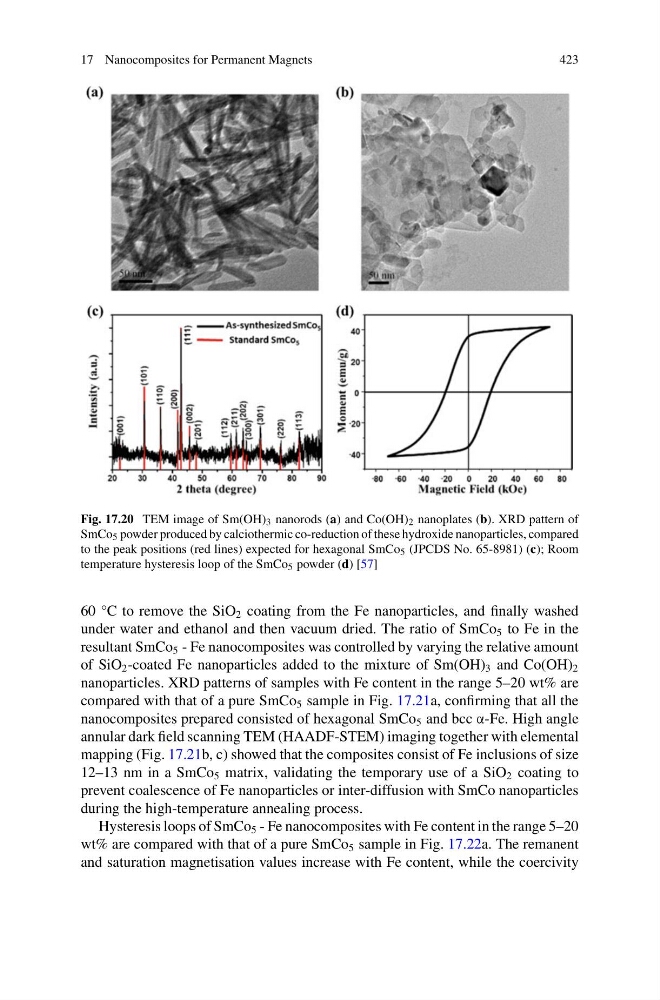
Fig. 17.20 TEM image of Sm(OH) 3 nanorods (a) and Co(OH) 2 nanoplates (b). XRD pattern of
SmCo 5 powder produced by calciothermic co-reduction of these hydroxide nanoparticles, compared
to the peak positions (red lines) expected for hexagonal SmCo 5 (JPCDS No. 65-8981) (c); Room
temperature hysteresis loop of the SmCo 5 powder (d) [57]
60 °C to remove the SiO 2 coating from the Fe nanoparticles, and finally washed
under water and ethanol and then vacuum dried. The ratio of SmCo 5 to Fe in the
resultant SmCo 5 - Fe nanocomposites was controlled by varying the relative amount
of SiO 2 -coated Fe nanoparticles added to the mixture of Sm(OH) 3 and Co(OH) 2
nanoparticles. XRD patterns of samples with Fe content in the range 5–20 wt% are
compared with that of a pure SmCo 5 sample in Fig. 17.21a, confirming that all the
nanocomposites prepared consisted of hexagonal SmCo 5 and bcc α-Fe. High angle
annular dark field scanning TEM (HAADF-STEM) imaging together with elemental
mapping (Fig. 17.21b, c) showed that the composites consist of Fe inclusions of size
12–13 nm in a SmCo 5 matrix, validating the temporary use of a SiO 2 coating to
prevent coalescence of Fe nanoparticles or inter-diffusion with SmCo nanoparticles
during the high-temperature annealing process.
Hysteresis loops of SmCo 5 - Fe nanocomposites with Fe content in the range 5–20
wt% are compared with that of a pure SmCo 5 sample in Fig. 17.22a. The remanent
and saturation magnetisation values increase with Fe content, while the coercivity
423
Fig. 17.20 TEM image of Sm(OH) 3 nanorods (a) and Co(OH) 2 nanoplates (b). XRD pattern of
SmCo 5 powder produced by calciothermic co-reduction of these hydroxide nanoparticles, compared
to the peak positions (red lines) expected for hexagonal SmCo 5 (JPCDS No. 65-8981) (c); Room
temperature hysteresis loop of the SmCo 5 powder (d) [57]
60 °C to remove the SiO 2 coating from the Fe nanoparticles, and finally washed
under water and ethanol and then vacuum dried. The ratio of SmCo 5 to Fe in the
resultant SmCo 5 - Fe nanocomposites was controlled by varying the relative amount
of SiO 2 -coated Fe nanoparticles added to the mixture of Sm(OH) 3 and Co(OH) 2
nanoparticles. XRD patterns of samples with Fe content in the range 5–20 wt% are
compared with that of a pure SmCo 5 sample in Fig. 17.21a, confirming that all the
nanocomposites prepared consisted of hexagonal SmCo 5 and bcc α-Fe. High angle
annular dark field scanning TEM (HAADF-STEM) imaging together with elemental
mapping (Fig. 17.21b, c) showed that the composites consist of Fe inclusions of size
12–13 nm in a SmCo 5 matrix, validating the temporary use of a SiO 2 coating to
prevent coalescence of Fe nanoparticles or inter-diffusion with SmCo nanoparticles
during the high-temperature annealing process.
Hysteresis loops of SmCo 5 - Fe nanocomposites with Fe content in the range 5–20
wt% are compared with that of a pure SmCo 5 sample in Fig. 17.22a. The remanent
and saturation magnetisation values increase with Fe content, while the coercivity