

420
I. de Moraes and N. M. Dempsey
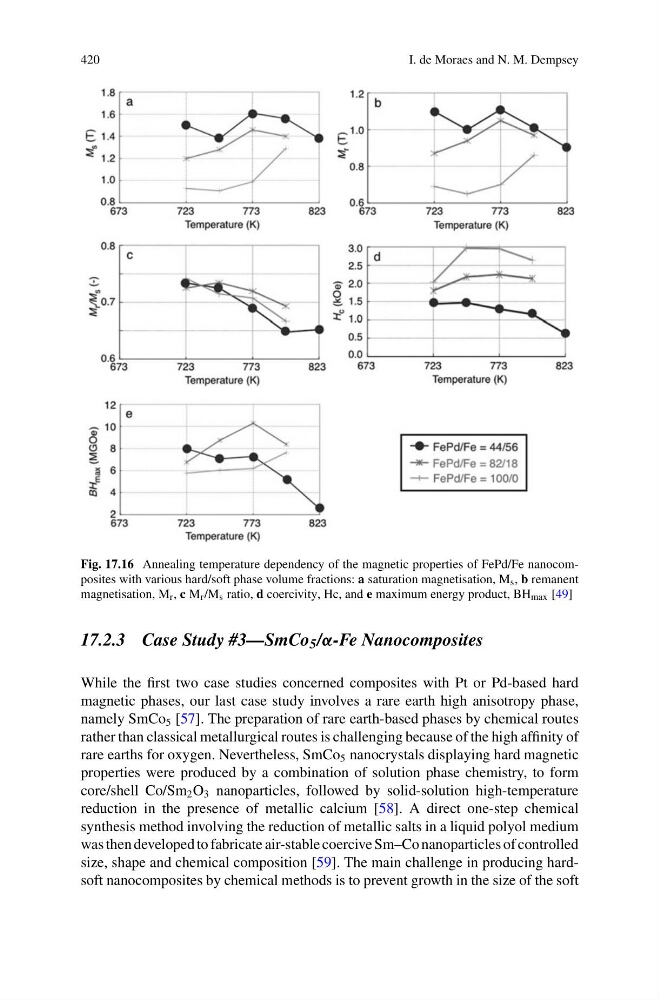
Fig. 17.16 Annealing temperature dependency of the magnetic properties of FePd/Fe nanocomposites with various hard/soft phase volume fractions: a saturation magnetisation, M s , b remanent
magnetisation, M r , c M r /M s ratio, d coercivity, Hc, and e maximum energy product, BH max [49]
17.2.3 Case Study #3—SmCo 5 /α-Fe Nanocomposites
While the first two case studies concerned composites with Pt or Pd-based hard
magnetic phases, our last case study involves a rare earth high anisotropy phase,
namely SmCo 5 [57]. The preparation of rare earth-based phases by chemical routes
rather than classical metallurgical routes is challenging because of the high affinity of
rare earths for oxygen. Nevertheless, SmCo 5 nanocrystals displaying hard magnetic
properties were produced by a combination of solution phase chemistry, to form
core/shell Co/Sm 2 O 3 nanoparticles, followed by solid-solution high-temperature
reduction in the presence of metallic calcium [58]. A direct one-step chemical
synthesis method involving the reduction of metallic salts in a liquid polyol medium
was then developed to fabricate air-stable coercive Sm–Co nanoparticles of controlled
size, shape and chemical composition [59]. The main challenge in producing hardsoft nanocomposites by chemical methods is to prevent growth in the size of the soft
I. de Moraes and N. M. Dempsey
Fig. 17.16 Annealing temperature dependency of the magnetic properties of FePd/Fe nanocomposites with various hard/soft phase volume fractions: a saturation magnetisation, M s , b remanent
magnetisation, M r , c M r /M s ratio, d coercivity, Hc, and e maximum energy product, BH max [49]
17.2.3 Case Study #3—SmCo 5 /α-Fe Nanocomposites
While the first two case studies concerned composites with Pt or Pd-based hard
magnetic phases, our last case study involves a rare earth high anisotropy phase,
namely SmCo 5 [57]. The preparation of rare earth-based phases by chemical routes
rather than classical metallurgical routes is challenging because of the high affinity of
rare earths for oxygen. Nevertheless, SmCo 5 nanocrystals displaying hard magnetic
properties were produced by a combination of solution phase chemistry, to form
core/shell Co/Sm 2 O 3 nanoparticles, followed by solid-solution high-temperature
reduction in the presence of metallic calcium [58]. A direct one-step chemical
synthesis method involving the reduction of metallic salts in a liquid polyol medium
was then developed to fabricate air-stable coercive Sm–Co nanoparticles of controlled
size, shape and chemical composition [59]. The main challenge in producing hardsoft nanocomposites by chemical methods is to prevent growth in the size of the soft