

17 Nanocomposites for Permanent Magnets
417
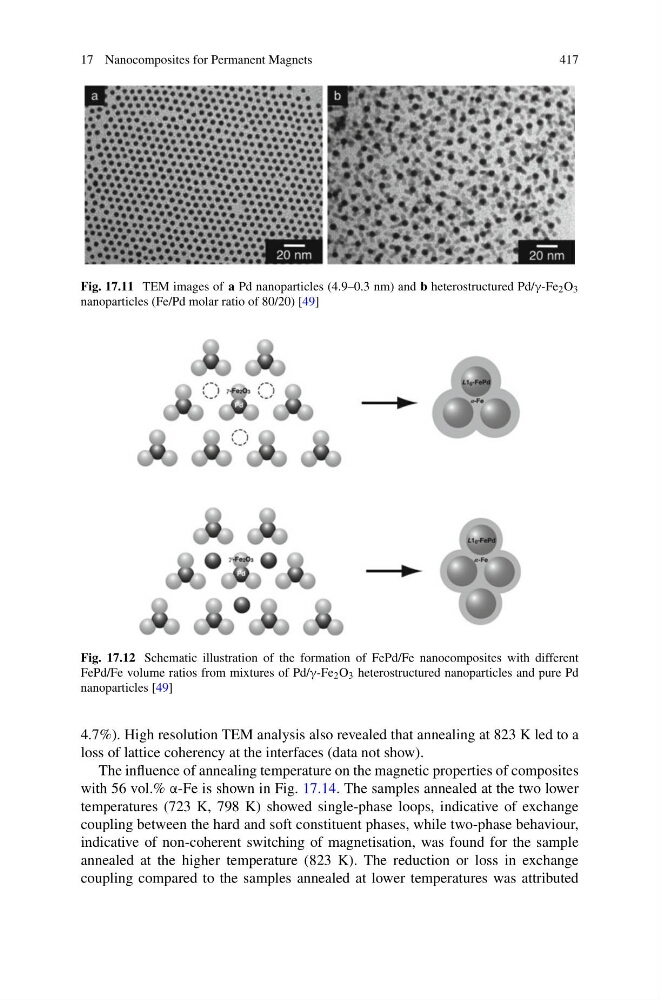
Fig. 17.11 TEM images of a Pd nanoparticles (4.9–0.3 nm) and b heterostructured Pd/γ-Fe 2 O 3
nanoparticles (Fe/Pd molar ratio of 80/20) [49]
Fig. 17.12 Schematic illustration of the formation of FePd/Fe nanocomposites with different
FePd/Fe volume ratios from mixtures of Pd/γ-Fe 2 O 3 heterostructured nanoparticles and pure Pd
nanoparticles [49]
4.7%). High resolution TEM analysis also revealed that annealing at 823 K led to a
loss of lattice coherency at the interfaces (data not show).
The influence of annealing temperature on the magnetic properties of composites
with 56 vol.% α-Fe is shown in Fig. 17.14. The samples annealed at the two lower
temperatures (723 K, 798 K) showed single-phase loops, indicative of exchange
coupling between the hard and soft constituent phases, while two-phase behaviour,
indicative of non-coherent switching of magnetisation, was found for the sample
annealed at the higher temperature (823 K). The reduction or loss in exchange
coupling compared to the samples annealed at lower temperatures was attributed
417
Fig. 17.11 TEM images of a Pd nanoparticles (4.9–0.3 nm) and b heterostructured Pd/γ-Fe 2 O 3
nanoparticles (Fe/Pd molar ratio of 80/20) [49]
Fig. 17.12 Schematic illustration of the formation of FePd/Fe nanocomposites with different
FePd/Fe volume ratios from mixtures of Pd/γ-Fe 2 O 3 heterostructured nanoparticles and pure Pd
nanoparticles [49]
4.7%). High resolution TEM analysis also revealed that annealing at 823 K led to a
loss of lattice coherency at the interfaces (data not show).
The influence of annealing temperature on the magnetic properties of composites
with 56 vol.% α-Fe is shown in Fig. 17.14. The samples annealed at the two lower
temperatures (723 K, 798 K) showed single-phase loops, indicative of exchange
coupling between the hard and soft constituent phases, while two-phase behaviour,
indicative of non-coherent switching of magnetisation, was found for the sample
annealed at the higher temperature (823 K). The reduction or loss in exchange
coupling compared to the samples annealed at lower temperatures was attributed