

412
I. de Moraes and N. M. Dempsey
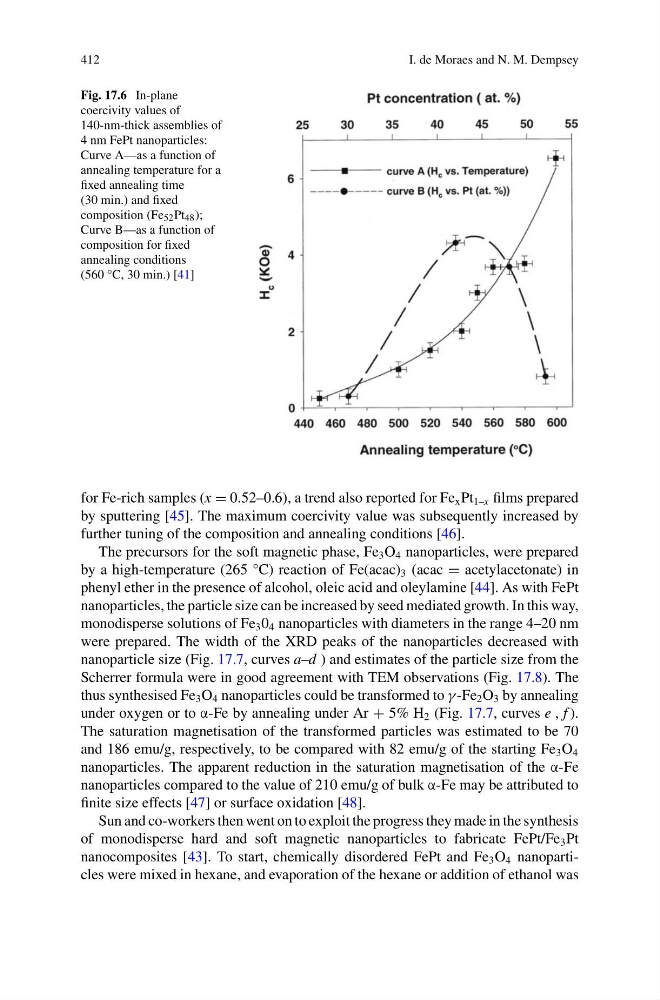
Fig. 17.6 In-plane
coercivity values of
140-nm-thick assemblies of
4 nm FePt nanoparticles:
Curve A—as a function of
annealing temperature for a
fixed annealing time
(30 min.) and fixed
composition (Fe 52 Pt 48 );
Curve B—as a function of
composition for fixed
annealing conditions
(560 °C, 30 min.) [41]
for Fe-rich samples (x = 0.52–0.6), a trend also reported for Fe x Pt 1–x films prepared
by sputtering [45]. The maximum coercivity value was subsequently increased by
further tuning of the composition and annealing conditions [46].
The precursors for the soft magnetic phase, Fe 3 O 4 nanoparticles, were prepared
by a high-temperature (265 °C) reaction of Fe(acac) 3 (acac = acetylacetonate) in
phenyl ether in the presence of alcohol, oleic acid and oleylamine [44]. As with FePt
nanoparticles, the particle size can be increased by seed mediated growth. In this way,
monodisperse solutions of Fe 3 0 4 nanoparticles with diameters in the range 4–20 nm
were prepared. The width of the XRD peaks of the nanoparticles decreased with
nanoparticle size (Fig. 17.7, curves a–d ) and estimates of the particle size from the
Scherrer formula were in good agreement with TEM observations (Fig. 17.8). The
thus synthesised Fe 3 O 4 nanoparticles could be transformed to γ -Fe 2 O 3 by annealing
under oxygen or to α-Fe by annealing under Ar + 5% H 2 (Fig. 17.7, curves e , f ).
The saturation magnetisation of the transformed particles was estimated to be 70
and 186 emu/g, respectively, to be compared with 82 emu/g of the starting Fe 3 O 4
nanoparticles. The apparent reduction in the saturation magnetisation of the α-Fe
nanoparticles compared to the value of 210 emu/g of bulk α-Fe may be attributed to
finite size effects [47] or surface oxidation [48].
Sun and co-workers then went on to exploit the progress they made in the synthesis
of monodisperse hard and soft magnetic nanoparticles to fabricate FePt/Fe 3 Pt
nanocomposites [43]. To start, chemically disordered FePt and Fe 3 O 4 nanoparticles were mixed in hexane, and evaporation of the hexane or addition of ethanol was
I. de Moraes and N. M. Dempsey
Fig. 17.6 In-plane
coercivity values of
140-nm-thick assemblies of
4 nm FePt nanoparticles:
Curve A—as a function of
annealing temperature for a
fixed annealing time
(30 min.) and fixed
composition (Fe 52 Pt 48 );
Curve B—as a function of
composition for fixed
annealing conditions
(560 °C, 30 min.) [41]
for Fe-rich samples (x = 0.52–0.6), a trend also reported for Fe x Pt 1–x films prepared
by sputtering [45]. The maximum coercivity value was subsequently increased by
further tuning of the composition and annealing conditions [46].
The precursors for the soft magnetic phase, Fe 3 O 4 nanoparticles, were prepared
by a high-temperature (265 °C) reaction of Fe(acac) 3 (acac = acetylacetonate) in
phenyl ether in the presence of alcohol, oleic acid and oleylamine [44]. As with FePt
nanoparticles, the particle size can be increased by seed mediated growth. In this way,
monodisperse solutions of Fe 3 0 4 nanoparticles with diameters in the range 4–20 nm
were prepared. The width of the XRD peaks of the nanoparticles decreased with
nanoparticle size (Fig. 17.7, curves a–d ) and estimates of the particle size from the
Scherrer formula were in good agreement with TEM observations (Fig. 17.8). The
thus synthesised Fe 3 O 4 nanoparticles could be transformed to γ -Fe 2 O 3 by annealing
under oxygen or to α-Fe by annealing under Ar + 5% H 2 (Fig. 17.7, curves e , f ).
The saturation magnetisation of the transformed particles was estimated to be 70
and 186 emu/g, respectively, to be compared with 82 emu/g of the starting Fe 3 O 4
nanoparticles. The apparent reduction in the saturation magnetisation of the α-Fe
nanoparticles compared to the value of 210 emu/g of bulk α-Fe may be attributed to
finite size effects [47] or surface oxidation [48].
Sun and co-workers then went on to exploit the progress they made in the synthesis
of monodisperse hard and soft magnetic nanoparticles to fabricate FePt/Fe 3 Pt
nanocomposites [43]. To start, chemically disordered FePt and Fe 3 O 4 nanoparticles were mixed in hexane, and evaporation of the hexane or addition of ethanol was