

404
I. de Moraes and N. M. Dempsey
17.1 Permanent Magnets
17.1.1 A Brief History of Permanent Magnets
Permanent magnets are exploited in a wide variety of applications, ranging from
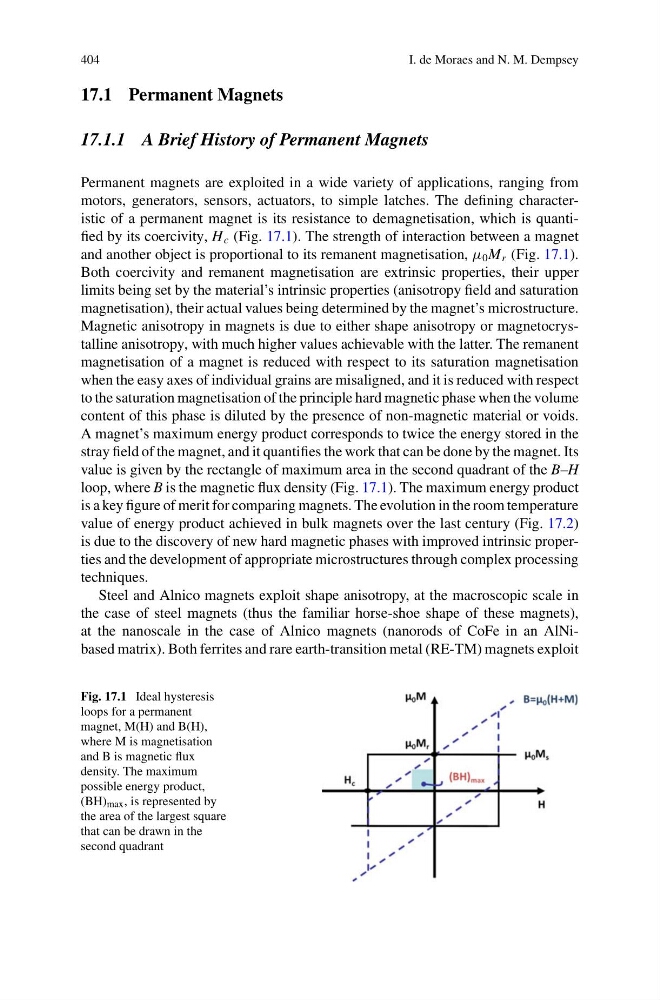
motors, generators, sensors, actuators, to simple latches. The defining characteristic of a permanent magnet is its resistance to demagnetisation, which is quantified by its coercivity, H c (Fig. 17.1). The strength of interaction between a magnet
and another object is proportional to its remanent magnetisation, μ 0 M r (Fig. 17.1).
Both coercivity and remanent magnetisation are extrinsic properties, their upper
limits being set by the material’s intrinsic properties (anisotropy field and saturation
magnetisation), their actual values being determined by the magnet’s microstructure.
Magnetic anisotropy in magnets is due to either shape anisotropy or magnetocrystalline anisotropy, with much higher values achievable with the latter. The remanent
magnetisation of a magnet is reduced with respect to its saturation magnetisation
when the easy axes of individual grains are misaligned, and it is reduced with respect
to the saturation magnetisation of the principle hard magnetic phase when the volume
content of this phase is diluted by the presence of non-magnetic material or voids.
A magnet’s maximum energy product corresponds to twice the energy stored in the
stray field of the magnet, and it quantifies the work that can be done by the magnet. Its
value is given by the rectangle of maximum area in the second quadrant of the B–H
loop, where B is the magnetic flux density (Fig. 17.1). The maximum energy product
is a key figure of merit for comparing magnets. The evolution in the room temperature
value of energy product achieved in bulk magnets over the last century (Fig. 17.2)
is due to the discovery of new hard magnetic phases with improved intrinsic properties and the development of appropriate microstructures through complex processing
techniques.
Steel and Alnico magnets exploit shape anisotropy, at the macroscopic scale in
the case of steel magnets (thus the familiar horse-shoe shape of these magnets),
at the nanoscale in the case of Alnico magnets (nanorods of CoFe in an AlNibased matrix). Both ferrites and rare earth-transition metal (RE-TM) magnets exploit
Fig. 17.1 Ideal hysteresis
loops for a permanent
magnet, M(H) and B(H),
where M is magnetisation
and B is magnetic flux
density. The maximum
possible energy product,
(BH) max , is represented by
the area of the largest square
that can be drawn in the
second quadrant
I. de Moraes and N. M. Dempsey
17.1 Permanent Magnets
17.1.1 A Brief History of Permanent Magnets
Permanent magnets are exploited in a wide variety of applications, ranging from
motors, generators, sensors, actuators, to simple latches. The defining characteristic of a permanent magnet is its resistance to demagnetisation, which is quantified by its coercivity, H c (Fig. 17.1). The strength of interaction between a magnet
and another object is proportional to its remanent magnetisation, μ 0 M r (Fig. 17.1).
Both coercivity and remanent magnetisation are extrinsic properties, their upper
limits being set by the material’s intrinsic properties (anisotropy field and saturation
magnetisation), their actual values being determined by the magnet’s microstructure.
Magnetic anisotropy in magnets is due to either shape anisotropy or magnetocrystalline anisotropy, with much higher values achievable with the latter. The remanent
magnetisation of a magnet is reduced with respect to its saturation magnetisation
when the easy axes of individual grains are misaligned, and it is reduced with respect
to the saturation magnetisation of the principle hard magnetic phase when the volume
content of this phase is diluted by the presence of non-magnetic material or voids.
A magnet’s maximum energy product corresponds to twice the energy stored in the
stray field of the magnet, and it quantifies the work that can be done by the magnet. Its
value is given by the rectangle of maximum area in the second quadrant of the B–H
loop, where B is the magnetic flux density (Fig. 17.1). The maximum energy product
is a key figure of merit for comparing magnets. The evolution in the room temperature
value of energy product achieved in bulk magnets over the last century (Fig. 17.2)
is due to the discovery of new hard magnetic phases with improved intrinsic properties and the development of appropriate microstructures through complex processing
techniques.
Steel and Alnico magnets exploit shape anisotropy, at the macroscopic scale in
the case of steel magnets (thus the familiar horse-shoe shape of these magnets),
at the nanoscale in the case of Alnico magnets (nanorods of CoFe in an AlNibased matrix). Both ferrites and rare earth-transition metal (RE-TM) magnets exploit
Fig. 17.1 Ideal hysteresis
loops for a permanent
magnet, M(H) and B(H),
where M is magnetisation
and B is magnetic flux
density. The maximum
possible energy product,
(BH) max , is represented by
the area of the largest square
that can be drawn in the
second quadrant