

16 Magnetic Fluids for Thermoelectricity
395
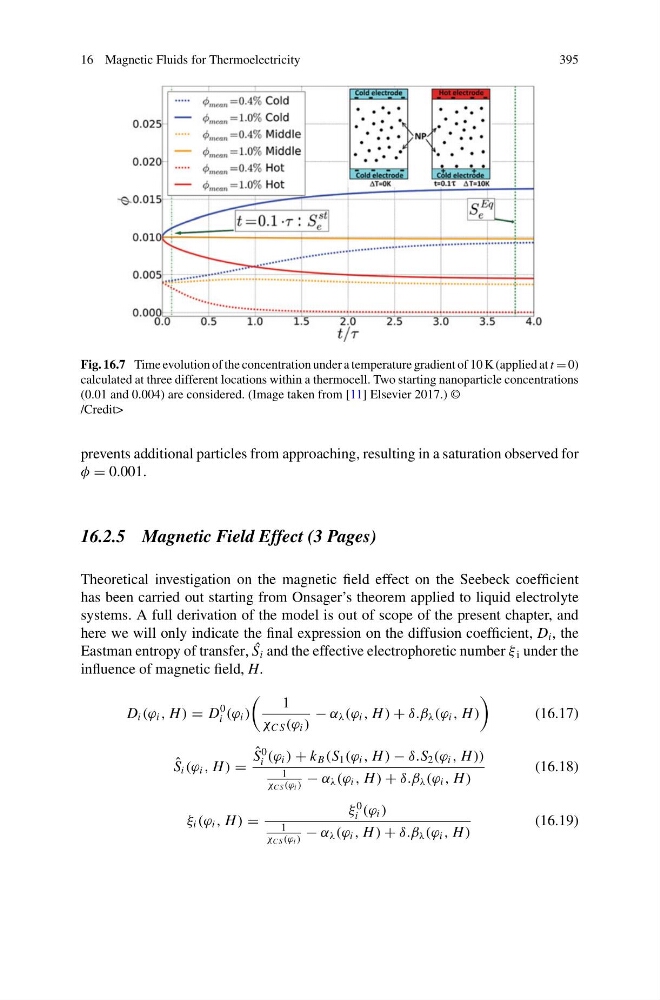
Fig. 16.7 Time evolution of the concentration under a temperature gradient of 10 K (applied at t = 0)
calculated at three different locations within a thermocell. Two starting nanoparticle concentrations
(0.01 and 0.004) are considered. (Image taken from [11] Elsevier 2017.) ©
/Credit>
prevents additional particles from approaching, resulting in a saturation observed for
φ = 0.001.
16.2.5 Magnetic Field Effect (3 Pages)
Theoretical investigation on the magnetic field effect on the Seebeck coefficient
has been carried out starting from Onsager’s theorem applied to liquid electrolyte
systems. A full derivation of the model is out of scope of the present chapter, and
here we will only indicate the final expression on the diffusion coefficient, D i , the
Eastman entropy of transfer, ˆ
S i and the effective electrophoretic number ξ i under the
influence of magnetic field, H.
D i (ϕ i , H ) = D
0
i (ϕ i )
1
χ C S (ϕ i )
− α λ (ϕ i , H ) + δ.β λ (ϕ i , H )
(16.17)
ˆ
S i (ϕ i , H ) =
ˆ
S
0
i (ϕ i ) + k B (S 1 (ϕ i , H ) − δ.S 2 (ϕ i , H ))
1
χ C S (ϕi )
− α λ (ϕ i , H ) + δ.β λ (ϕ i , H )
(16.18)
ξ i (ϕ i , H ) =
ξ
0
i (ϕ i )
1
χ C S (ϕi )
− α λ (ϕ i , H ) + δ.β λ (ϕ i , H )
(16.19)
395
Fig. 16.7 Time evolution of the concentration under a temperature gradient of 10 K (applied at t = 0)
calculated at three different locations within a thermocell. Two starting nanoparticle concentrations
(0.01 and 0.004) are considered. (Image taken from [11] Elsevier 2017.) ©
/Credit>
prevents additional particles from approaching, resulting in a saturation observed for
φ = 0.001.
16.2.5 Magnetic Field Effect (3 Pages)
Theoretical investigation on the magnetic field effect on the Seebeck coefficient
has been carried out starting from Onsager’s theorem applied to liquid electrolyte
systems. A full derivation of the model is out of scope of the present chapter, and
here we will only indicate the final expression on the diffusion coefficient, D i , the
Eastman entropy of transfer, ˆ
S i and the effective electrophoretic number ξ i under the
influence of magnetic field, H.
D i (ϕ i , H ) = D
0
i (ϕ i )
1
χ C S (ϕ i )
− α λ (ϕ i , H ) + δ.β λ (ϕ i , H )
(16.17)
ˆ
S i (ϕ i , H ) =
ˆ
S
0
i (ϕ i ) + k B (S 1 (ϕ i , H ) − δ.S 2 (ϕ i , H ))
1
χ C S (ϕi )
− α λ (ϕ i , H ) + δ.β λ (ϕ i , H )
(16.18)
ξ i (ϕ i , H ) =
ξ
0
i (ϕ i )
1
χ C S (ϕi )
− α λ (ϕ i , H ) + δ.β λ (ϕ i , H )
(16.19)