

394
S. Nakamae
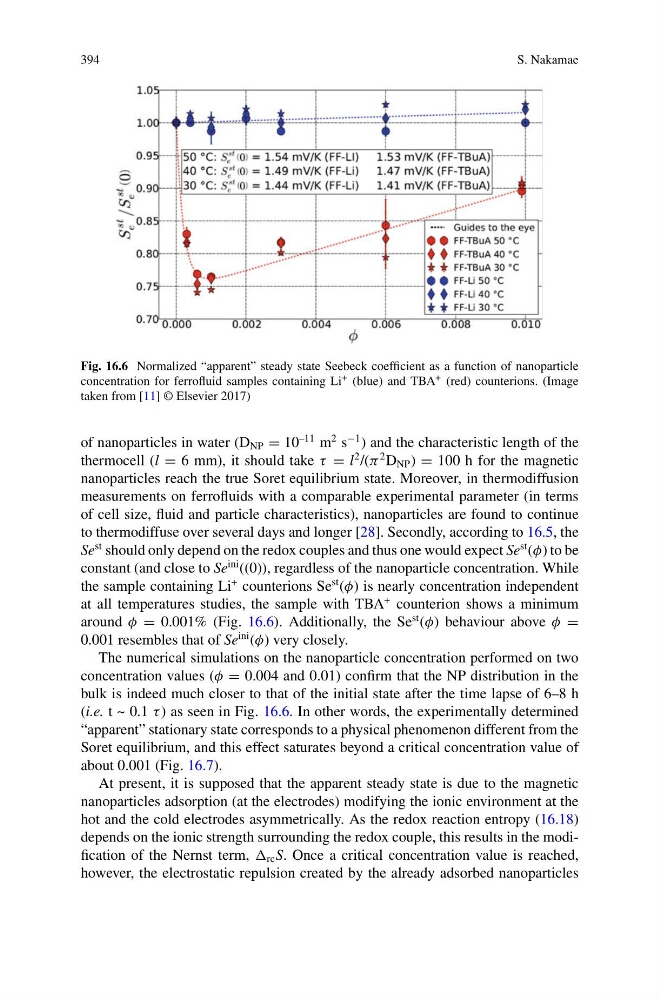
Fig. 16.6 Normalized “apparent” steady state Seebeck coefficient as a function of nanoparticle
concentration for ferrofluid samples containing Li + (blue) and TBA + (red) counterions. (Image
taken from [11] © Elsevier 2017)
of nanoparticles in water (D NP = 10
–11 m
2 s
−1 ) and the characteristic length of the
thermocell (l = 6 mm), it should take τ = l
2 /(π
2 D NP ) = 100 h for the magnetic
nanoparticles reach the true Soret equilibrium state. Moreover, in thermodiffusion
measurements on ferrofluids with a comparable experimental parameter (in terms
of cell size, fluid and particle characteristics), nanoparticles are found to continue
to thermodiffuse over several days and longer [28]. Secondly, according to 16.5, the
Se
st should only depend on the redox couples and thus one would expect Se
st (φ) to be
constant (and close to Se
ini ((0)), regardless of the nanoparticle concentration. While
the sample containing Li
+ counterions Se
st (φ) is nearly concentration independent
at all temperatures studies, the sample with TBA
+ counterion shows a minimum
around φ = 0.001% (Fig. 16.6). Additionally, the Se
st (φ) behaviour above φ =
0.001 resembles that of Se
ini (φ) very closely.
The numerical simulations on the nanoparticle concentration performed on two
concentration values (φ = 0.004 and 0.01) confirm that the NP distribution in the
bulk is indeed much closer to that of the initial state after the time lapse of 6–8 h
(i.e. t ~ 0.1 τ ) as seen in Fig. 16.6. In other words, the experimentally determined
“apparent” stationary state corresponds to a physical phenomenon different from the
Soret equilibrium, and this effect saturates beyond a critical concentration value of
about 0.001 (Fig. 16.7).
At present, it is supposed that the apparent steady state is due to the magnetic
nanoparticles adsorption (at the electrodes) modifying the ionic environment at the
hot and the cold electrodes asymmetrically. As the redox reaction entropy (16.18)
depends on the ionic strength surrounding the redox couple, this results in the modification of the Nernst term, rc S. Once a critical concentration value is reached,
however, the electrostatic repulsion created by the already adsorbed nanoparticles
S. Nakamae
Fig. 16.6 Normalized “apparent” steady state Seebeck coefficient as a function of nanoparticle
concentration for ferrofluid samples containing Li + (blue) and TBA + (red) counterions. (Image
taken from [11] © Elsevier 2017)
of nanoparticles in water (D NP = 10
–11 m
2 s
−1 ) and the characteristic length of the
thermocell (l = 6 mm), it should take τ = l
2 /(π
2 D NP ) = 100 h for the magnetic
nanoparticles reach the true Soret equilibrium state. Moreover, in thermodiffusion
measurements on ferrofluids with a comparable experimental parameter (in terms
of cell size, fluid and particle characteristics), nanoparticles are found to continue
to thermodiffuse over several days and longer [28]. Secondly, according to 16.5, the
Se
st should only depend on the redox couples and thus one would expect Se
st (φ) to be
constant (and close to Se
ini ((0)), regardless of the nanoparticle concentration. While
the sample containing Li
+ counterions Se
st (φ) is nearly concentration independent
at all temperatures studies, the sample with TBA
+ counterion shows a minimum
around φ = 0.001% (Fig. 16.6). Additionally, the Se
st (φ) behaviour above φ =
0.001 resembles that of Se
ini (φ) very closely.
The numerical simulations on the nanoparticle concentration performed on two
concentration values (φ = 0.004 and 0.01) confirm that the NP distribution in the
bulk is indeed much closer to that of the initial state after the time lapse of 6–8 h
(i.e. t ~ 0.1 τ ) as seen in Fig. 16.6. In other words, the experimentally determined
“apparent” stationary state corresponds to a physical phenomenon different from the
Soret equilibrium, and this effect saturates beyond a critical concentration value of
about 0.001 (Fig. 16.7).
At present, it is supposed that the apparent steady state is due to the magnetic
nanoparticles adsorption (at the electrodes) modifying the ionic environment at the
hot and the cold electrodes asymmetrically. As the redox reaction entropy (16.18)
depends on the ionic strength surrounding the redox couple, this results in the modification of the Nernst term, rc S. Once a critical concentration value is reached,
however, the electrostatic repulsion created by the already adsorbed nanoparticles