

1 Single Nanomagnet Behaviour: Surface and Finite-Size Effects
23
-0.6
-0.3
0
0.3
0.6
M z
Total
0.7
0.8
0.9
1
M n
Surf
0.6
0.8
1
M n
Core
-150 -100 -50 0 50 100 150
h
-0.6
-0.3
0
0.3
0.6
-100 -50 0 50 100
h
0.9
1
-100 -50 0 50 100
h
0.4
0.6
0.8
1
k S = 10
k S = 100
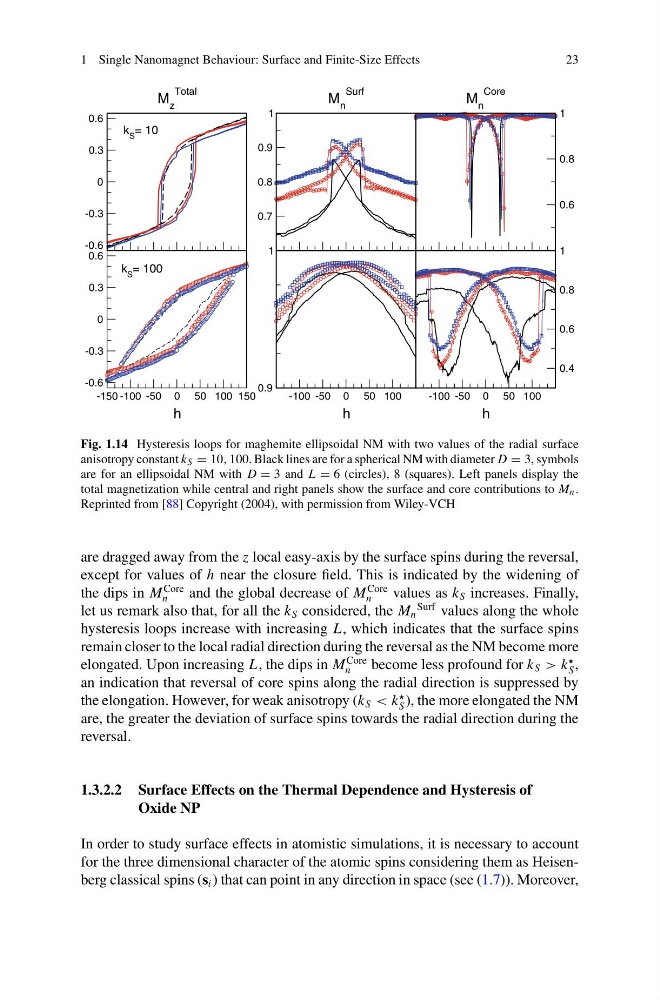
Fig. 1.14 Hysteresis loops for maghemite ellipsoidal NM with two values of the radial surface
anisotropy constant k S = 10, 100. Black lines are for a spherical NM with diameter D = 3, symbols
are for an ellipsoidal NM with D = 3 and L = 6 (circles), 8 (squares). Left panels display the
total magnetization while central and right panels show the surface and core contributions to M n .
Reprinted from [88] Copyright (2004), with permission from Wiley-VCH
are dragged away from the z local easy-axis by the surface spins during the reversal,
except for values of h near the closure field. This is indicated by the widening of
the dips in M
Core
n
and the global decrease of M
Core
n
values as k S increases. Finally,
let us remark also that, for all the k S considered, the M n
Surf values along the whole
hysteresis loops increase with increasing L, which indicates that the surface spins
remain closer to the local radial direction during the reversal as the NM become more
elongated. Upon increasing L, the dips in M
Core
n
become less profound for k S > k
S ,
an indication that reversal of core spins along the radial direction is suppressed by
the elongation. However, for weak anisotropy (k S < k
S ), the more elongated the NM
are, the greater the deviation of surface spins towards the radial direction during the
reversal.
1.3.2.2 Surface Effects on the Thermal Dependence and Hysteresis of
Oxide NP
In order to study surface effects in atomistic simulations, it is necessary to account
for the three dimensional character of the atomic spins considering them as Heisenberg classical spins (s i ) that can point in any direction in space (see (1.7)). Moreover,
23
-0.6
-0.3
0
0.3
0.6
M z
Total
0.7
0.8
0.9
1
M n
Surf
0.6
0.8
1
M n
Core
-150 -100 -50 0 50 100 150
h
-0.6
-0.3
0
0.3
0.6
-100 -50 0 50 100
h
0.9
1
-100 -50 0 50 100
h
0.4
0.6
0.8
1
k S = 10
k S = 100
Fig. 1.14 Hysteresis loops for maghemite ellipsoidal NM with two values of the radial surface
anisotropy constant k S = 10, 100. Black lines are for a spherical NM with diameter D = 3, symbols
are for an ellipsoidal NM with D = 3 and L = 6 (circles), 8 (squares). Left panels display the
total magnetization while central and right panels show the surface and core contributions to M n .
Reprinted from [88] Copyright (2004), with permission from Wiley-VCH
are dragged away from the z local easy-axis by the surface spins during the reversal,
except for values of h near the closure field. This is indicated by the widening of
the dips in M
Core
n
and the global decrease of M
Core
n
values as k S increases. Finally,
let us remark also that, for all the k S considered, the M n
Surf values along the whole
hysteresis loops increase with increasing L, which indicates that the surface spins
remain closer to the local radial direction during the reversal as the NM become more
elongated. Upon increasing L, the dips in M
Core
n
become less profound for k S > k
S ,
an indication that reversal of core spins along the radial direction is suppressed by
the elongation. However, for weak anisotropy (k S < k
S ), the more elongated the NM
are, the greater the deviation of surface spins towards the radial direction during the
reversal.
1.3.2.2 Surface Effects on the Thermal Dependence and Hysteresis of
Oxide NP
In order to study surface effects in atomistic simulations, it is necessary to account
for the three dimensional character of the atomic spins considering them as Heisenberg classical spins (s i ) that can point in any direction in space (see (1.7)). Moreover,