

392
S. Nakamae
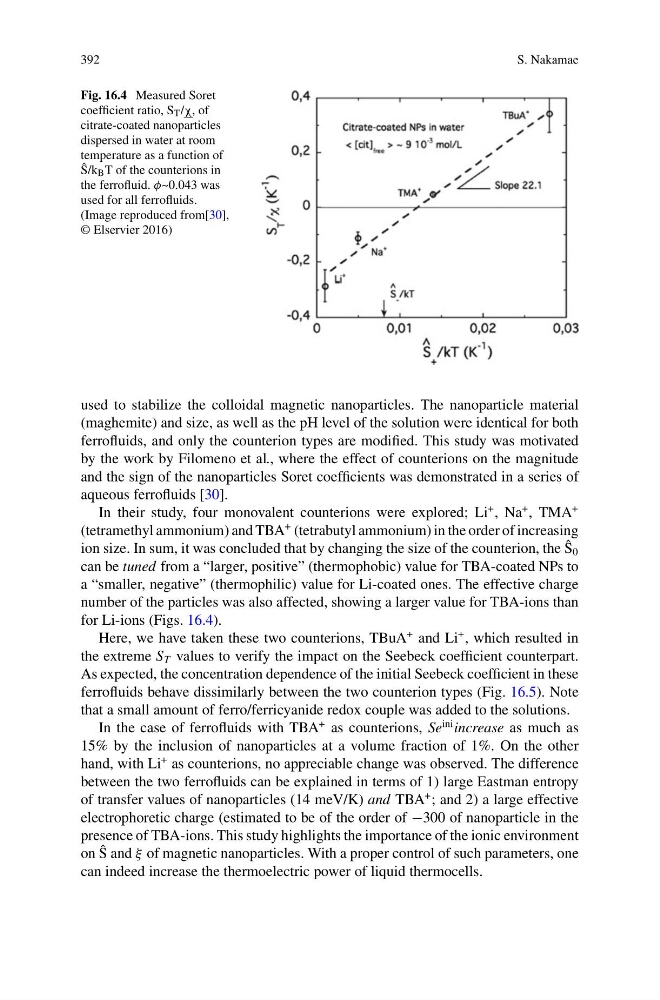
Fig. 16.4 Measured Soret
coefficient ratio, S T /χ, of
citrate-coated nanoparticles
dispersed in water at room
temperature as a function of
ˆ
S/k B T of the counterions in
the ferrofluid. φ~0.043 was
used for all ferrofluids.
(Image reproduced from[30],
© Elservier 2016)
used to stabilize the colloidal magnetic nanoparticles. The nanoparticle material
(maghemite) and size, as well as the pH level of the solution were identical for both
ferrofluids, and only the counterion types are modified. This study was motivated
by the work by Filomeno et al., where the effect of counterions on the magnitude
and the sign of the nanoparticles Soret coefficients was demonstrated in a series of
aqueous ferrofluids [30].
In their study, four monovalent counterions were explored; Li
+ , Na
+ , TMA
+
(tetramethyl ammonium) and TBA
+ (tetrabutyl ammonium) in the order of increasing
ion size. In sum, it was concluded that by changing the size of the counterion, the ˆ
S 0
can be tuned from a “larger, positive” (thermophobic) value for TBA-coated NPs to
a “smaller, negative” (thermophilic) value for Li-coated ones. The effective charge
number of the particles was also affected, showing a larger value for TBA-ions than
for Li-ions (Figs. 16.4).
Here, we have taken these two counterions, TBuA
+ and Li
+ , which resulted in
the extreme S T values to verify the impact on the Seebeck coefficient counterpart.
As expected, the concentration dependence of the initial Seebeck coefficient in these
ferrofluids behave dissimilarly between the two counterion types (Fig. 16.5). Note
that a small amount of ferro/ferricyanide redox couple was added to the solutions.
In the case of ferrofluids with TBA
+ as counterions, Se
ini increase as much as
15% by the inclusion of nanoparticles at a volume fraction of 1%. On the other
hand, with Li
+ as counterions, no appreciable change was observed. The difference
between the two ferrofluids can be explained in terms of 1) large Eastman entropy
of transfer values of nanoparticles (14 meV/K) and TBA
+ ; and 2) a large effective
electrophoretic charge (estimated to be of the order of −300 of nanoparticle in the
presence of TBA-ions. This study highlights the importance of the ionic environment
on ˆ
S and ξ of magnetic nanoparticles. With a proper control of such parameters, one
can indeed increase the thermoelectric power of liquid thermocells.
S. Nakamae
Fig. 16.4 Measured Soret
coefficient ratio, S T /χ, of
citrate-coated nanoparticles
dispersed in water at room
temperature as a function of
ˆ
S/k B T of the counterions in
the ferrofluid. φ~0.043 was
used for all ferrofluids.
(Image reproduced from[30],
© Elservier 2016)
used to stabilize the colloidal magnetic nanoparticles. The nanoparticle material
(maghemite) and size, as well as the pH level of the solution were identical for both
ferrofluids, and only the counterion types are modified. This study was motivated
by the work by Filomeno et al., where the effect of counterions on the magnitude
and the sign of the nanoparticles Soret coefficients was demonstrated in a series of
aqueous ferrofluids [30].
In their study, four monovalent counterions were explored; Li
+ , Na
+ , TMA
+
(tetramethyl ammonium) and TBA
+ (tetrabutyl ammonium) in the order of increasing
ion size. In sum, it was concluded that by changing the size of the counterion, the ˆ
S 0
can be tuned from a “larger, positive” (thermophobic) value for TBA-coated NPs to
a “smaller, negative” (thermophilic) value for Li-coated ones. The effective charge
number of the particles was also affected, showing a larger value for TBA-ions than
for Li-ions (Figs. 16.4).
Here, we have taken these two counterions, TBuA
+ and Li
+ , which resulted in
the extreme S T values to verify the impact on the Seebeck coefficient counterpart.
As expected, the concentration dependence of the initial Seebeck coefficient in these
ferrofluids behave dissimilarly between the two counterion types (Fig. 16.5). Note
that a small amount of ferro/ferricyanide redox couple was added to the solutions.
In the case of ferrofluids with TBA
+ as counterions, Se
ini increase as much as
15% by the inclusion of nanoparticles at a volume fraction of 1%. On the other
hand, with Li
+ as counterions, no appreciable change was observed. The difference
between the two ferrofluids can be explained in terms of 1) large Eastman entropy
of transfer values of nanoparticles (14 meV/K) and TBA
+ ; and 2) a large effective
electrophoretic charge (estimated to be of the order of −300 of nanoparticle in the
presence of TBA-ions. This study highlights the importance of the ionic environment
on ˆ
S and ξ of magnetic nanoparticles. With a proper control of such parameters, one
can indeed increase the thermoelectric power of liquid thermocells.