

14 Medical Applications of Magnetic Nanoparticles
341
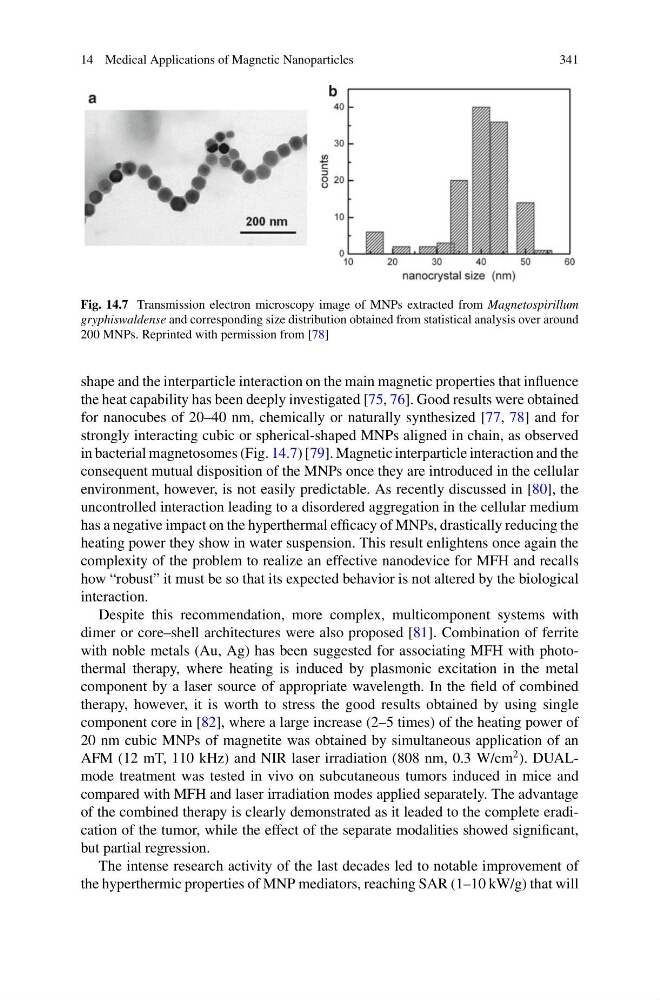
Fig. 14.7 Transmission electron microscopy image of MNPs extracted from Magnetospirillum
gryphiswaldense and corresponding size distribution obtained from statistical analysis over around
200 MNPs. Reprinted with permission from [78]
shape and the interparticle interaction on the main magnetic properties that influence
the heat capability has been deeply investigated [75, 76]. Good results were obtained
for nanocubes of 20–40 nm, chemically or naturally synthesized [77, 78] and for
strongly interacting cubic or spherical-shaped MNPs aligned in chain, as observed
in bacterial magnetosomes (Fig. 14.7) [79]. Magnetic interparticle interaction and the
consequent mutual disposition of the MNPs once they are introduced in the cellular
environment, however, is not easily predictable. As recently discussed in [80], the
uncontrolled interaction leading to a disordered aggregation in the cellular medium
has a negative impact on the hyperthermal efficacy of MNPs, drastically reducing the
heating power they show in water suspension. This result enlightens once again the
complexity of the problem to realize an effective nanodevice for MFH and recalls
how “robust” it must be so that its expected behavior is not altered by the biological
interaction.
Despite this recommendation, more complex, multicomponent systems with
dimer or core–shell architectures were also proposed [81]. Combination of ferrite
with noble metals (Au, Ag) has been suggested for associating MFH with photothermal therapy, where heating is induced by plasmonic excitation in the metal
component by a laser source of appropriate wavelength. In the field of combined
therapy, however, it is worth to stress the good results obtained by using single
component core in [82], where a large increase (2–5 times) of the heating power of
20 nm cubic MNPs of magnetite was obtained by simultaneous application of an
AFM (12 mT, 110 kHz) and NIR laser irradiation (808 nm, 0.3 W/cm
2 ). DUALmode treatment was tested in vivo on subcutaneous tumors induced in mice and
compared with MFH and laser irradiation modes applied separately. The advantage
of the combined therapy is clearly demonstrated as it leaded to the complete eradication of the tumor, while the effect of the separate modalities showed significant,
but partial regression.
The intense research activity of the last decades led to notable improvement of
the hyperthermic properties of MNP mediators, reaching SAR (1–10 kW/g) that will
341
Fig. 14.7 Transmission electron microscopy image of MNPs extracted from Magnetospirillum
gryphiswaldense and corresponding size distribution obtained from statistical analysis over around
200 MNPs. Reprinted with permission from [78]
shape and the interparticle interaction on the main magnetic properties that influence
the heat capability has been deeply investigated [75, 76]. Good results were obtained
for nanocubes of 20–40 nm, chemically or naturally synthesized [77, 78] and for
strongly interacting cubic or spherical-shaped MNPs aligned in chain, as observed
in bacterial magnetosomes (Fig. 14.7) [79]. Magnetic interparticle interaction and the
consequent mutual disposition of the MNPs once they are introduced in the cellular
environment, however, is not easily predictable. As recently discussed in [80], the
uncontrolled interaction leading to a disordered aggregation in the cellular medium
has a negative impact on the hyperthermal efficacy of MNPs, drastically reducing the
heating power they show in water suspension. This result enlightens once again the
complexity of the problem to realize an effective nanodevice for MFH and recalls
how “robust” it must be so that its expected behavior is not altered by the biological
interaction.
Despite this recommendation, more complex, multicomponent systems with
dimer or core–shell architectures were also proposed [81]. Combination of ferrite
with noble metals (Au, Ag) has been suggested for associating MFH with photothermal therapy, where heating is induced by plasmonic excitation in the metal
component by a laser source of appropriate wavelength. In the field of combined
therapy, however, it is worth to stress the good results obtained by using single
component core in [82], where a large increase (2–5 times) of the heating power of
20 nm cubic MNPs of magnetite was obtained by simultaneous application of an
AFM (12 mT, 110 kHz) and NIR laser irradiation (808 nm, 0.3 W/cm
2 ). DUALmode treatment was tested in vivo on subcutaneous tumors induced in mice and
compared with MFH and laser irradiation modes applied separately. The advantage
of the combined therapy is clearly demonstrated as it leaded to the complete eradication of the tumor, while the effect of the separate modalities showed significant,
but partial regression.
The intense research activity of the last decades led to notable improvement of
the hyperthermic properties of MNP mediators, reaching SAR (1–10 kW/g) that will