

280
P. Torruella et al.
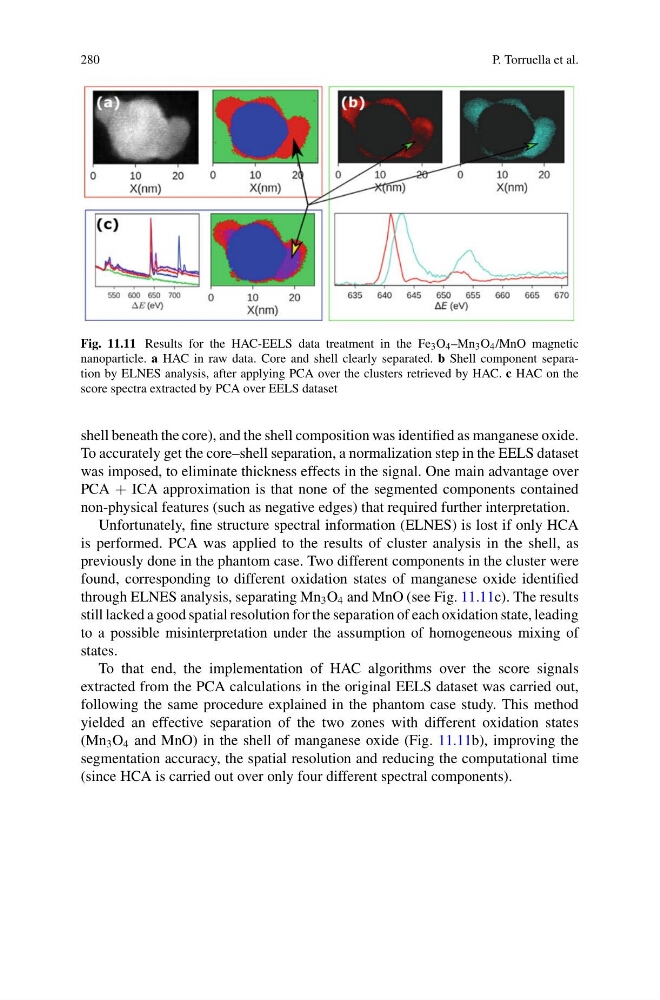
Fig. 11.11 Results for the HAC-EELS data treatment in the Fe 3 O 4 –Mn 3 O 4 /MnO magnetic
nanoparticle. a HAC in raw data. Core and shell clearly separated. b Shell component separation by ELNES analysis, after applying PCA over the clusters retrieved by HAC. c HAC on the
score spectra extracted by PCA over EELS dataset
shell beneath the core), and the shell composition was identified as manganese oxide.
To accurately get the core–shell separation, a normalization step in the EELS dataset
was imposed, to eliminate thickness effects in the signal. One main advantage over
PCA + ICA approximation is that none of the segmented components contained
non-physical features (such as negative edges) that required further interpretation.
Unfortunately, fine structure spectral information (ELNES) is lost if only HCA
is performed. PCA was applied to the results of cluster analysis in the shell, as
previously done in the phantom case. Two different components in the cluster were
found, corresponding to different oxidation states of manganese oxide identified
through ELNES analysis, separating Mn 3 O 4 and MnO (see Fig. 11.11c). The results
still lacked a good spatial resolution for the separation of each oxidation state, leading
to a possible misinterpretation under the assumption of homogeneous mixing of
states.
To that end, the implementation of HAC algorithms over the score signals
extracted from the PCA calculations in the original EELS dataset was carried out,
following the same procedure explained in the phantom case study. This method
yielded an effective separation of the two zones with different oxidation states
(Mn 3 O 4 and MnO) in the shell of manganese oxide (Fig. 11.11b), improving the
segmentation accuracy, the spatial resolution and reducing the computational time
(since HCA is carried out over only four different spectral components).
P. Torruella et al.
Fig. 11.11 Results for the HAC-EELS data treatment in the Fe 3 O 4 –Mn 3 O 4 /MnO magnetic
nanoparticle. a HAC in raw data. Core and shell clearly separated. b Shell component separation by ELNES analysis, after applying PCA over the clusters retrieved by HAC. c HAC on the
score spectra extracted by PCA over EELS dataset
shell beneath the core), and the shell composition was identified as manganese oxide.
To accurately get the core–shell separation, a normalization step in the EELS dataset
was imposed, to eliminate thickness effects in the signal. One main advantage over
PCA + ICA approximation is that none of the segmented components contained
non-physical features (such as negative edges) that required further interpretation.
Unfortunately, fine structure spectral information (ELNES) is lost if only HCA
is performed. PCA was applied to the results of cluster analysis in the shell, as
previously done in the phantom case. Two different components in the cluster were
found, corresponding to different oxidation states of manganese oxide identified
through ELNES analysis, separating Mn 3 O 4 and MnO (see Fig. 11.11c). The results
still lacked a good spatial resolution for the separation of each oxidation state, leading
to a possible misinterpretation under the assumption of homogeneous mixing of
states.
To that end, the implementation of HAC algorithms over the score signals
extracted from the PCA calculations in the original EELS dataset was carried out,
following the same procedure explained in the phantom case study. This method
yielded an effective separation of the two zones with different oxidation states
(Mn 3 O 4 and MnO) in the shell of manganese oxide (Fig. 11.11b), improving the
segmentation accuracy, the spatial resolution and reducing the computational time
(since HCA is carried out over only four different spectral components).