

11 Electron Tomography
261
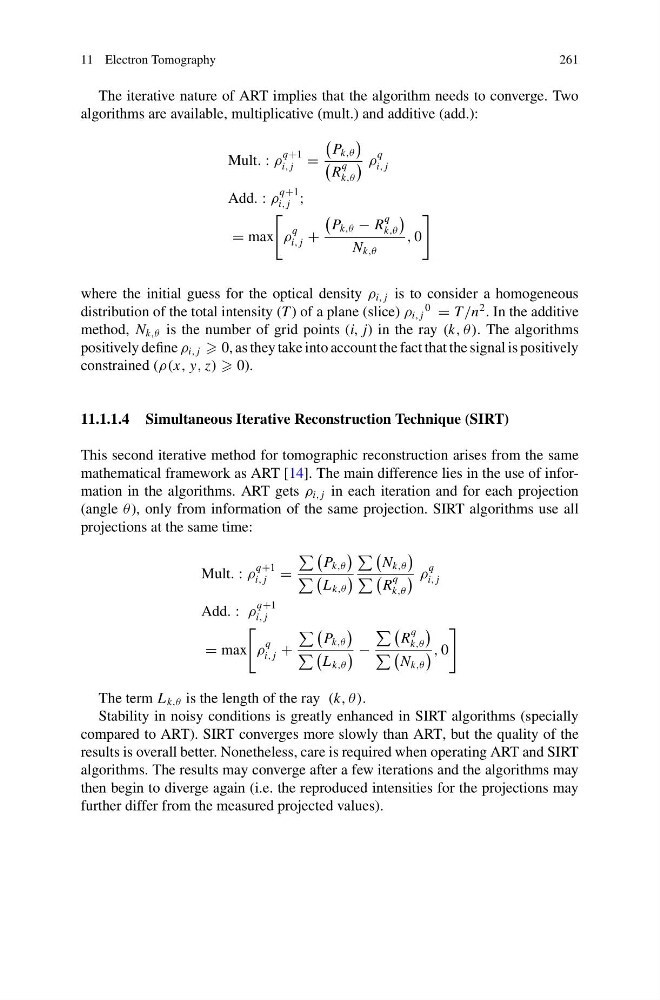
The iterative nature of ART implies that the algorithm needs to converge. Two
algorithms are available, multiplicative (mult.) and additive (add.):
Mult. : ρ
q+1
i, j =
P k,θ
R
q
k,θ
ρ
q
i, j
Add. : ρ
q+1
i, j ;
= max
ρ
q
i, j +
P k,θ − R
q
k,θ
N k,θ
, 0
where the initial guess for the optical density ρ i, j is to consider a homogeneous
distribution of the total intensity (T ) of a plane (slice) ρ i, j
0
= T /n
2 . In the additive
method, N k,θ is the number of grid points (i, j) in the ray (k, θ). The algorithms
positively define ρ i, j 0, as they take into account the fact that the signal is positively
constrained (ρ(x, y, z) 0).
11.1.1.4 Simultaneous Iterative Reconstruction Technique (SIRT)
This second iterative method for tomographic reconstruction arises from the same
mathematical framework as ART [14]. The main difference lies in the use of information in the algorithms. ART gets ρ i, j in each iteration and for each projection
(angle θ ), only from information of the same projection. SIRT algorithms use all
projections at the same time:
Mult. : ρ
q+1
i, j =
P k,θ
L k,θ
N k,θ
R
q
k,θ
ρ
q
i, j
Add. : ρ
q+1
i, j
= max
ρ
q
i, j +
P k,θ
L k,θ
−
R
q
k,θ
N k,θ
, 0
The term L k,θ is the length of the ray (k, θ).
Stability in noisy conditions is greatly enhanced in SIRT algorithms (specially
compared to ART). SIRT converges more slowly than ART, but the quality of the
results is overall better. Nonetheless, care is required when operating ART and SIRT
algorithms. The results may converge after a few iterations and the algorithms may
then begin to diverge again (i.e. the reproduced intensities for the projections may
further differ from the measured projected values).
261
The iterative nature of ART implies that the algorithm needs to converge. Two
algorithms are available, multiplicative (mult.) and additive (add.):
Mult. : ρ
q+1
i, j =
P k,θ
R
q
k,θ
ρ
q
i, j
Add. : ρ
q+1
i, j ;
= max
ρ
q
i, j +
P k,θ − R
q
k,θ
N k,θ
, 0
where the initial guess for the optical density ρ i, j is to consider a homogeneous
distribution of the total intensity (T ) of a plane (slice) ρ i, j
0
= T /n
2 . In the additive
method, N k,θ is the number of grid points (i, j) in the ray (k, θ). The algorithms
positively define ρ i, j 0, as they take into account the fact that the signal is positively
constrained (ρ(x, y, z) 0).
11.1.1.4 Simultaneous Iterative Reconstruction Technique (SIRT)
This second iterative method for tomographic reconstruction arises from the same
mathematical framework as ART [14]. The main difference lies in the use of information in the algorithms. ART gets ρ i, j in each iteration and for each projection
(angle θ ), only from information of the same projection. SIRT algorithms use all
projections at the same time:
Mult. : ρ
q+1
i, j =
P k,θ
L k,θ
N k,θ
R
q
k,θ
ρ
q
i, j
Add. : ρ
q+1
i, j
= max
ρ
q
i, j +
P k,θ
L k,θ
−
R
q
k,θ
N k,θ
, 0
The term L k,θ is the length of the ray (k, θ).
Stability in noisy conditions is greatly enhanced in SIRT algorithms (specially
compared to ART). SIRT converges more slowly than ART, but the quality of the
results is overall better. Nonetheless, care is required when operating ART and SIRT
algorithms. The results may converge after a few iterations and the algorithms may
then begin to diverge again (i.e. the reproduced intensities for the projections may
further differ from the measured projected values).